care@kuremara.com.au
 1300 000 799

Yes, autistic adults can get NDIS support after 18. Turning 18 does not end NDIS eligibility. You can apply for the first time at any age before 65. What changes at 18 is everything around the plan. School supports end. Paediatric care moves to adult services. You become the legal decision-maker for your own plan. The supports you need also shift, towards independent living, work, study and community life.
Autism is the largest disability group in the Scheme. At 31 March 2026, 338,099 active NDIS participants had autism as their primary disability. That is 44% of all participants (NDIS Quarterly Report Supplement E, March 2026). Most attention still goes to early childhood, so many families reach the adult years with little guidance.
This guide explains how the NDIS works for autistic adults: who is eligible, what evidence helps, what a plan can fund, how to manage the move from school, and which 2026–2028 reforms matter. If your question is about a young child, read our guide to the NDIS access changes for under-8s instead.
Why turning 18 changes things for autistic people
The years after school are often called the “services cliff”. Supports that were built into the school week end at once, and adult services have to be arranged on purpose. For autistic young people, five shifts usually land at the same time.
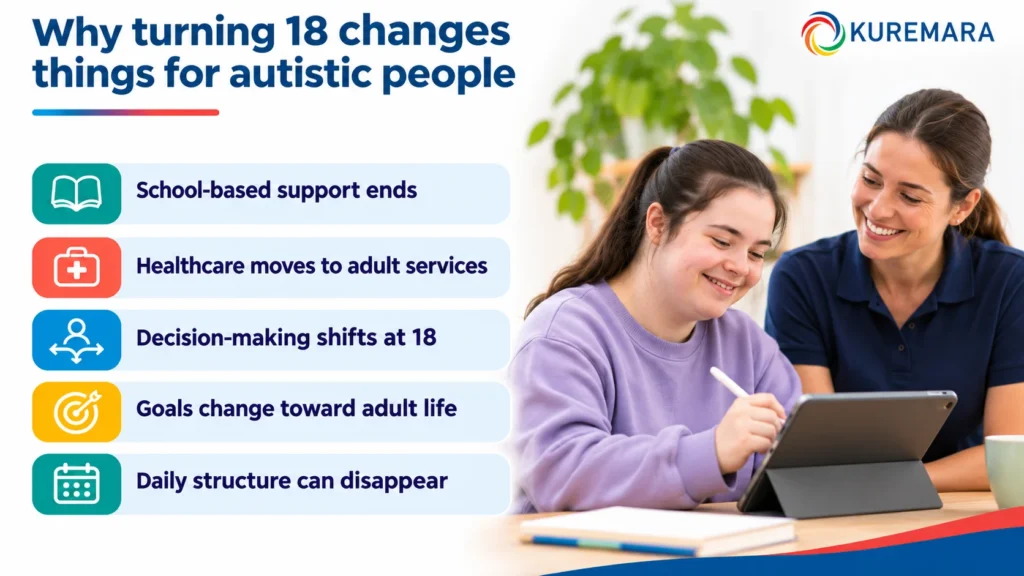
- School-based support ends. Teacher aides, structured routines and school allied health stop with the last term.
- Health care moves to adult services. Paediatricians usually hand over to a GP, psychiatrist or adult specialists.
- Decision-making passes to the young person. In the NDIS, a parent acts as a child’s representative only until 18. After that the participant makes their own plan decisions. They can still choose a plan nominee or use supported decision-making.
- Goals change. Plans move from development and therapy towards living skills, work, study, relationships and independence.
- Daily structure disappears. Without a school timetable, many young adults lose routine, social contact and a reason to leave home.
The outcomes data shows why planning for this stage matters. The ABS Autism in Australia, 2022 release found:
| Measure (autistic Australians, 2022) | Result |
| Unemployment rate, working age | 18.2% |
| Labour force participation, working age | 50.2% (84.9% for people without disability) |
| Need help with cognitive or emotional tasks | 76.2% |
| Need help with communication | 55.2% |
| Completed Year 12 (aged 15 and over) | 45.1% |
The same release records autism in 3.0% of people aged 15–24 but only 0.6% of those aged 25–39. One likely reason is that many older autistic people were never formally assessed. That is why late diagnosis features in the eligibility section below.
Who is eligible: NDIS access for autistic adults
An adult applying for the NDIS must meet three requirements: age (under 65 when applying), residency (an Australian citizen, permanent resident or Protected Special Category Visa holder) and disability. For autism, the disability test depends heavily on the diagnostic level and on evidence of day-to-day impact.
How the autism levels affect access
The NDIS lists autism among the conditions likely to meet the disability requirements. This applies when autism has been diagnosed by a specialist multidisciplinary team, paediatrician, psychiatrist or clinical psychologist. The assessment must use current DSM-5 criteria and record Level 2 (requiring substantial support) or Level 3 (requiring very substantial support).
| DSM-5 level | What it means for an NDIS application |
| Level 3 | Usually enough on its own when the diagnosis meets the criteria above |
| Level 2 | Usually enough on its own when the diagnosis meets the criteria above |
| Level 1 | Not ineligible, but you must also show how autism substantially reduces functional capacity |
Applying with Level 1 autism, or after a late diagnosis
Many adults are diagnosed in their 20s, 30s or later, and many receive a Level 1 diagnosis. Level 1 is not a barrier, but the application has to show functional impact. That means showing how autism affects everyday life in areas such as communication, social interaction, learning, self-care, self-management or mobility.
Evidence that tends to help:
- A diagnostic report that states the DSM-5 level for both domains (social communication, and restricted or repetitive behaviours)
- A recent functional assessment from an occupational therapist or psychologist, such as the Vineland-3 or WHODAS 2.0
- Reports from treating professionals that describe what support you need and how often, not only the diagnosis
- Examples from daily life: meltdowns or shutdowns, sensory overload at work or on transport, missed bills or appointments, difficulty keeping a job
Co-occurring conditions are common in autistic adults, including anxiety, depression, ADHD and intellectual disability. Include evidence for each one, because together they give a fuller picture of your support needs.
If you are new to the process, our first 5 steps for new NDIS applicants walks through the access request itself.
What the NDIS can fund for autistic adults
NDIS plans fund supports that are “reasonable and necessary” and linked to your disability and goals. There are no fixed autism packages. Two adults with the same diagnosis can receive very different plans. Adult plans tend to draw on these budget areas:
| Budget area | Examples relevant to autistic adults |
| Core: assistance with daily life | Help with routines, meal preparation, household tasks and personal care, through in-home support or shared living |
| Core: social and community participation | Support to join groups, volunteer, attend classes or build confidence in public places, through community access |
| Core: transport | Funding for travel when public transport is not manageable, or support to learn routes, through disability transport |
| Capacity building: daily living | Occupational therapy, speech pathology and psychology aimed at independence (see how NDIS funds allied health services) |
| Capacity building: relationships | Positive Behaviour Support where behaviours of concern affect safety or quality of life |
| Capacity building: finding and keeping a job | School Leaver Employment Supports (SLES) and workplace skill building |
| Capacity building: support coordination | Help to understand the plan, choose providers and solve problems, through support coordination |
| Home and living | Supported Independent Living (SIL), Individualised Living Options (ILO) and Short Term Accommodation for respite or trial stays |
Supports the NDIS generally does not fund
The NDIS does not fund everyday living costs (rent, groceries, utilities). It also does not fund services that another system is responsible for, such as clinical mental health treatment, mainstream education or Medicare-funded GP care. For co-occurring anxiety or depression, the NDIS can fund disability-related psychosocial support alongside clinical care. Our NDIS mental health care service works in that space.
How to plan the move from school to adult NDIS support
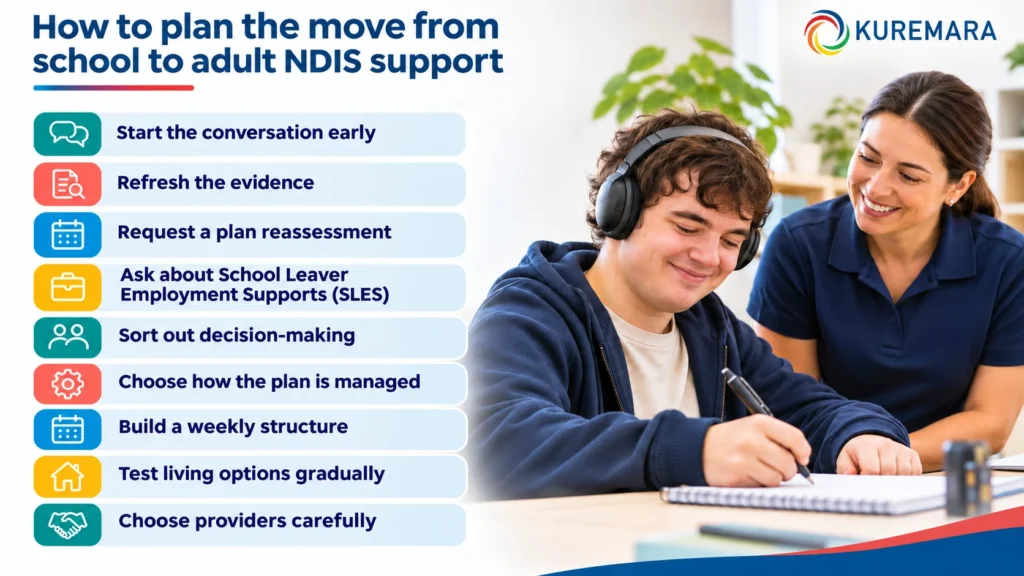 The smoothest transitions start in Years 11 and 12, not after graduation. These steps apply whether the young person is already a participant or applying for the first time.
- Start the conversation 12–18 months before school ends. Ask the young person what they want life to look like after school: work, study, where they live, who they spend time with. Write the goals in their own words.
- Refresh the evidence. Childhood reports may no longer show current support needs. Ask treating professionals for updated functional assessments that describe adult life: travel, money, work and self-care.
- Request a plan reassessment before the last term. Ask for adult goals to be reflected before school supports stop, so there is no gap between the two systems.
- Ask about School Leaver Employment Supports (SLES). SLES is funded under Capacity Building – Finding and Keeping a Job. It is generally available to participants in their final year of school or who have recently left, usually up to age 22. It can build work skills, travel training and workplace confidence. Read more on how the NDIS helps participants build careers.
- Sort out decision-making. Decide whether the young person will manage the plan alone, with supported decision-making, or with a plan nominee. Wider legal decisions outside the NDIS, such as guardianship in Queensland, go through QCAT and are separate from the NDIS plan.
- Choose how the plan is managed. Options are NDIA-managed, plan-managed or self-managed. Our guide to NDIS self-management covers the trade-offs.
- Build a weekly structure before the old one disappears. Line up community activities, work experience or study and in-home support so the first week after school already has a routine.
- Test living options gradually. Short Term Accommodation stays can help a young adult try time away from the family home before committing to shared or independent living. If home is already under strain, these signs your living arrangement isn’t working can help you decide.
- Choose providers carefully. Look for experience with autistic adults, consistent staff and clear communication. Our 8 questions to ask before committing to an NDIS provider is a useful checklist.
Tip for autistic adults: ask for planning meetings in a format that suits you. That could be written questions in advance, a quieter room, a support person, or breaks. These are reasonable adjustments, and asking for them helps the NDIA understand how you communicate.
NDIS reforms that matter for autistic adults (2026–2028)
The NDIS Amendment (Securing the NDIS for Future Generations) Act 2026 received Royal Assent on 20 August 2026 (Department of Health, Disability and Ageing). These are the changes most relevant to autistic adults. For every date, see our full NDIS reform timeline 2026–2028.
| When | What changes | What it means for autistic adults |
| From 1 Oct 2026 | Social and community participation budgets begin resetting as plans renew | Show clearly how community supports link to your goals and disability |
| 1 Dec 2026 | The window to claim supports drops from 2 years to 90 days | Providers and self-managers must claim promptly |
| From 2027 | New framework planning, built on a support needs assessment, begins a staged rollout | Plans will be shaped by a guided assessment of support needs rather than reports alone |
| 1 Jan 2028 | Access for new applicants is based on a standardised functional capacity assessment, not diagnosis lists (consultation paper) | A Level 2 or 3 diagnosis alone will no longer be the route in. Evidence of daily-life impact becomes central for everyone |
Existing participants are expected to be reassessed against the new access criteria progressively after 2028. Detailed thresholds are still being developed with a Technical Advisory Group, so some details may change.
The practical message is the same for every date: keep functional evidence current. Reports that describe what you need help with, how often and why will carry more weight than a diagnosis letter alone.
Outside the NDIS, the National Autism Strategy 2025–2031 sets national commitments on inclusion, employment, health and mental health for autistic people, whether or not they are NDIS participants.
How Kuremara supports autistic adults in Brisbane and South East Queensland
Kuremara is a registered NDIS provider based in Milton, Brisbane. We support participants up to age 65 across South East Queensland. For autistic adults, we build support around the person’s goals, routines and communication preferences, not around a diagnosis label.
Supports autistic adults and their families often ask us about:
- A home of their own, with support. Supported Independent Living for shared homes with rostered support, or Individualised Living Options for more personalised arrangements.
- Trying time away from home first. Short Term Accommodation for respite or a planned trial stay.
- Independence skills at home. In-home support for routines, cooking, cleaning and household management.
- A life outside the house. Community access and transport for work, study, hobbies and social connection.
- Co-occurring mental health needs. NDIS mental health care that works alongside the person’s clinical team.
- Making the plan work. Support coordination to connect providers, track funding and prepare for reassessments.
Already with a provider that isn’t working for you? Here is how to change your support provider in Brisbane without gaps in care.
Frequently asked questions
Can I apply for the NDIS as an autistic adult if I was never on it as a child?
Yes. You can make an access request at any age under 65. You will need evidence of your autism diagnosis and how it affects your daily life. A first-time adult application is assessed the same way as any other.
Does my NDIS plan stop when I turn 18?
No. Your plan continues after your 18th birthday. What changes is who makes decisions: from 18, you become the decision-maker for your plan unless a plan nominee is appointed. It is a good time to request a reassessment so the plan reflects adult goals.
Is Level 1 autism eligible for the NDIS?
It can be. Level 1 autism is not automatically accepted, but you can still qualify. You need to show that autism substantially reduces your functional capacity in areas such as communication, social interaction, self-care or self-management.
What evidence do adults with a late autism diagnosis need?
You need a DSM-5 diagnostic report from an appropriate specialist, ideally stating your support level. Add recent functional assessments and letters from treating professionals that describe what you need help with day to day. Evidence of co-occurring conditions also helps.
Can the NDIS help autistic adults find work?
Yes. Plans can include Capacity Building – Finding and Keeping a Job funding. This includes School Leaver Employment Supports (SLES) for recent school leavers, usually up to age 22. Plans can also fund supports such as travel training and workplace skill building.
Can the NDIS fund housing for autistic adults?
The NDIS does not pay rent. It can fund the support you need to live away from the family home, for example Supported Independent Living, Individualised Living Options or Short Term Accommodation. In some cases of very high need, it can also fund Specialist Disability Accommodation.
Will the 2028 NDIS changes affect autistic adults?
Yes. From 1 January 2028, new applicants will be assessed on functional capacity rather than diagnosis lists. Existing participants are expected to be reassessed progressively. Keeping functional evidence up to date is the best preparation.
Talk to Kuremara about adult NDIS support
Whether you are a school leaver, a parent planning ahead, or an adult with a recent diagnosis, the right support can make the move into adulthood feel manageable. Speak with our Brisbane disability support team about your goals, your current plan, and the supports that could help.
This article is general information, not legal or NDIS planning advice. NDIS rules and reform dates may change. Check the NDIS website or speak with your planner, Local Area Coordinator or support coordinator about your circumstances.