care@kuremara.com.au
 1300 000 799
If you have been trying to keep track of when the NDIS changes actually happen, you have probably noticed the problem: most explanations tell you what is changing, but not when it lands on your calendar or what to do before each date arrives. That gap is where the stress lives.
This guide fixes that. It is a straight, date-by-date timeline of the reforms now written into law, and beside each date sits one practical thing you can do to stay ahead of it. No theory, no politics, just a diary you can act on.
One thing worth saying up front, because it changes how you should read everything below: these are no longer proposals. On 19 August 2026 the National Disability Insurance Scheme Amendment (Securing the NDIS for Future Generations) Bill 2026 passed Parliament, and the Governor-General signed it into law on 20 August 2026. The dates in this article are commencement dates in an Act, not a wish-list still moving through consultation. That is exactly why a clean timeline matters now more than it did a few months ago.
If you want the fuller “why is this happening and what does each pillar mean” explanation, we have covered that separately in The Future of NDIS: Key Policy Changes and What They Mean for You. This piece assumes you already get the gist and just want the schedule.
How to use this timeline
Think of the reforms as arriving in three waves:
- Late 2026 — the administrative and budget changes. These are the ones that can touch your funding and your claiming habits first.
- 2027 — the planning changes. How your plan is built and renewed starts to shift.
- 2028 and beyond — the eligibility changes. Who gets on the Scheme, and how existing participants are reassessed, moves to a functional model.
Daily living and essential care supports are not the target of the early changes. The first adjustments are aimed at social and community participation budgets and at back-office rules like claiming windows. Keep that distinction in mind so the headlines do not frighten you into thinking your core supports vanish overnight.
Now, the diary.
Wave 1: Late 2026 – the admin and budget shifts
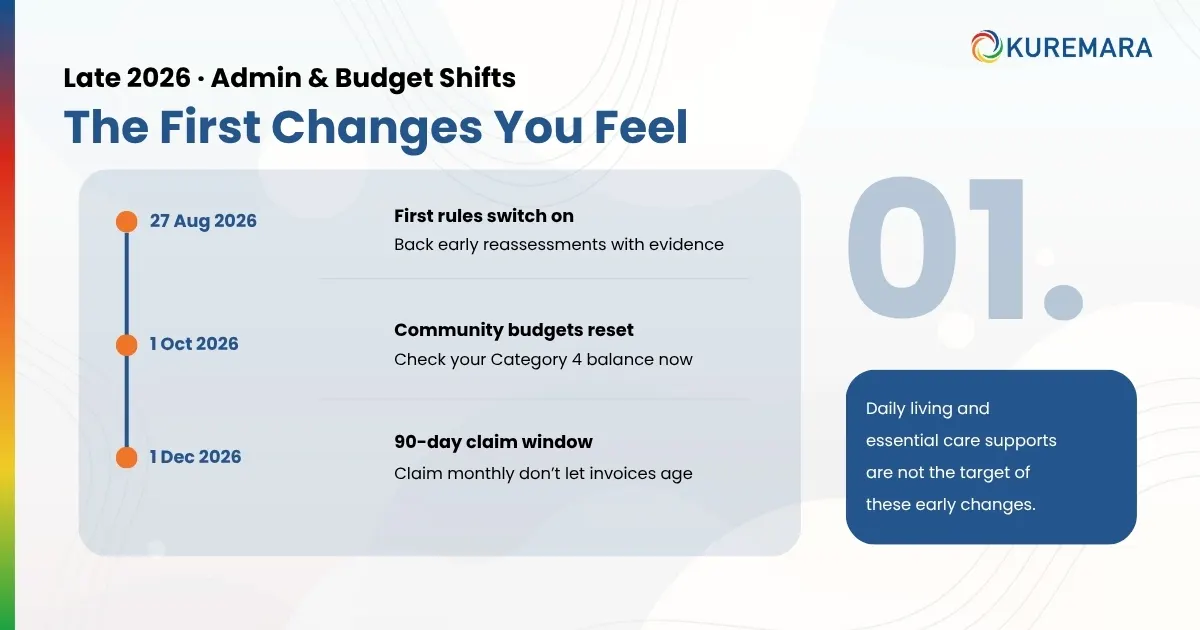
27 August 2026 – the first rules switch on
Seven days after the new laws were signed, the first tranche commenced. This wave tightens the rules around unscheduled plan reassessments (the reviews you request outside your normal cycle), strengthens record-keeping expectations, and brings the new functional-capacity language into the Act. In practical terms, the bar for asking the NDIA to reassess your plan early is now higher, and the Agency has up to 90 days to decide whether it will even action such a request.
What to do: If you were planning to request an early reassessment because your circumstances have genuinely changed, gather your evidence properly before you lodge it. A request backed by a recent report showing a significant, ongoing change in your functional capacity is far more likely to succeed than one that is not.
1 October 2026 – community participation budgets begin to be reset
This is the first change many participants will feel in their funding. From this date, budgets for social, civic and community participation, and to a lesser extent capacity-building daily-activity budgets, start being reset progressively. The resets do not hit everyone on day one; they apply as plans are renewed or reassessed. Reporting across the sector has pointed to sizeable reductions in the community participation category specifically, while daily living and core care supports are not part of this initial adjustment.
What to do: Log in to your myplace portal and check your Assistance with Social, Economic and Community Participation balance. If you are carrying a large unspent balance in that category, talk to your support coordinator about using it purposefully before your next plan renewal, rather than losing the opportunity later. If community access is central to your week, this is the moment to make sure it is well documented as a genuine support need. (New to how the categories fit together? Our guide to NDIS support categories, simplified is a useful refresher.)
Also from October 2026, the first phase of Thriving Kids begins for younger children with developmental delay or autism and lower-to-moderate support needs, a support layer that sits outside the NDIS itself.
What to do (families): If you have a child aged eight or under, stay close to your early childhood partner and ask specifically how Thriving Kids applies to your family, so you are not caught between systems.
1 December 2026 – the claiming window shrinks to 90 days
This one is quietly important. The window to claim for support drops from two years to 90 days after the support is delivered. If you self-manage, or if you have informal arrangements where invoices pile up, this changes your admin rhythm completely.
What to do: Build a habit now of claiming within weeks, not months. If you self-manage your plan, set a recurring reminder to reconcile and claim monthly. Late invoices could simply become unclaimable. If keeping on top of this feels like a lot, it is one of the practical reasons some participants revisit whether self-management is still the right fit for them.
Wave 2: 2027 – the planning changes
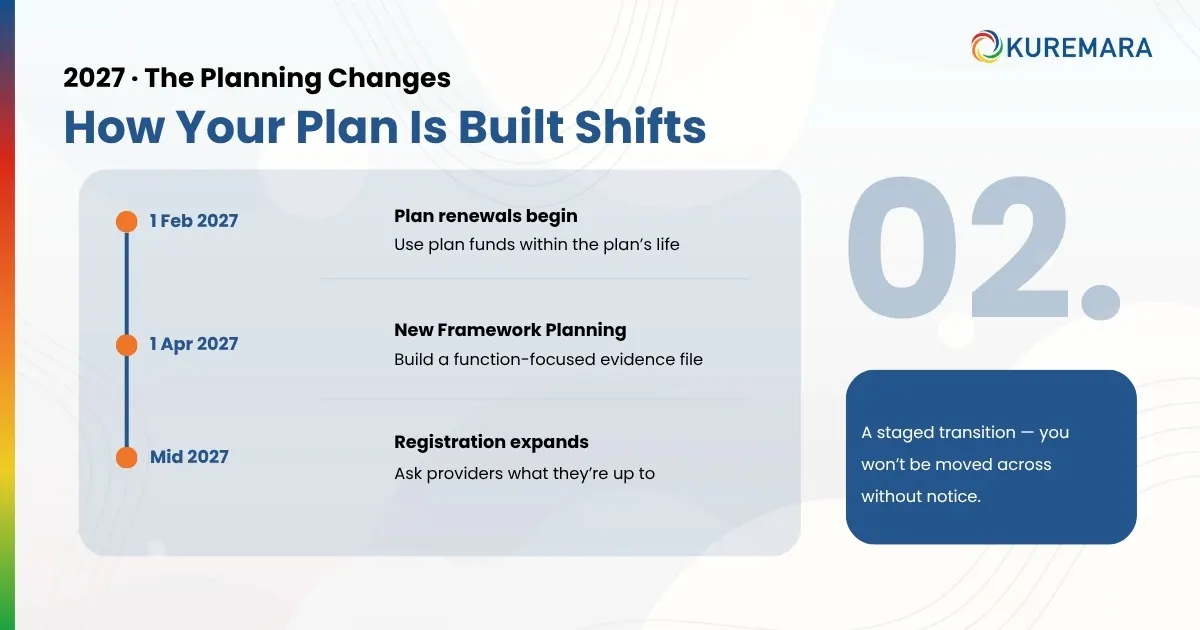
1 February 2027 – plan renewals and new “reasonable and necessary” rules
From this date, the tighter assessment of what counts as reasonable and necessary begins to roll through progressively, and many plan continuations give way to plan renewals. A key practical detail widely flagged across the sector: unspent funding from an old plan is not designed to roll into a renewed plan the way some participants have been used to.
What to do: Treat each plan as a “use it within its life” budget rather than something you can bank indefinitely. Before a renewal, review with your provider or coordinator whether your funded supports are being used and clearly evidenced, because renewal is when your plan gets looked at against the newer criteria.
1 April 2027 – New Framework Planning begins to roll out
This is the big structural change to how plans are made. New Framework Planning, built around a whole-of-person support-needs assessment that weighs functional capacity, life stage and environment rather than a list of separate line items, begins its staged rollout, starting with a selection of participants (adults first). It was originally flagged for mid-2026 and pushed back to 1 April 2027 after consultation.
Crucially, this is a transition, not a switch. You will not be moved to the new framework without notice, and existing participants move across gradually.
What to do: Start assembling a function-focused picture of your support needs now- assessments and reports that describe what you can and cannot do day-to-day, not just your diagnosis. That is the evidence the new assessment leans on. If you have ever wondered how “functional impact” differs from a diagnosis, our explainer on how the NDIS assesses disabilities is a good place to start, and it pairs naturally with our simple guide to the I-CAN assessment.
Mid-to-late 2027 – provider and commissioning changes deepen
Through 2027, the Government expands its provider enrolment and registration reforms, and a new commissioned approach to plan management begins around 1 October 2027 with a six-month transition period. For participants, the headline is quality and oversight: more of the providers delivering higher-risk supports come under formal registration.
What to do: Ask any provider you use where they are up to with registration. A provider who can answer that clearly is a provider taking your safety seriously. If you are weighing up providers, our list of questions to ask before you commit to an NDIS provider is built for exactly this moment.
Wave 3: 2028 and beyond – the eligibility shift
1 January 2028 – access moves to a functional model
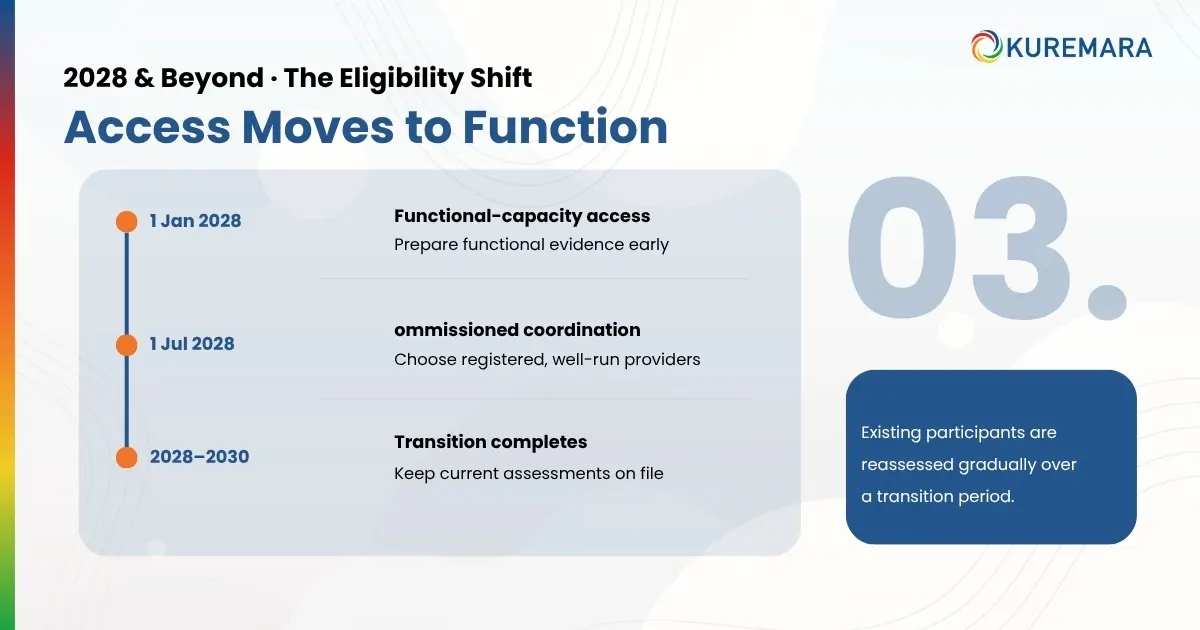
This is the most consequential long-term change. From 1 January 2028, new applicants are assessed for access using a standardised, evidence-based assessment of functional capacity rather than a diagnosis list. A firmer test of permanence (whether an impairment can be effectively treated) and a more consistent check on access to other schemes come in at the same point. Existing participants are then reassessed over a transition period reported to run across roughly three years.
Also from this date, the boundary between the NDIS and mainstream systems shifts for younger children, with those who have lower support needs supported through Thriving Kids and Foundational Supports rather than the Scheme, while children with higher needs continue on the NDIS.
What to do (prospective applicants): Build your functional evidence early. An occupational therapist’s report that spells out concrete impacts, for example, needing physical assistance to shower safely, or being unable to travel independently, will carry far more weight than a diagnosis letter alone. For some people with lower or emerging needs, Foundational Supports may become the faster, more suitable pathway, and that is not a brush-off.
What to do (current participants): You do not need to act on eligibility today, but the single most useful long-term move is to keep current, function-focused assessments on file so that when your reassessment arrives, the evidence does the heavy lifting.
Across 2028–2030 – the transition completes
A newly commissioned support coordination and connection function begins around 1 July 2028, Foundational Supports reach full national operation, and the expanded provider registration regime continues its build-out toward the end of the decade. This is the long tail of the reform, and it is deliberately staged so nobody has to absorb everything at once.
The timeline at a glance
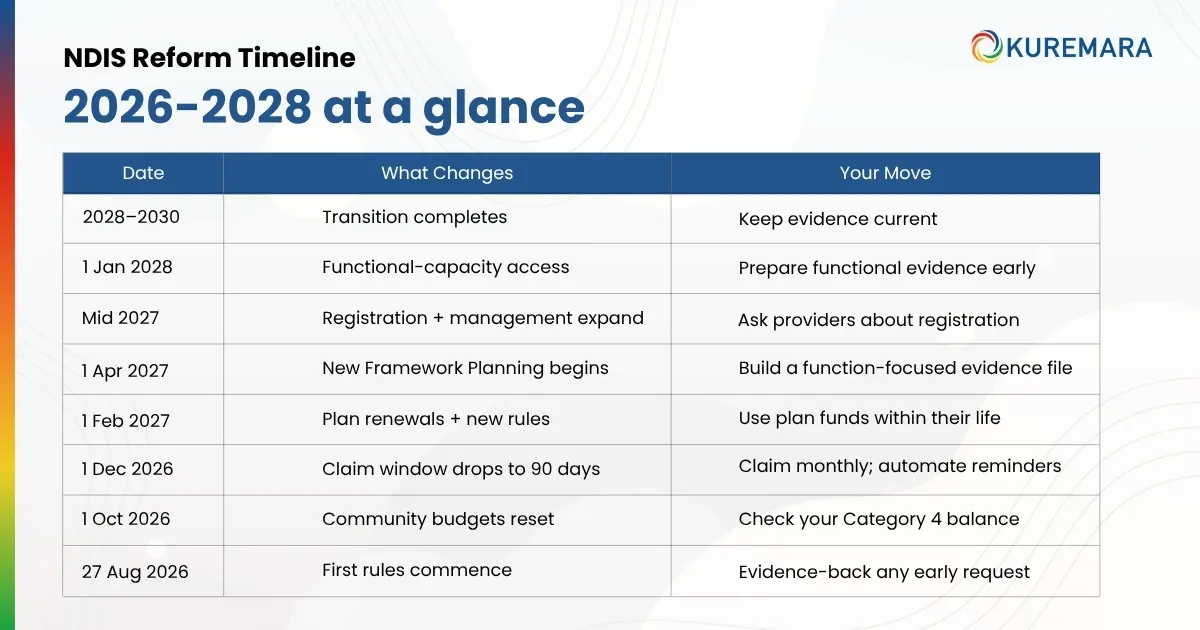
| Date | What changes | Your move |
| 27 Aug 2026 | First rules commence; tighter unscheduled reassessment criteria | Evidence-back any early reassessment request |
| 1 Oct 2026 | Community participation budgets begin resetting; Thriving Kids phase 1 | Check your Category 4 balance; use it purposefully |
| 1 Dec 2026 | Claiming window drops to 90 days | Claim monthly; automate reminders |
| 1 Feb 2027 | Plan renewals + new reasonable-and-necessary rules | Use plan funds within the plan’s life |
| 1 Apr 2027 | New Framework Planning rollout begins (staged) | Build a function-focused evidence file |
| From mid-2027 | Provider registration + commissioned plan management expand | Ask providers about their registration status |
| 1 Jan 2028 | Access shifts to functional-capacity assessment | Prepare functional evidence early |
| 2028–2030 | Commissioned coordination; full Foundational Supports; wider registration | Stay informed; keep evidence current |
Dates reflect the reform timeline as legislated in August 2026 and may be refined as the Government confirms design detail.
The thread running through every date
Read the “your move” column top to bottom, and you will notice almost all of it points at one habit: keep current, function-focused evidence, and use your plan actively rather than passively. Whether the next date on your calendar is a budget reset, a shorter claiming window, a new planning conversation or an eligibility reassessment, the participant who has recent assessments describing daily impact and who uses their funding with intent is the one who moves through each change with the least disruption.
That is genuinely good news, because it means you do not need a different strategy for every date. You need one steady approach, applied consistently.
Where Kuremara fits
At Kuremara, a registered NDIS provider delivering Supported Independent Living, support coordination, complex care, community nursing and in-home support across Brisbane, Melbourne, Sydney, Mackay and Emerald, we have been preparing our services for this new registration and planning environment well ahead of these dates. Our role through the transition is simple: help you understand which date on this timeline actually affects your situation, keep your supports stable while the model changes around you, and make sure your evidence and your voice are ready when your reassessment comes. If you are not sure which wave you sit in, that is a conversation worth having sooner rather than later.
Disclaimer: This article is general information drawn from the Australian Government’s Securing the NDIS for Future Generations materials, including the reform timeline and the NDIS Amendment (Securing the NDIS for Future Generations) Act 2026 passed on 19 August 2026 and given Royal Assent on 20 August 2026, together with related public sources available at the time of writing. Some commencement dates depend on further design work and rule-making and may be refined. This is not legal, medical or financial advice. For guidance specific to your circumstances, speak with a qualified professional or refer to official sources at ndis.gov.au and health.gov.au.