care@kuremara.com.au
 1300 000 799
If you have spent any time inside the NDIS world, you have probably come across the phrase positive behaviour support. It appears in plan reviews, provider brochures, and support meetings, usually surrounded by other formal-sounding terms like “functional assessment,” “regulated restrictive practices,” and “capability framework.” For a lot of participants and families, it can feel like a language you were never taught.
At Kuremara, we think understanding your own supports should never require a glossary. So this is positive behaviour support explained in plain English: what it actually is, who is involved, what a plan looks like, and why the whole approach is built around one simple idea: helping a person live a better life, not just managing a moment.
What positive behaviour support actually means
Strip away the jargon, and positive behaviour support is a way of understanding why a behaviour is happening, and then changing the things around a person so the behaviour becomes less necessary.
That is the part people often miss. Behaviour is communication. When someone becomes distressed, withdrawn, or aggressive, that behaviour is usually telling us that they are in pain, overwhelmed, frightened, bored, unable to make themselves understood, or stuck in an environment that does not suit them. Positive behaviour support treats the behaviour as a clue rather than a problem to be shut down.
The NDIS Quality and Safeguards Commission, the national body that regulates this area, describes it this way: positive behaviour support focuses on improving a person’s quality of life and understanding the reasons behind behaviour and how to change it. Notice what comes first in that sentence. Quality of life. Everything else follows from there.
It is also an evidence-based approach, not a set of good intentions. Positive Behaviour Support is an evidence-based approach that focuses on understanding and addressing the reasons behind challenging behaviours. Rather than using punishment, PBS aims to teach and reinforce positive, appropriate behaviours through supportive strategies tailored to each individual. It draws on decades of research in behavioural science, and in disability support, it has become a recognised best-practice framework precisely because it is measured, reviewed and adjusted rather than guessed at.
What it is not
Because the term gets used loosely, it helps to clear up some common misunderstandings.
Positive behaviour support is not punishment, and it is not about control. The goal is never to make a person compliant or quiet for someone else’s convenience.
It is not the same as restraint or seclusion. Those are restrictive practices, a separate and tightly regulated category. Under the NDIS, when restrictive practices are used, they must be implemented within a Positive Behaviour Support framework, with robust safeguards and a focus on reducing and eliminating their use. In other words, good positive behaviour support works to make restrictive practices less and less necessary over time, the opposite of relying on them.
And it is not only for people considered “difficult.” Anyone whose behaviour is creating a barrier to a full, safe and connected life can benefit from it.
Who is involved: the Behaviour Support Practitioner
The person who leads this work is a Behaviour Support Practitioner. This is not a role anyone with NDIS funding can simply take on. Practitioners must be assessed and considered suitable by the NDIS Commission before they can develop a plan.
Their job, in plain terms, is to get to know the person deeply, their history, their strengths, their communication style, what a good day looks like and what tips a day into a hard one, and then translate that understanding into practical strategies. Formally, the NDIS Rules state that a behaviour support practitioner can “undertake behaviour support assessments (including functional behaviour assessments) and … develop behaviour support plans that may contain the use of restrictive practices.”
To lift the standard of this work across the country, the Commission has published a Positive Behaviour Support Capability Framework, which provides clear expectations for behaviour support practitioners and helps them move towards a higher standard of practice, aims to strengthen the safeguarding for people with disability receiving behaviour support, and demonstrates the NDIS Commission’s commitment to reducing and eliminating restrictive practices. There are four defined levels of practitioners within that framework, so the person supporting you is expected to work within their actual training and experience.
Good practitioners never work alone. They work with the participant, their family, carers, and support workers because the people who spend the most time with someone often hold the most useful insights.
What a Behaviour Support Plan looks like
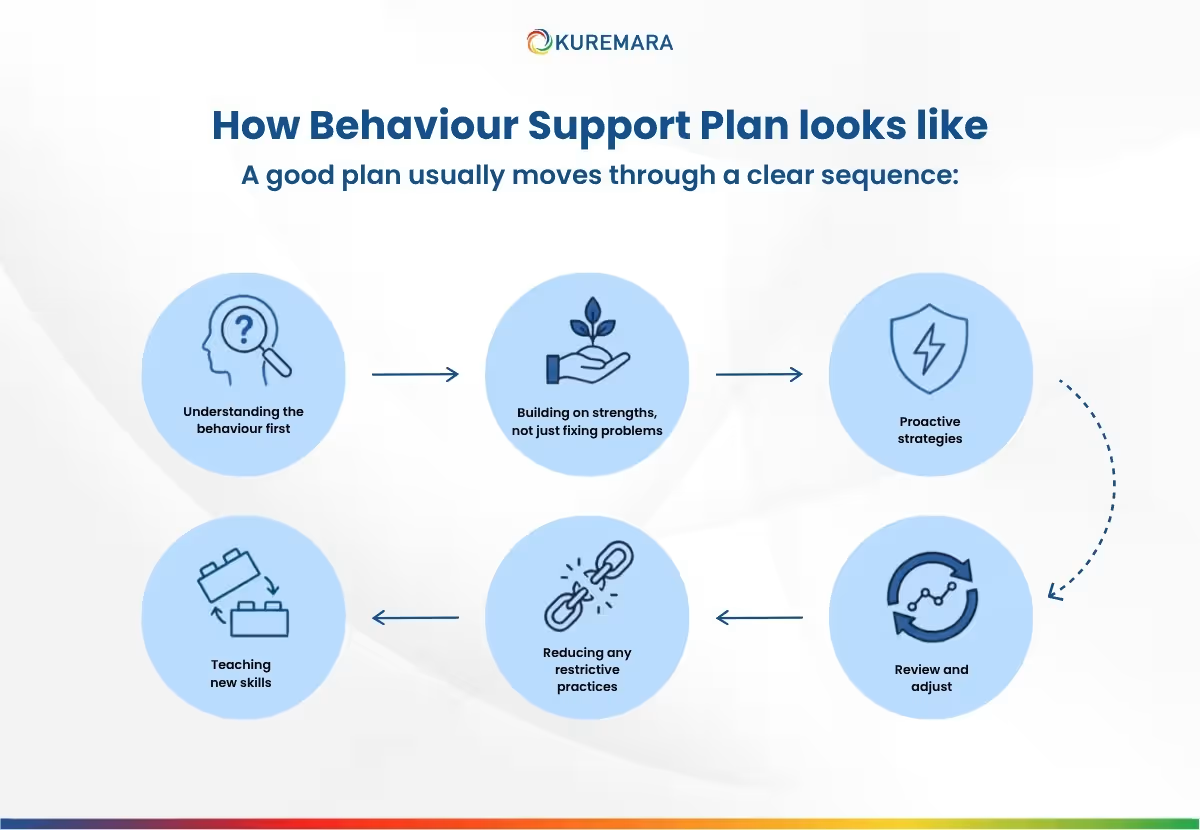
The main output of all this work is a Behaviour Support Plan, a written document, tailored to one person, that captures what has been learned and sets out how everyone should respond.
A good plan usually moves through a clear sequence:
1. Understanding the behaviour first
Before any strategy is written, the practitioner completes a functional behaviour assessment. This is the structured process of working out why a behaviour keeps happening, what tends to happen just before it (the triggers), and what the behaviour achieves for the person. If we know why someone is exhibiting behaviours of concern, we can structure an effective response in order to assist them. Skipping this step is like prescribing medication without a diagnosis.
2. Building on strengths, not just fixing problems
Plans take a person-centredand strengths-based approach starting from what the person can do, enjoys and values, rather than a list of deficits. The PBSP involves utilising a person-centred and strength-based approach to address the needs of the individual, the underlying causes of behaviours of concern, and the overall quality of life.
3. Proactive strategies
Much of the plan is about preventing distress in the first place, adjusting the environment, the routine, or the demands placed on someone. A well-known example: making sure a regular walking route is quiet if the person finds dogs frightening, so the trigger simply never arrives.
4. Teaching new skills
Rather than removing behaviour and leaving a gap, plans focus on building alternatives, often communication skills, so a person can express a need directly instead of through distress. This might mean introducing communication aids, gestures, or picture-based systems.
5. Reducing any restrictive practices
Where a plan does involve a regulated restrictive practice, it must show a genuine path toward reducing and ideally removing it. Under the NDIS Rules, every participant should have an up-to-datebehaviour support plan that reflects their needs, improves their quality of life, supports positive progress, and aims to reduce and eventually eliminate any regulated restrictive practices, if applicable.
6. Review and adjust
A plan is a living document. Support workers record how strategies are working, and the plan is revisited and refined based on what the data actually shows, not on assumptions.
The safeguards, in plain terms
This is a genuinely high-stakes area of support, and it is regulated accordingly. It helps to know the guardrails that exist to protect people.
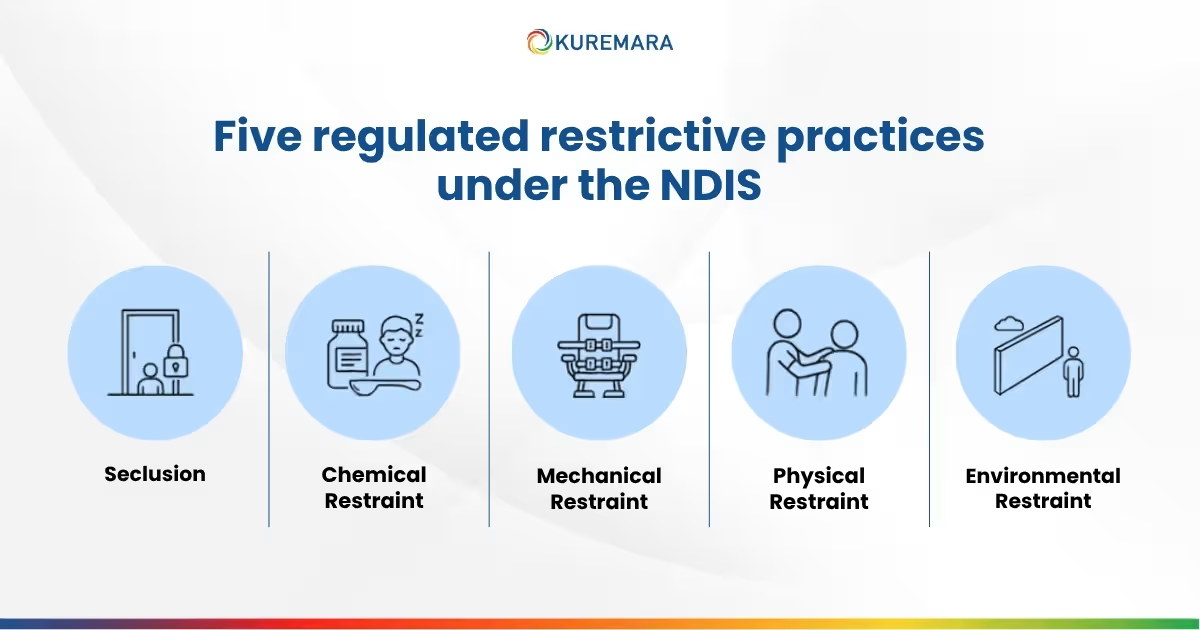
There are five regulated restrictive practices under the NDIS: seclusion, chemical restraint, mechanical restraint, physical restraint, and environmental restraint. Any use of these is treated as high-risk and is closely monitored.
The core principle is that they are always a last resort. As the NDIS-aligned guidance puts it, their use must be performed within a positive behaviour support framework, only as a last resort to protect the person or others from harm, and only after other less restrictive strategies have been tried and are ineffective.
There are also hard lines. High-risk practices should never appear in a behaviour support plan at all, and if a registered provider uses an unauthorised or high-risk practice, they must report it to the NDIS Commission by submitting a Reportable incident. These rules sit under the NDIS (Restrictive Practices and Behaviour Support) Rules 2018, which govern how such practices must be used, reported and monitored across Australia.
If any of this ever raises a concern for you, you are entitled to raise it with your provider and directly with the NDIS Commission, which oversees monitoring and provides guidance.
Why the “positive” in positive behaviour support matters
It would be easy to read all of this as a compliance exercise. It is not. The word positive is doing real work.
The entire approach starts from the belief that every person has the right to a good life, and that behaviour we find challenging is almost always a reasonable response to an unmet need or an unsuitable environment. Contemporary Australian practice frameworks make this explicit, describing positive behaviour support as rights-based work in which quality-of-life improvements are fundamental to PBS and upholding a person’s human rights is both an ethical and a legal requirement.
That is the difference between managing a person and supporting them. One asks, “How do we stop this behaviour?” The other asks, “What is this person trying to tell us, and how do we help them build the life they want?” Positive behaviour support, done well, always asks the second question.
How Kuremara approaches positive behaviour support
At Kuremara, we see behaviour support as a partnership. You and the people who know you best are not bystanders in this process; you are the experts on your own life, and the most effective plans are the ones built with you rather than handed to you.
Our focus is on understanding first, dignity always, and practical strategies that make everyday life calmer, safer and more connected while working steadily to reduce reliance on anything restrictive. If you or someone you support is exploring behaviour support under the NDIS and would like to talk it through in plain language, our team is here to help.
This article is general information only and is not a substitute for individualised professional advice. For authoritative guidance, see the NDIS Quality and Safeguards Commission. If a person’s life is at risk or there is an immediate risk of harm, call 000.