care@kuremara.com.au
 1300 000 799
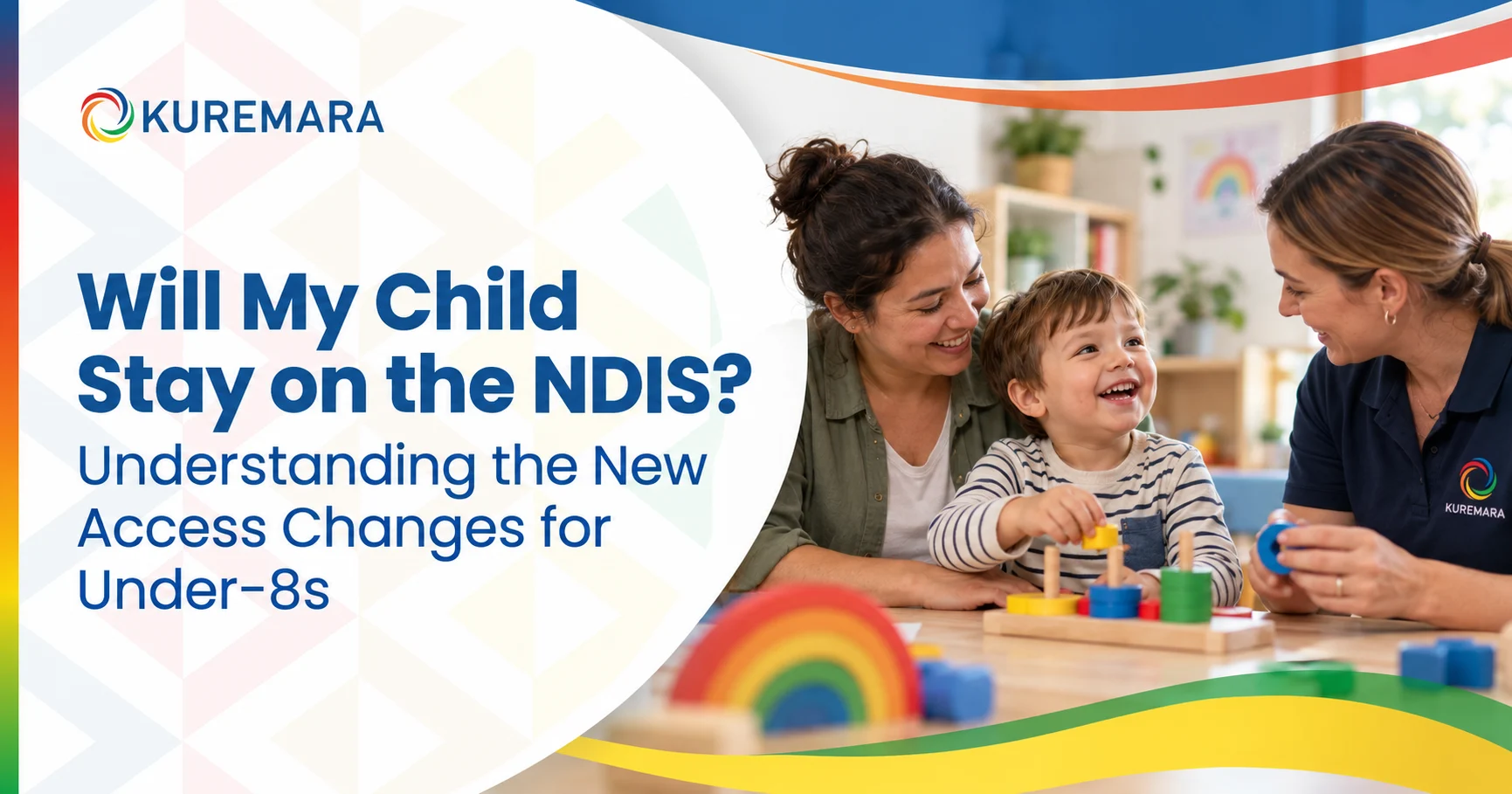
If your child is on the NDIS, or you were about to apply, the Thriving Kids announcements have probably left you with one question above all others: will my child stay on the NDIS, or lose their plan? It is a fair worry. Headlines have blurred the dates, and some online guides have even suggested children are already being moved off the Scheme. They are not.
This guide sets out what the Australian Government has actually confirmed about NDIS access for young children, which families the changes touch, and the one checkpoint every parent or carer of a young participant should circle on the calendar: their child’s ninth birthday.
A quick note on wording. Official documents describe this group as children “aged 8 and under”, meaning up to and including eight years old. We use “under-8s” as everyday shorthand, but the new rules apply right up until a child turns 9. We also use both “autistic children” and “children with autism”, because people in the autistic community hold different preferences and official documents use both.
The short answer
- No child is being removed from the NDIS right now. NDIS access rules for young children do not change until 1 January 2028.
- Already a participant before 1 January 2028? Your child continues to be reassessed under the eligibility rules in place before that date while they are 8 or under. Once they turn 9, any reassessment uses the new eligibility criteria based on functional capacity.
- Applying from 1 January 2028? Children aged 8 and under with autism and/or developmental delay and low to moderate support needs will be supported through Thriving Kids rather than the NDIS.
- High support needs, or a permanent and significant disability? These children remain eligible for the NDIS, subject to the usual access arrangements.
- Thriving Kids has already started. A phased national rollout began on 1 October 2026, with services expected to be at scale by 1 January 2028.
Information in this article is current as at 12 October 2026. Some design details are still being finalised by governments, so we will update this page as they are confirmed.
What has actually changed, and what hasn’t
Two separate things are happening. Most of the confusion comes from treating them as one.
- A new support system outside the NDIS. Thriving Kids is a national system of supports for children aged 8 and under with developmental delay and/or autism and low to moderate support needs, and for their families, carers and kin. It is the first phase of Foundational Supports, a key recommendation of the Independent NDIS Review. All governments have committed to jointly fund it, with $4 billion over five years.
- A change to who can join the NDIS. From 1 January 2028, NDIS access changes for young children will be limited to that same group. All governments have agreed to this in principle, and the government says the specific NDIS Act amendments for children will follow once Thriving Kids design is settled with the states. They sit alongside the wider reform package passed by Parliament in August 2026, which we map date by date in our full NDIS reform timeline for 2026–2028.
The order is deliberate. Governments scheduled Thriving Kids to start first so national services are in place before NDIS access tightens. That gives families more than a year to understand the new system before any eligibility decision depends on it.
Myths we are hearing from families
| What you may have heard | What the official position says |
| “Kids are being moved off the NDIS from October 2026.” | Only Thriving Kids started in October 2026. NDIS access for children does not change until 1 January 2028. |
| “An autism diagnosis will no longer get my child onto the NDIS.” | From 2028, eligibility for this age group turns on support needs assessed through functional capacity, not the diagnosis label alone. Autistic children with high support needs remain eligible. |
| “My child needs a diagnosis to get Thriving Kids help.” | No diagnosis is required to access Thriving Kids. |
| “If we use Thriving Kids, we can never apply for the NDIS.” | State agreements acknowledge a child using Thriving Kids may also be eligible for the NDIS. The parliamentary inquiry also recommended that Thriving Kids should not block later NDIS access. |
| “Every child on the NDIS gets reassessed on 1 January 2028.” | Children already on the Scheme stay under the pre-2028 eligibility rules while they are 8 or under. The switch to the new criteria happens at age 9. |
Will your child stay on the NDIS? Five common situations
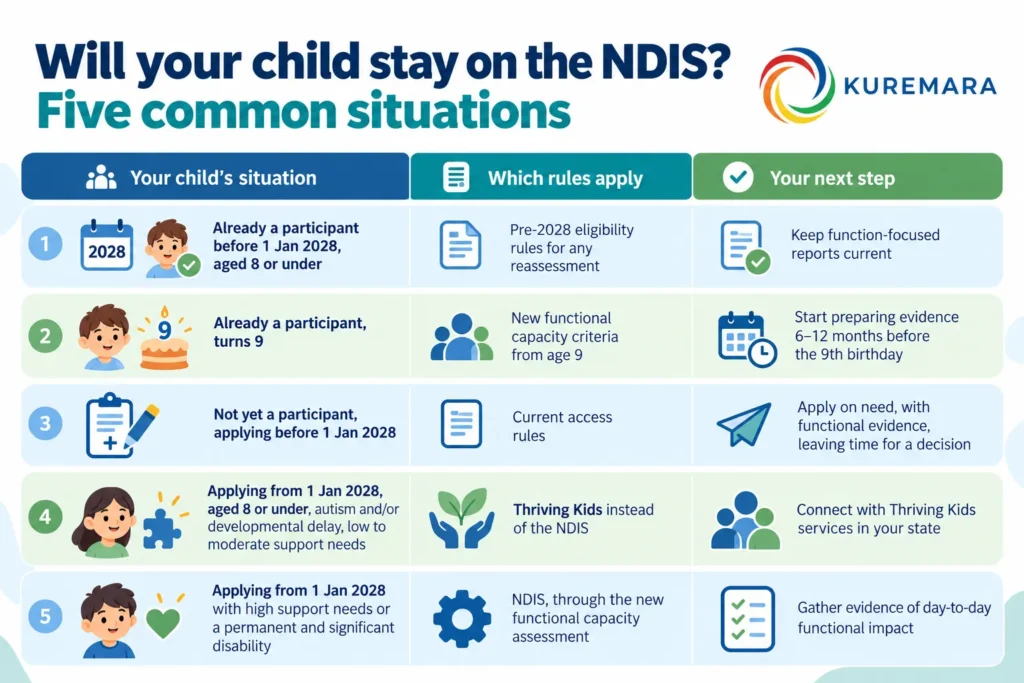 Two facts decide which rules apply to your child: when they joined (or apply to) the NDIS, and how old they are when an eligibility decision is made. Find the row closest to your family, then read the detail below.
1. Your child is already a participant and is 8 or under
Your child does not lose their plan when the rules change. The government’s participant FAQs confirm that children aged 8 and under who access the NDIS before 1 January 2028 will continue to be reassessed under the eligibility criteria in place before that date.
“Continue to be reassessed” is the phrase to notice. The current rules already include eligibility checks, especially for children who joined through the early intervention pathway. So staying on is not a lifetime guarantee. It means the yardstick does not move while your child is 8 or under.
2. Your child is already a participant and turns 9
This is the real checkpoint. Once a child on the NDIS turns 9, they will be reassessed under the new eligibility criteria based on functional capacity.
A worked example: a child born in March 2021 who joined the NDIS in 2025 turns 9 in March 2030. Until then, the pre-2028 rules govern any reassessment. From March 2030, the functional capacity criteria apply.
Be aware of the gap this creates. Thriving Kids is designed for children aged 8 and under, so a child found ineligible for the NDIS at 9 may not have an obvious next service. Researchers writing in The Conversation flag this as a key concern, noting a “Thriving Teens” idea has been floated without firm plans. Children who are already 9 or older fall under the wider reassessment arrangements for existing participants, covered in our reform timeline.
3. Your child is not yet on the NDIS, and you apply before 1 January 2028
Applications made before the change are assessed under the current rules, and children will continue to be admitted to the Scheme until then. If you are planning to apply in late 2027, lodge early enough for a decision before the change. Edge cases, such as an application lodged in December and decided in February, have not been spelled out publicly.
Our advice is to apply because your child needs the support, not to beat a deadline. A strong application rests on evidence of functional impact, not timing. Our first steps for new NDIS applicants walks through the process.
4. Your child applies from 2028, is 8 or under, and has autism and/or developmental delay
Eligibility will hinge on support needs. Children with low to moderate support needs will be supported through Thriving Kids instead of the NDIS. Children whose functional capacity is substantially reduced, described officially as high support needs, remain eligible for the NDIS.
No final threshold for “low to moderate” has been published yet. Governments are still working on a consistent national definition. The NDIA has told its Children’s Expert Advisory Group it is developing a support needs assessment approach for children younger than 9, with functional assessment information as one part of it. If you are unsure what “functional” means in practice, our explainer on why the NDIS looks at functional impact rather than diagnosis is a good primer.
5. Your child has a permanent and significant disability or high support needs
These children remain eligible for the NDIS, subject to the usual arrangements. That includes children with permanent and significant disability of any kind, and children aged 8 and under with autism and/or developmental delay whose functional capacity is substantially reduced.
Many children with complex medical needs, such as those who rely on PEG feeding, tracheostomy care or seizure management, sit in this group. New applicants from 2028 will still complete the new standardised functional capacity assessment. For context on how the Scheme supports these children, see our guide to complex care under the NDIS.
Thriving Kids in practice: what’s available now
Thriving Kids is rolling out in stages, and the first stage is deliberately broad. Supports are delivered where children already live, learn and play, such as home, early learning, school, community spaces and health care, rather than through an individual funding package.
- From 1 October 2026: universal supports, including information and advice for families with developmental concerns and supported playgroups for children aged five and under.
- National supports: a Thriving Kids National Digital Information Hub delivered by the Raising Children Network, and a Thriving Kids Autism Helpline on 1300 654 789.
- From November 2026: a Medicare-funded health check for three-year-olds, delivered by GPs.
- From January 2027: states and territories begin rolling out targeted supports, such as speech therapy or low-cost assistive technology. These require some form of assessment, but not a diagnosis.
- By 1 January 2028: services are expected to be operating at scale nationally.
How Thriving Kids differs from an NDIS plan
| NDIS individual plan | Thriving Kids | |
| Who it is for | People with permanent and significant disability, including children with high support needs | Children aged 8 and under with autism and/or developmental delay and low to moderate support needs |
| Diagnosis needed | Evidence of impairment and its functional impact | No diagnosis required |
| How support arrives | Individual funded budget; families choose providers | Services in everyday settings, commissioned by state and territory governments |
| Who runs it | National Disability Insurance Agency | States and territories, with national measures from the Commonwealth |
| Age range | Entry before age 65 | Up to and including age 8 |
Where your state stands
Each state and territory designs its own Thriving Kids services under a bilateral agreement with the Commonwealth, so what your family can access depends on where you live.
| State | Status as at early October 2026 | What to expect |
| Queensland | Signed the National Agreement on Foundational Supports, but had not finalised its Thriving Kids bilateral agreement when rollout began on 1 October | General national supports are available; the timing of Queensland-designed targeted services is unclear |
| New South Wales | Bilateral agreement signed, with a Commonwealth contribution of $442.4 million over five years | Services delivered by NSW Government agencies and commissioned non-government organisations |
| Victoria | Bilateral agreement signed | Victorian approach announced, with services starting from October 2026 |
Queensland’s position matters for families in Brisbane, Logan, Ipswich, the Gold Coast and regional centres like Mackay and Emerald. The state’s disability minister, Amanda Camm, has argued the Commonwealth has not clearly defined developmental delay or levels of support need. Advocates share a related worry: that children could fall between systems if they lose NDIS eligibility before targeted local services exist. If you are in Queensland, keep your child’s current NDIS arrangements well documented while this is resolved.
Seven practical steps for families right now
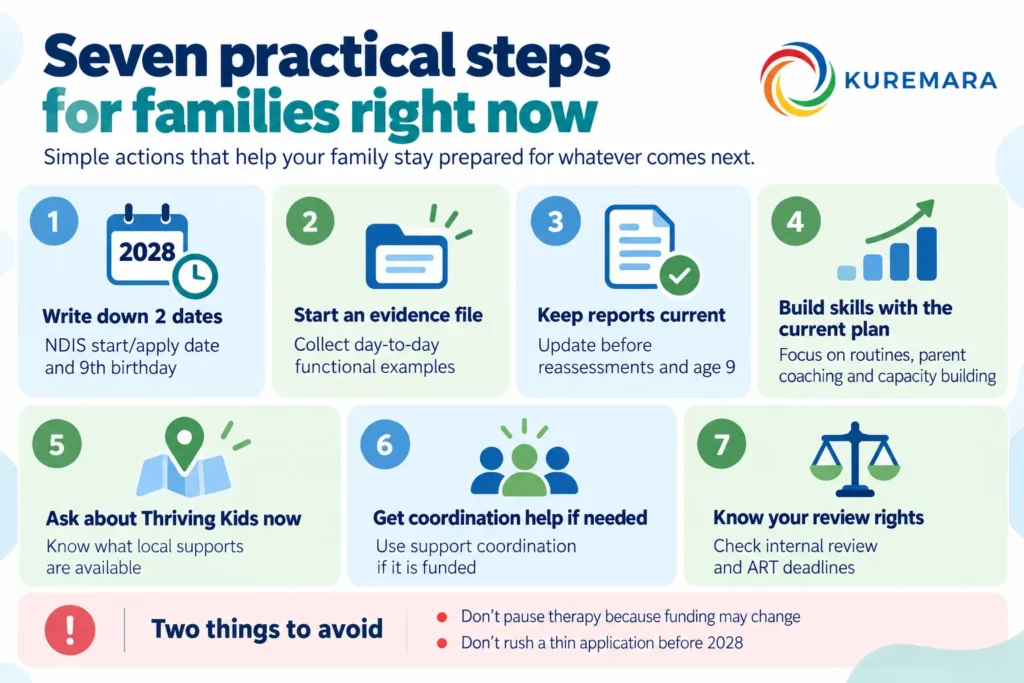 You do not need to act on eligibility today. These steps simply put your family in the strongest position for whichever checkpoint comes first.
- Write down two dates. When your child joined the NDIS (or when you plan to apply), and their ninth birthday. Together they tell you which rules apply and when.
- Start a functional evidence file. Ask your child’s therapists to describe what your child can and cannot do day to day across the areas the NDIS considers: communication, social interaction, learning, self-care, self-management and mobility. A line such as “needs an adult to prompt and physically help with each step of dressing” carries far more weight than a diagnosis letter alone.
- Keep reports current, not just complete. A report from three years ago describes a different child. Aim for updated reports around each plan reassessment, and again in the 6–12 months before your child turns 9.
- Use the current plan to build lasting skills. Therapy that coaches parents and builds routines keeps paying off whichever system your child is in later. Our guides to capacity building supports and using NDIS funding for allied health explain how.
- Ask your early childhood partner about Thriving Kids now. Find out which local services exist in your area, so any future change is a handover rather than a cliff edge. If you want a refresher on the partner’s role, see how early childhood intervention works under the NDIS.
- Get help to coordinate if you are stretched. Families juggling therapists, school and a looming reassessment often benefit from support coordination where it is funded in the plan. Here is how support coordination lightens the load for parents.
- Know your review rights. If an eligibility or plan decision does not reflect your child’s needs, you can ask the NDIA for an internal review, then apply to the Administrative Review Tribunal. Check the deadline on your decision letter. Our article on your review and appeal options covers the process.
Two things we would avoid. First, pausing therapy because you expect funding to end: your child’s plan remains in place until a decision says otherwise. Second, rushing a thin application just to get in before 2028: a well-evidenced application is what succeeds under any set of rules.
Frequently asked questions
Will my child be removed from the NDIS on 1 January 2028?
No. The 1 January 2028 change applies to new applicants. Children aged 8 and under who are already on the NDIS before that date continue to be reassessed under the pre-2028 eligibility rules. Their eligibility is tested against the new functional capacity criteria once they turn 9.
My child has an autism diagnosis. Is that enough to get onto the NDIS after 2028?
For children aged 8 and under applying from 1 January 2028, a diagnosis alone will not decide access. The question becomes whether your child’s support needs are low to moderate, which points to Thriving Kids, or high, meaning substantially reduced functional capacity, which points to the NDIS.
What happens when my child turns 9?
If your child joined the NDIS before 1 January 2028, turning 9 is when the new eligibility criteria based on functional capacity apply to them. Current, function-focused evidence is the best preparation. Thriving Kids is designed for children aged 8 and under, so it is not a fallback after that age.
Does my child need a diagnosis to access Thriving Kids?
No. Governments have agreed that children do not need a diagnosis to access Thriving Kids. Targeted supports, such as allied health, will involve some form of assessment of your child’s needs.
Can my child use Thriving Kids and the NDIS at the same time?
State and territory agreements acknowledge that a child who accesses Thriving Kids may also be eligible for the NDIS. How the two systems share responsibility in practice is still being worked through in each state, so ask your early childhood partner how it works locally.
Should we apply for the NDIS before 2028?
Apply if your child genuinely needs NDIS-level support and you have evidence of functional impact. Applications made before 1 January 2028 are assessed under the current rules. If you are applying late in 2027, lodge early enough for a decision before the change.
We live in Queensland. Does Thriving Kids apply to us?
Some Thriving Kids supports, such as the digital information hub and the autism helpline, are available nationally. As at early October 2026, Queensland had not finalised its Thriving Kids bilateral agreement, so the timing of state-designed targeted services there is unclear.
What does “low to moderate support needs” mean?
No national threshold has been published yet. Governments are working on a consistent definition, and the NDIA is developing a support needs assessment approach for children younger than 9 that draws on functional assessment information. It is expected to reflect how your child manages daily life, not a diagnostic label.
The bottom line
If your child is already on the NDIS, the honest answer to “will my child stay on?” is yes under today’s rules until they turn 9, and after that it depends on evidence of how they manage daily life. If your child has not yet applied, timing and support needs now matter as much as diagnosis. Either way, the families who move through these changes most smoothly keep current, function-focused evidence and know exactly which checkpoint applies to them.
How Kuremara can help
Kuremara is a registered NDIS provider (registration 4-GIGSGY1) delivering supports across Brisbane and South East Queensland, Mackay, Emerald, Sydney and Melbourne. If you are unsure which situation applies to your family, our support coordination team is happy to talk it through and point you to the right information. We also provide in-home support, complex care and community nursing; ask us whether these services suit your child’s age and needs.
Not sure which situation applies to your family? Call us on 1300 000 799 or get in touch online.
Disclaimer: This article is general information based on Australian Government and NDIS sources current at 12 October 2026. Thriving Kids design details, state service timelines and the NDIS Act amendments for children are still being finalised and may change. This is not legal or clinical advice. For decisions about your child, check ndis.gov.au and health.gov.au, or speak with your early childhood partner.