care@kuremara.com.au
 1300 000 799

Making the decision to change your NDIS provider is significant, but it doesn’t have to be stressful. Whether you’re seeking better specialised services, improved support coordination, or a provider that aligns more closely with your values and goals, switching providers is entirely within your rights as an NDIS participant.
The challenge that concerns most Brisbane participants isn’t the decision itself; it’s the fear of falling through the cracks during the transition. Gaps in support can disrupt your routine, jeopardise your independence, and undermine the progress you’ve made. But with proper planning and clear communication, you can change providers seamlessly while maintaining continuity of care.
This guide walks you through the entire process of switching NDIS providers in Brisbane, addressing your concerns at every step and ensuring you never lose the support you depend on.
Why Brisbane Participants Are Changing Providers
Before diving into the process, it’s worth understanding why more participants in Brisbane are exploring provider changes:
1. Service Gaps: Your current provider might not offer all the services listed in your plan. If you need specialised complex care support such as enteral feeding assistance, catheter care, or seizure management and your provider can’t deliver it, switching to a provider with those capabilities makes sense.
2. Geographic Limitations: While some providers focus on specific regions, Brisbane’s growth means coverage boundaries shift. If you’ve relocated within Southeast Queensland or want support that extends across Greater Brisbane, Ipswich, Logan, and beyond, a geographically flexible provider may be necessary.
3. Support Coordination Concerns: Quality support coordination is foundational to NDIS success. If your current provider’s support coordinator isn’t helping you optimise your plan or isn’t responsive to your needs, this is a valid reason to explore alternatives.
4. Personality and Values Fit: NDIS support is deeply personal. You deserve a provider whose culture, communication style, and values align with yours. Sometimes, a change of provider relationship can dramatically improve your experience.
5. Cost Efficiency: Not all providers manage budgets equally. If you believe another provider can deliver better value stretching your funding further while maintaining quality, it’s worth investigating.
Step 1: Clarify Your Reasons and Define Your Ideal Provider
Before you lodge a change request, spend time identifying exactly what you want from a new provider.
Write down your answers to these questions:
-
- What isn’t working with your current provider?
-
- What specific services or support do you need that you’re not receiving?
-
- Are there geographic, cultural, or communication preferences?
-
- How important is specialisation in particular care areas?
-
- Do you prefer a large organisation or smaller, community-focused provider?
This clarity will guide your research and help you avoid repeating the same problems. Many participants find it helpful to revisit the questions we outlined in our guide, “8 Questions to Ask Before You Commit to an NDIS Provider.” Even though you’re switching rather than choosing initially, these questions help identify what matters most to you.
Step 2: Research Potential New Providers in Brisbane
Brisbane has several registered NDIS providers. Your research should focus on three areas:
a. Service Capabilities: Visit provider websites and check their service descriptions carefully. Do they offer everything in your plan? Are they registered for your specific support categories? Some providers specialise in particular areas; if you need complex care support, for instance, ensure they have experience and staffing to provide it reliably.
b. Geographic Coverage: Confirm the provider operates in your area and any locations you access regularly. If your plan includes support in Greater Brisbane, the Gold Coast, and Central Queensland, you need a provider whose coverage spans those regions.
c. Provider Track Record: Look for reviews, Google ratings, and (if you’re comfortable) reach out to current participants to understand their experience. Ask your NDIA representative or local disability advocates about provider reputation.
d. Support Coordination Quality: Since quality support coordination is crucial, ask potential providers about their approach to coordination. How do they help participants optimise their plans? How responsive are they? Learn more about the role of support coordinators in NDIS planning.
Step 3: Notify Your Current Provider
Interestingly, you don’t need permission to change providers, but you do need to inform your current provider. This is a courtesy that prevents confusion and helps manage transition logistics.
Best practice approach:
-
- Put your intention in writing (email or formal letter)
-
- Be clear but don’t over-explain (you don’t need to justify your decision)
-
- Provide at least 2-4 weeks’ notice
-
- Request a final plan review if needed
-
- Ask for all documentation to be transferred
Example notice:
“I am writing to notify you that, effective [DATE], I will be transitioning my NDIS supports to [New Provider Name]. Please arrange for the transfer of all documentation and ensure continuity of support through the transition date. I will be in contact with my new provider regarding service commencement. Please confirm receipt of this notice and outline the handover process.“
Step 4: Notify the NDIA (If Required)
Here’s an important point: the NDIA doesn’t formally approve provider changes in most cases; you have the right to choose any registered provider. However, you should notify them to ensure your plan records are accurate and to clarify any changes to how your funding will be allocated.
Contact your local NDIA office:
-
- Provide your participant number
-
- State your intention to change providers
-
- Ask if any plan adjustments are needed (this is rare)
-
- Request confirmation that the transition won’t affect plan timing or reviews
In most cases, this is a simple administrative update. The NDIA’s role is to ensure you have access to support, not to restrict your choices.
Step 5: Formally Engage Your New Provider
Once you’ve decided and notified the NDIA, formalise your relationship with the new provider.
Contact them and provide:
-
- Your NDIS participant number
-
- Your current plan (ask your old provider for a copy if needed)
-
- Any recent plan reviews or amendments
-
- Details of current services you want to continue
-
- Your intended transition date
Schedule a detailed onboarding meeting where you discuss:
-
- How they’ll coordinate with your current provider during transition
-
- Introduction to your new support coordinator (if applicable)
-
- Key contacts and emergency procedures
-
- How they’ll familiarise themselves with your specific needs and goals
-
- Any changes to scheduling or service delivery logistics
This meeting is your opportunity to build confidence. If something doesn’t feel right at this stage, you can still pause and reconsider.
Step 6: Establish Overlap if Possible
This is the critical gap-prevention step.
Ideally, there should be 1-2 weeks where both your old and new providers are active. During this overlap:
-
- Your new provider’s staff can observe current support routines
-
- Staff can meet you in familiar settings
-
- Questions about your specific needs, preferences, and routines can be clarified in real-time
-
- If you receive complex care (feeding support, catheter care, seizure protocols), the new team can learn your specific requirements from experienced staff
-
- Any scheduling or logistical issues can be identified and resolved before the old provider steps back
Funding consideration: Some participants worry about paying twice during overlap. In most cases, you won’t be double-charged; instead, your plan funding is simply allocated to both providers during transition. Clarify this with both providers in advance.
Step 7: Plan for Service-Specific Transitions
Different services require different transition approaches.
a. Supported Independent Living (SIL) or In-Home Support:
-
- Arrange overlapping visits where new staff shadow existing staff
-
- Ensure household systems, emergency procedures, and participant preferences are fully documented
-
- Confirm new staff have keys, alarm codes, and access information
b. Support Coordination:
-
- Request a formal handover between coordinators
-
- Ensure all plan documents, communication preferences, and goal notes are transferred
-
- Schedule a three-way meeting: you, old coordinator, new coordinator
c. Community Access or Transport Services:
-
- Confirm new provider knows regular community locations and routines
-
- Discuss any behavioral or communication approaches that work well for you
-
- Ensure continuity with community partners (day programs, gyms, activities)
d. Complex Care Support:
-
- This requires the most meticulous transition
-
- New staff must be trained on specific clinical protocols (feeding techniques, medication management, emergency procedures)
-
- Arrange for detailed handover documentation
-
- If possible, ensure nursing staff or clinical supervisors from both providers connect directly
Learn more about support coordination and independent living.
Step 8: Create a Transition Checklist with Your New Provider
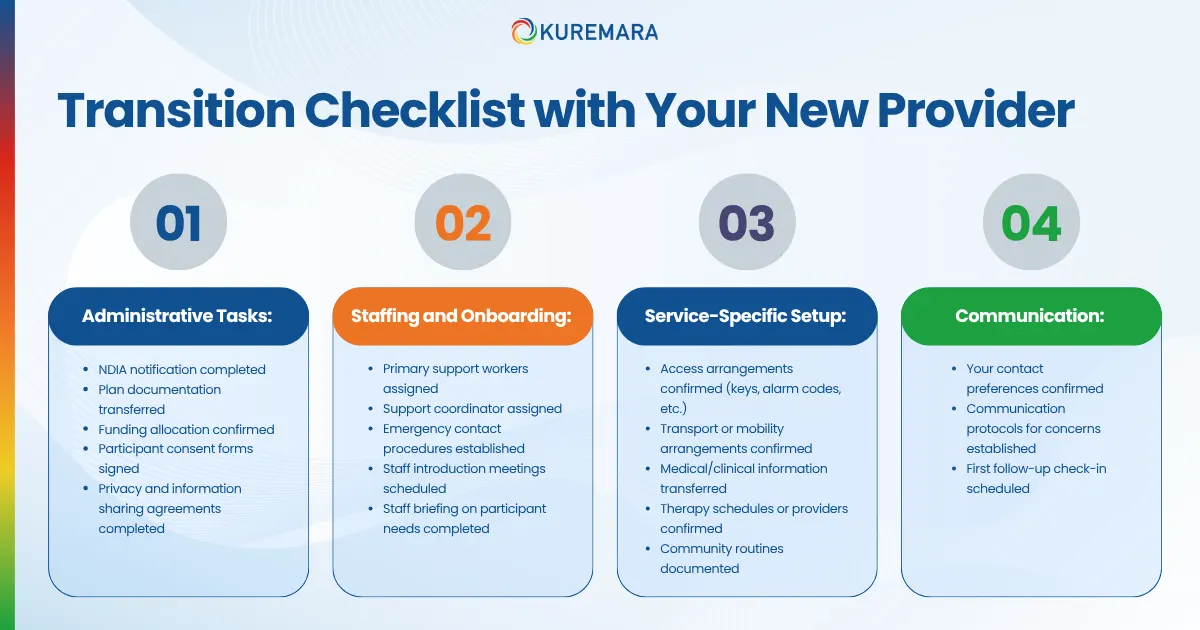
Work with your new provider to create a detailed transition plan. This document should include:
Administrative Tasks:
-
-
- [ ] NDIA notification completed
-
-
-
- [ ] Plan documentation transferred
-
-
-
- [ ] Funding allocation confirmed
-
-
-
- [ ] Participant consent forms signed
-
-
-
- [ ] Privacy and information sharing agreements completed
-
Staffing and Onboarding:
-
-
- [ ] Primary support workers assigned
-
-
-
- [ ] Support coordinator assigned
-
-
-
- [ ] Emergency contact procedures established
-
-
-
- [ ] Staff introduction meetings scheduled
-
-
-
- [ ] Staff briefing on participant needs completed
-
Service-Specific Setup:
-
-
- [ ] Access arrangements confirmed (keys, alarm codes, etc.)
-
-
-
- [ ] Transport or mobility arrangements confirmed
-
-
-
- [ ] Medical/clinical information transferred
-
-
-
- [ ] Therapy schedules or providers confirmed
-
-
-
- [ ] Community routines documented
-
Communication:
-
-
- [ ] Your contact preferences confirmed
-
-
-
- [ ] Communication protocols for concerns established
-
-
-
- [ ] First follow-up check-in scheduled
-
Having this checklist prevents ad-hoc transitions where things are forgotten or overlooked.
Step 9: Communicate Your Needs Clearly
Your new provider can only support you effectively if they understand your needs, preferences, and goals.
Prepare a summary document that includes:
-
- Your primary goals and what success looks like
-
- Daily routines and any specific times/sequences that matter
-
- Communication preferences (some people prefer email, others phone; some prefer written instructions, others verbal)
-
- Any sensory sensitivities or behavioral responses to be aware of
-
- Medical or clinical information (even if documented, a summary helps)
-
- What works well and what doesn’t in your experience
-
- Your preferred working relationship style (independent, collaborative, directive, etc.)
This document isn’t about training your provider; it’s about helping them understand you quickly, so they can deliver better support from day one.
Step 10: Monitor the Transition and Advocate for Yourself
The first 4-6 weeks with a new provider are a getting-to-know-you period. During this time:
-
- Schedule regular check-ins to address concerns quickly
-
- Document any service gaps or issues (date, time, what happened)
-
- Provide feedback on what’s working well (this reinforces good practice)
-
- Escalate concerns promptly; don’t wait until frustration builds
Red flags that warrant escalation:
-
- Staff missing scheduled sessions without notice
-
- Services listed in your plan not being delivered
-
- Significant gaps in support coordination
-
- Concerns about the quality or consistency of care
-
- Communication or cultural misalignment that isn’t improving
If issues emerge, follow your provider’s complaint process first. If that doesn’t resolve things, contact the NDIA or seek advocacy support.
Maintaining Continuity: What Your New Provider Should Guarantee
Before signing the dotted line, clarify these continuity guarantees:
1.No Service Disruptions: Your new provider commits to maintaining all services listed in your plan without gaps.
2. Informed Staff: Support workers will be briefed on your specific needs, preferences, and any clinical or behavioral information relevant to your support.
3. Consistent Relationships: If continuity of a particular support worker is important (especially in complex care scenarios), your new provider will make this a priority.
4. Responsive Communication: Your new provider will establish clear communication protocols and respond to concerns within agreed timeframes.
5. Plan Optimisation Support: Your new support coordinator will work with you to ensure your plan is being used effectively to meet your goals.
Special Considerations for Complex Care
If your plan includes complex care support, enteral feeding, catheter care, seizure management, behavioral support planning, or similar high-intensity needs, the transition requires additional rigor.
Additional steps:
-
- Ensure the new provider has specialised staff available (nursing, clinical supervision)
-
- Request a clinical handover meeting before the transition date
-
- Ask for written protocols for all clinical procedures
-
- Confirm staff hold current first aid and relevant clinical qualifications
-
- Establish clear escalation procedures for medical concerns
This is where provider specialisation truly matters. Not all providers are equally equipped for complex care, and a provider change should improve your access to specialised support, not compromise it.
What If You’re Unhappy After the Switch?
Switching again is always an option, but before you do, give the relationship time to develop (at least 3-4 months). Many participants hit a learning curve in the first 8 weeks and then see improvement as relationships strengthen and routines settle.
If you’re genuinely unsure whether to stay or switch again, consider:
-
- Having a formal meeting with your support coordinator to address specific concerns
-
- Requesting a plan review to adjust expectations or service allocation
-
- Consulting with a disability advocate who can provide an independent perspective
-
- Giving it another month while actively managing the issues you’ve identified
Switching providers repeatedly can create its own continuity challenges. Choose your second provider more carefully by then; you’ll have learned what matters most to you.
Key Takeaways: Making a Smooth Provider Change
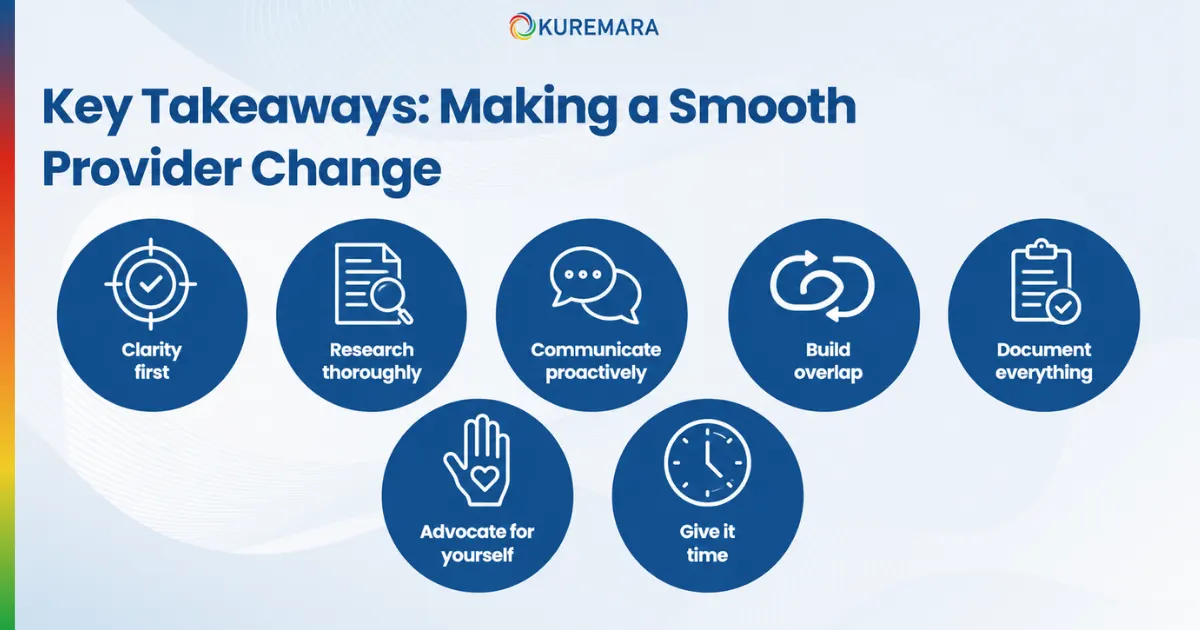
1. Clarity first: Know exactly why you’re changing and what you need from a new provider.
2. Research thoroughly: Don’t rush into a new provider relationship.
3. Communicate proactively: Keep both current and new providers informed and engaged.
4. Build overlap: If possible, have both providers active during the transition.
5. Document everything: Create a transition checklist and communication document.
6. Advocate for yourself: Speak up about concerns early and often.
7. Give it time: Allow 3-4 months for a new relationship to settle before deciding to switch again.
Final Thought
Changing NDIS providers in Brisbane doesn’t have to mean falling through gaps in support. With thoughtful planning, clear communication, and a provider committed to continuity, you can transition smoothly while maintaining the support and independence you’ve built.
Your choice of provider matters, and your right to change providers is absolute. Use it wisely, change intentionally, and don’t settle for less than support that truly works for you.