care@kuremara.com.au
 1300 000 799
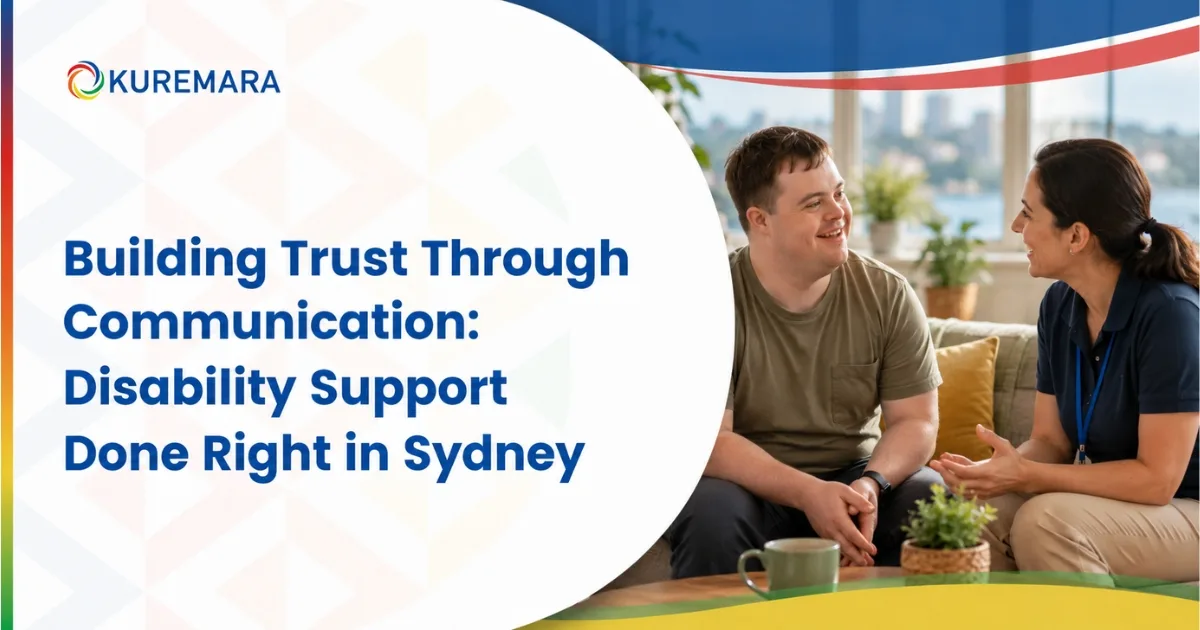
Ask any NDIS participant what separates a support arrangement they stay with from one they walk away from, and the answer rarely leads with qualifications or price. It leads with a feeling: do these people actually listen to me? Trust is the quiet currency of disability support, and it is earned or lost almost entirely through communication: how a support worker explains a decision, whether a coordinator returns a call, how a provider handles the moment something goes wrong.
For people living with disability in Sydney, where dozens of providers compete for attention across suburbs from Parramatta to Penrith, communication is often the deciding factor. The service list looks similar everywhere. What differs is whether a participant feels heard, informed, and genuinely in control of their own supports.
This article looks at why communication sits at the heart of trustworthy disability support, what good communication actually looks like day to day, and how a person-centred provider builds it into everything from the first phone call to a complex care plan review.
Why communication is the foundation of trust in disability support
Disability support is intimate work. A support worker may be in someone’s home, helping with personal care, medication, or meals. A support coordinator holds the keys to how a person’s funding is used for an entire plan period. That level of access only works when it rests on trust, and trust cannot be manufactured with a polished brochure. It is built in the small, repeated moments of being spoken to clearly and treated as the expert on your own life.
This is not just good manners; it is a regulatory expectation. Under the NDIS Practice Standards, registered providers must ensure that communication with each participant about their supports is responsive to their needs and delivered in the language, mode, and terms the participant is most likely to understand. The standards frame this as a matter of rights: the participant’s right to freedom of expression, self-determination, and informed decision-making. A provider who communicates poorly is not simply offering weaker customer service; they are falling short of the quality indicators auditors actually test against.
There is a practical dimension too. Poor communication is one of the most common causes of breakdown in support relationships. A missed message about a schedule change, a plan decision made without consultation, or clinical instructions that were never properly explained can each erode confidence quickly. Rebuilding that confidence takes far longer than it took to lose. Providers who invest in clear, consistent communication from the outset avoid most of these fractures altogether.
Communication also underpins informed choice, which is the philosophical core of the NDIS itself. Participants can only exercise genuine choice and control when they have clear, accurate information presented in a way they can actually use. A person who does not fully understand their plan, their options, or the reasoning behind a recommendation is not choosing freely; they are deferring. Good communication converts deference into real agency.
Consider what this looks like from the participant’s side. Someone new to the scheme is often handed a plan full of unfamiliar terms core supports, capacity building, plan management, line items and asked to make decisions with real consequences for their day-to-day life. A provider who takes the time to unpack that language, walk through the trade-offs, and answer questions without impatience is doing something more valuable than delivering a service. They are equipping the participant to advocate for themselves long after the conversation ends. That is the difference between a provider who does things to a participant and one who does things with them, and it is a difference participants feel immediately.
What good communication looks like in practice
It is easy to say a provider values communication. It is harder to show it in the daily rhythm of support. These are the concrete behaviours that separate genuine communication from a slogan on a website.
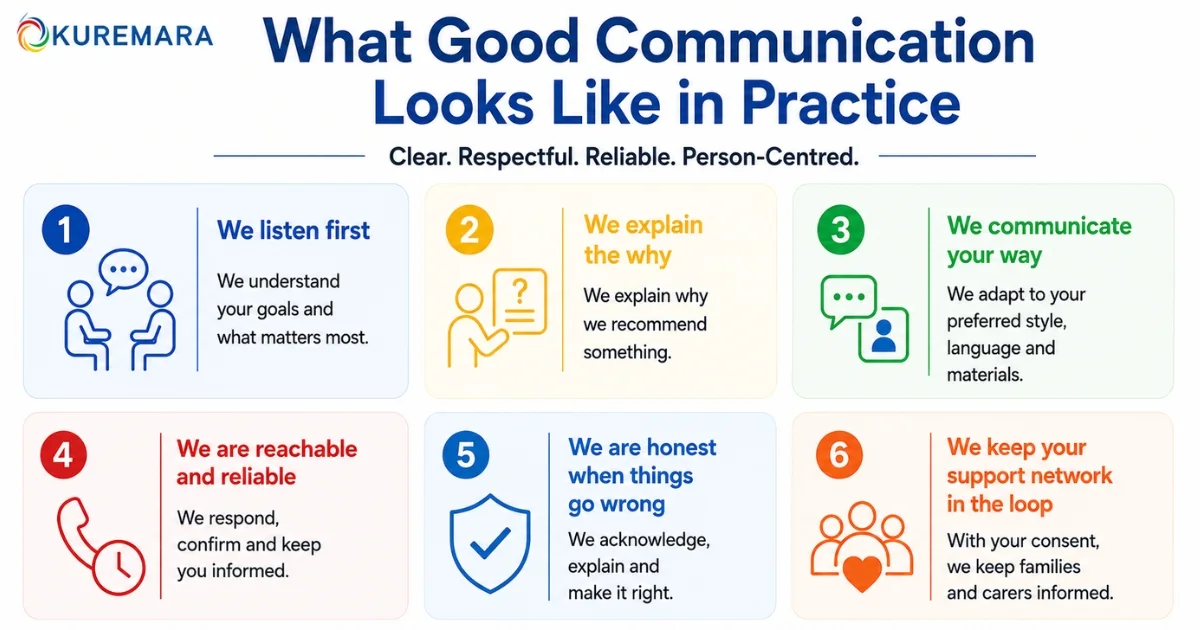
1. Listening before recommending
Trustworthy support begins with understanding, not prescribing. A good provider spends the early conversations learning about the participant’s routines, relationships, goals, and preferences before proposing a single service. When a participant feels their situation was understood before advice was given, they are far more likely to trust the advice that follows.
2. Explaining the “why,” not just the “what”
Telling someone what a support involves is the bare minimum. Explaining why it is being recommended, how it connects to their goals, what it is expected to change, and what the alternatives are treats the participant as a decision-maker rather than a recipient. This is especially important when navigating a complex plan, where jargon can quickly leave people feeling talked over.
3. Communicating in the participant’s preferred way
Some people want a phone call; others need written summaries, a support person present, an interpreter, or Easy Read materials. Meeting a participant in their preferred mode of communication is a direct requirement of the Practice Standards, and it signals respect. A provider who adapts to the person, rather than expecting the person to adapt to them, builds trust automatically.
4. Being reachable and reliable
Responsiveness is communication too. Returning calls, confirming appointments, and giving advance notice of any change tells a participant that their time and stability matter. Reliability over weeks and months is what turns a new arrangement into a dependable one.
5. Being honest when things go wrong
No provider is flawless. What distinguishes a trustworthy one is how they communicate about mistakes, acknowledging the issue plainly, explaining what happened, and setting out what will change. A transparent feedback and complaints process is not an admission of weakness; it is a sign of a provider confident enough to be accountable.
6. Keeping families and support networks in the loop
With the participant’s consent, clear communication with family members and informal carers keeps everyone aligned. Family-centred communication reduces confusion, prevents duplicated effort, and helps the people closest to a participant feel supported rather than sidelined.
Communication across the participant journey
Trust is not built in a single conversation. It accumulates across every stage of a participant’s relationship with their provider. Here is how communication shapes each one.
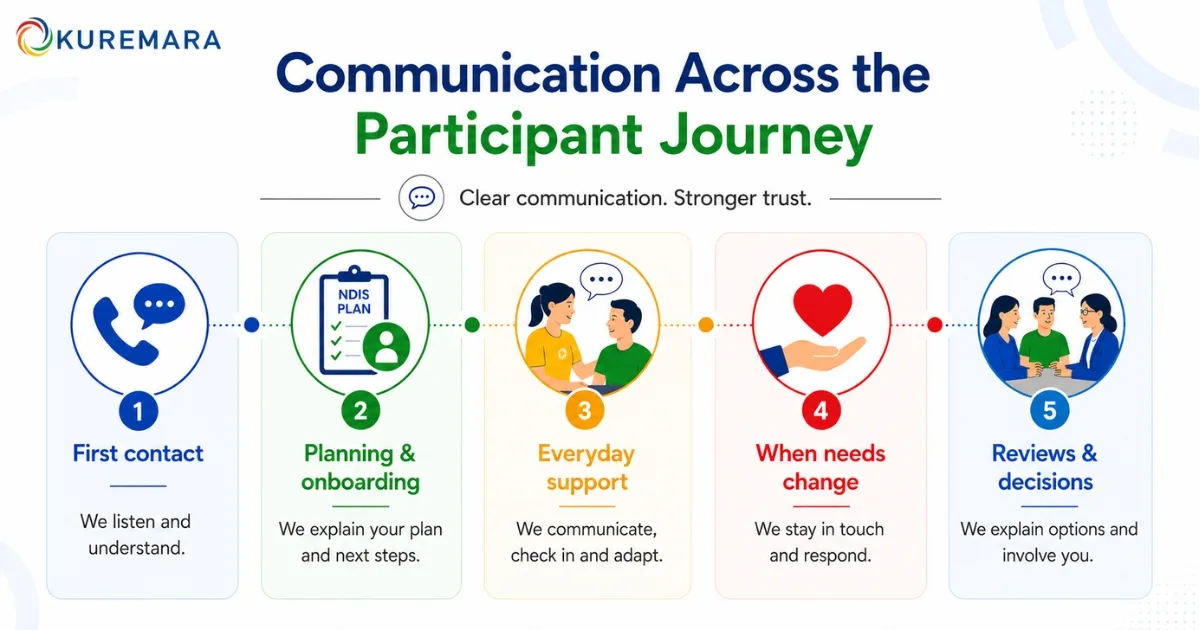
1. At the first contact.
The first phone call or email sets the tone. A participant who is met with patience, plain language, and a genuine effort to understand their needs immediately forms a different impression than one who is pushed through an intake script. This is where a provider either earns a second conversation or loses it.
2. During planning and onboarding
As supports are set up, clear communication ensures the participant understands what to expect, who will be involved, and how their NDIS plan will be used. Good support coordination is largely a communication role, translating a plan into action and connecting the participant with the right services without overwhelming them.
3. In everyday support delivery
This is where consistency matters most. Support workers who explain what they are doing, check in about preferences, and adapt as they learn a person’s rhythms turn routine assistance into a trusted relationship. The responsibilities of a support worker extend well beyond the physical tasks; much of the role is about communication and rapport.
4. When needs change
Circumstances shift. A participant’s health may change, a living arrangement may stop working, or goals may evolve. Providers who keep communication channels open notice these shifts early and respond, rather than pressing on with a plan that no longer fits. Regular, honest check-ins make it safe for participants to raise concerns before they become crises.
5. During reviews and complex decisions
When higher-stakes decisions arise moving into Supported Independent Living, arranging complex care, or preparing for a plan review the quality of communication directly affects outcomes. A participant who understands their options and feels genuinely consulted enters those decisions with confidence rather than anxiety.
Communication in complex care: where the stakes are highest
Nowhere is trust-through-communication more important than in high-intensity and complex care. When support involves clinical tasks such as continence support, enteral feeding, seizure response, medication administration, or behaviour support, clear communication is not only about relationships; it is about safety.
Complex care works only when everyone is aligned: the participant, their family, support workers, and the treating health professionals whose instructions guide daily practice. That alignment depends on precise, consistent communication, accurate handovers between shifts, careful documentation, and a shared understanding of the participant’s plan. A misheard instruction or an undocumented change can have real consequences, which is why strong providers treat communication as a core clinical discipline, not an afterthought.
Consent and dignity run through all of it. Participants receiving complex support have the same right to be informed, consulted, and in control as anyone else. Explaining what is happening, seeking consent, and respecting a person’s preferences at every step is what keeps high-intensity care humane. This becomes even more significant as the sector tightens its expectations: from 1 July 2026, Supported Independent Living providers must register under new NDIS Practice Standards developed specifically to strengthen participant voice and choice in supported accommodation settings. Communication is not a soft skill in this context; it is the mechanism through which rights are protected.
What Sydney participants should look for in a provider
If communication is the real test of a trustworthy provider, participants and families evaluating their options in Sydney can use it as a practical filter. A few questions cut straight to the heart of it. Does the provider take time to understand your situation before recommending services? Do they explain things in language you actually understand? Are they easy to reach, and do they follow through on what they say? Do they welcome feedback and handle concerns openly? And do they adapt to how you prefer to communicate, rather than expecting you to fit their process?
A provider who scores well on these questions is far more likely to deliver support that lasts because the relationship is built on the same foundation that keeps it standing.
It is also worth paying attention to how a provider communicates before you have signed anything. The intake and enquiry stage is the clearest window into how they will treat you as a participant. If a provider is patient, transparent about what they can and cannot offer, and willing to answer questions without pressure during those first conversations, that behaviour tends to carry through into the support itself. Conversely, an intake process that feels rushed, vague, or focused on filling a roster rather than understanding a person is a reliable warning sign. In a city with as many options as Sydney, participants and families are entitled to be selective, and communication is the fairest yardstick available, because it costs nothing to observe and reveals almost everything about how a provider will treat you once you are in their care.
The Kuremara approach to communication and trust
Kuremara is a registered NDIS provider supporting participants across Sydney, Melbourne, Brisbane, and surrounding regions, with more than a decade of experience delivering person-centred disability support. Communication sits at the centre of how the team works: listening first, explaining clearly, and keeping participants and their families genuinely informed at every stage of their support.
That commitment shows up in the details: support workers trained to communicate with empathy and adapt to individual needs, coordinators who translate NDIS plans into plain, actionable steps, and an open approach to feedback that treats participant voice as essential rather than optional. Across services from in-home support and community access to complex care, the goal is the same support that participants trust because they always know where they stand.
If you are looking for a Sydney disability support provider who leads with clear, honest communication, get in touch with the Kuremara team to talk through your needs. You can also learn more about the full range of NDIS services available in Sydney and how they can be shaped around your goals.
For general information on your rights as a participant and the standards every registered provider must meet, the NDIS Quality and Safeguards Commission and the official NDIS website are authoritative starting points.