 care@kuremara.com.au
 1300 000 799

NDIS plan management means a registered plan manager pays your providers and tracks your budget for you. You still choose your supports. In Melbourne, expect your plan manager to process invoices, send monthly statements and flag when a budget is running low. The NDIS funds the plan manager’s fee separately, so it does not reduce your other supports.
If you have just received your first plan, or you are reconsidering how your funding is managed, plan management can feel like one more thing to work out. It does not have to be. This guide walks through what plan management is, how to set it up and what the first few months usually look like.
You are far from alone in working this out. Victoria had 210,846 active NDIS participants at 30 June 2026, and about 144,500 of them lived across the eight metropolitan Melbourne service districts. Bayside Peninsula, Western Melbourne, Southern Melbourne and North East Melbourne each had more than 20,000 participants (NDIS Victorian Performance Dashboard, June 2026).
At Kuremara, we are a registered NDIS provider in Melbourne with a team in Southbank. We do not offer plan management ourselves, but as a provider we invoice plan managers and work alongside them as part of everyday service delivery.
What is NDIS plan management?
Plan management is one of three ways to manage the funding in your NDIS plan. A plan manager is a registered NDIS provider who handles the financial side: paying invoices, keeping records and reporting your spending back to you.
The key point is that plan management changes who does the paperwork, not who makes the decisions. You keep choice and control over which supports you use, which providers deliver them and when.
The three ways to manage NDIS funding
| NDIA-managed (agency-managed) | Plan-managed | Self-managed | |
| Who pays providers | The NDIA, directly | Your plan manager, from your plan | You, then you claim from the NDIA |
| Providers you can use | NDIS-registered providers only | Registered and unregistered providers | Registered and unregistered providers |
| Price limits apply | Yes | Yes | No, but costs must be reasonable |
| Your admin load | Low | Low | High (records, claims, receipts) |
| Statements and tracking | Via the my NDIS portal or app | Plan manager reports plus the portal | You keep your own records |
You can also combine approaches. For example, some participants self-manage one budget they are confident with and plan-manage the rest.
The difference in provider choice is real. In the June 2026 quarter, 64,279 of Victoria’s 87,676 active providers supported plan-managed participants, compared with 3,171 that supported NDIA-managed participants (NDIS Victorian Performance Dashboard).
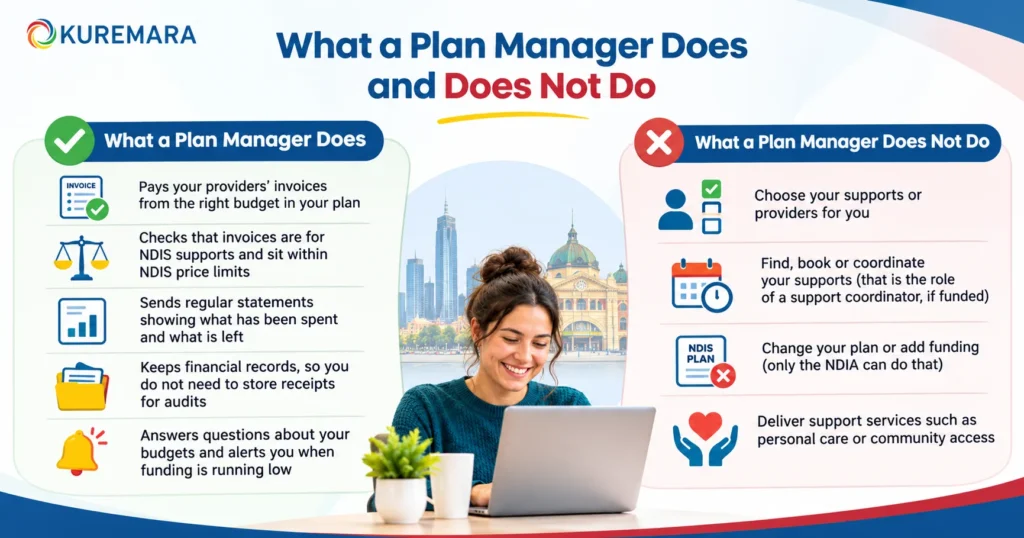 What a plan manager does
- Pays your providers’ invoices from the right budget in your plan
- Checks that invoices are for NDIS supports and sit within NDIS price limits
- Sends regular statements showing what has been spent and what is left
- Keeps financial records, so you do not need to store receipts for audits
- Answers questions about your budgets and alerts you when funding is running low
What a plan manager does not do
- Choose your supports or providers for you
- Find, book or coordinate your supports (that is the role of a support coordinator, if funded)
- Change your plan or add funding (only the NDIA can do that)
- Deliver support services such as personal care or community access
How to get started with plan management in Melbourne: step by step
Setting up plan management usually follows these steps, in this order.
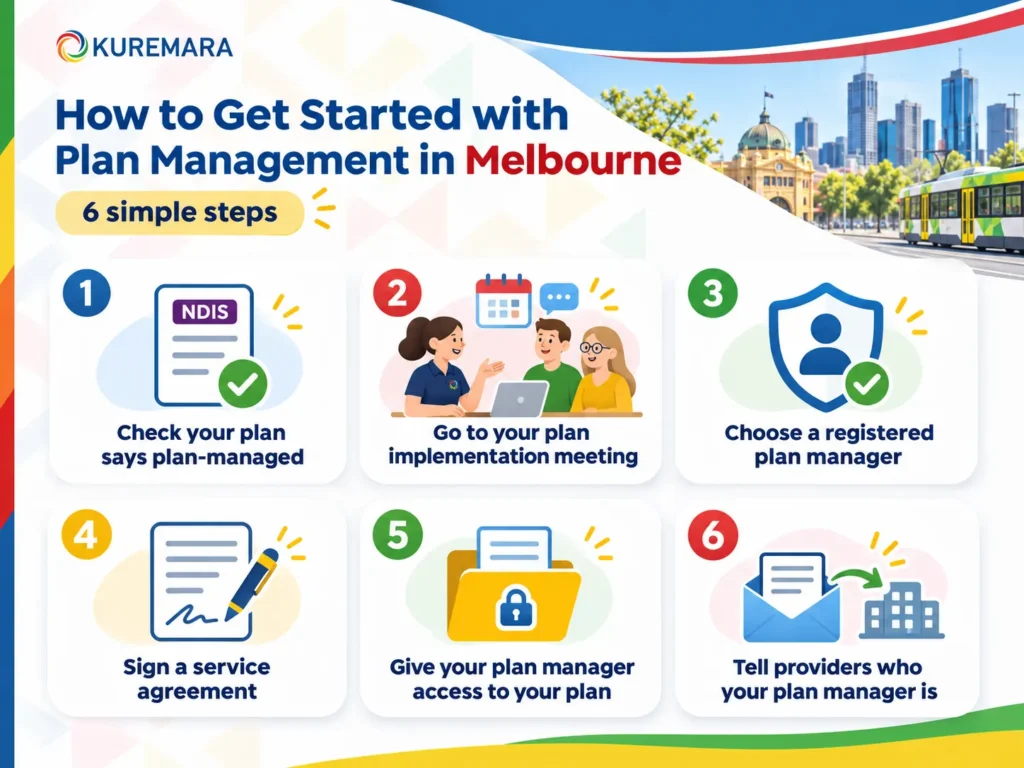
- Check your plan says “plan-managed”. Your plan shows how each budget is managed. If you did not ask for plan management at your planning meeting, contact the NDIA or your local area coordinator (LAC) and ask for it. You can request a change to how your funding is managed during a plan, without waiting for your next reassessment.
- Go to your plan implementation meeting. After your plan is approved, the NDIA offers a meeting to explain it. In Victoria, 89% of these offers were made within the seven-day service guarantee in the June 2026 quarter (NDIS Victorian Performance Dashboard). Bring your questions about budgets and management type.
- Choose a registered plan manager. Plan managers must be registered with the NDIS Quality and Safeguards Commission. Melbourne has many to choose from, and they do not need to be local because most work is done online and by phone. See the questions below to help compare them.
- Sign a service agreement. The agreement sets out what the plan manager will do, how they will contact you and how you can end the arrangement. Read it before signing and ask about anything unclear.
- Give your plan manager access to your plan. Your plan manager can only pay invoices once they are linked to your plan. They will usually confirm this with you, so check your plan budgets and dates match what they see.
- Tell your providers who your plan manager is. Give each provider your plan manager’s name and invoicing email. Providers then send invoices straight to the plan manager, and you are copied in or can see them online.
Tip: if you have a support coordinator, they can help with steps 3 to 6. Kuremara’s support coordination team in Melbourne can help you connect your plan manager with your providers.
If you are earlier in the journey and still applying or waiting on your first plan, start with our guide New to the NDIS? Start Here: Your First 5 Steps.
What to expect once your plan manager is in place
Once set up, plan management should run quietly in the background. Here is what the day-to-day looks like.
Invoices and payments
Your providers send invoices to your plan manager. The plan manager checks each one against your plan and pays it from the matching budget. Many plan managers let you approve invoices before payment, or send you a copy, so you can confirm the support was delivered as billed.
It is worth checking invoices for the first month or two. Look for the right dates, the right number of hours and the right support. If something looks wrong, tell your plan manager before it is paid.
Statements and budget tracking
Expect a regular statement, usually monthly, showing payments made and the balance left in each budget. Many plan managers also offer an online portal or app. You can still see your plan and payments in the my NDIS portal and app.
Read these statements against your plan dates. If you are spending faster than planned, you have time to adjust before funding runs short.
Using registered and unregistered providers
Being plan-managed means you can use providers that are not registered with the NDIS Commission, such as a local cleaner, gardener or therapist, as long as the support is allowed under your plan. This is one of the main reasons people choose plan management.
Registered providers like Kuremara still work with plan managers in the same way: we send our invoices to your plan manager, and they pay us from your plan.
Staying within NDIS supports and price limits
Two rules apply to every plan-managed payment:
- The support must be an NDIS support. Since October 2024, NDIS funding can only be spent on supports that fall within the NDIS’s defined list of supports. Your plan manager will query or decline invoices that fall outside it.
- The price must sit within NDIS price limits. For 2026–27, these are set out in the NDIS Pricing Schedule, which took effect on 1 July 2026 and replaced the former Pricing Arrangements and Price Limits document. Price limits are a ceiling, not a set fee, so you can agree a lower price with a provider.
If reform news is hard to keep up with, our NDIS Reform Timeline 2026–2028 lists the dates that matter.
How much does NDIS plan management cost in 2026–27?
Plan management costs you nothing out of pocket. The NDIS adds a separate amount to your plan, under Capacity Building (Improved Life Choices), to pay the plan manager. It does not come out of your Core or other Capacity Building budgets.
- Monthly fee: up to $104.45 per month in 2026–27, the same everywhere in Australia, including Melbourne. The fee was held at the 2025–26 level (Hunter Care Group summary of the 2026–27 Pricing Schedule).
- Set-up fee: none. The one-off establishment fee was removed from 1 July 2025 and has not returned in 2026–27 (Supportd).
If a plan manager asks you to pay an extra fee for standard services such as monthly statements, ask why. Those services are part of what the monthly fee covers. Always confirm current figures in the NDIS Pricing Schedule on ndis.gov.au, as the NDIA has signalled a future review of how plan management is priced.
Choosing a plan manager: questions worth asking
Plan managers all work to the same price limit, so the difference is in service. Ask these before you sign:
- How quickly do you usually pay provider invoices once received?
- Can I approve invoices before you pay them?
- How often will I get a statement, and can I see my balances online?
- Who is my main contact, and how fast do you respond to calls or emails?
- Will you warn me if a budget is being spent faster than my plan dates allow?
- How do you handle an invoice you think is wrong or outside the rules?
- How much notice do I need to give if I want to change plan managers?
These questions are about the financial side only. For choosing the providers who actually deliver your supports, see 8 Questions to Ask Before You Commit to an NDIS Provider.
How plan management works alongside support coordination and your providers
It helps to think of three separate roles that work together:
- Your plan manager looks after the money: paying invoices and tracking budgets.
- Your support coordinator (if funded) helps you understand your plan, find providers and keep supports on track.
- Your providers deliver the supports themselves.
Kuremara works in the second and third roles across Greater Melbourne. Our Southbank team coordinates with your plan manager so invoices, service agreements and budgets line up. Supports we provide in Melbourne include:
- Supported Independent Living (SIL), with current openings listed on our Melbourne SIL/ILO vacancies page
- Short Term Accommodation (STA) and respite
- Complex care for high-intensity needs
- In-home support and community access
- Community nursing and mental health support
If you are unhappy with a current provider, plan management can make switching simpler, because you can move to any registered or unregistered provider and simply tell your plan manager who to pay. Our guide to changing support providers without gaps in care explains the steps, which apply in Melbourne too.
Frequently asked questions
Does plan management come out of my NDIS budget for supports?
No. Plan management is funded as a separate line in your plan’s Capacity Building budget. Your plan manager’s fee does not reduce the money available for your Core supports, therapies or other services.
Can I change plan managers?
Yes. You can change plan managers at any time. Check the notice period in your service agreement, choose your new plan manager, then let your providers know where to send invoices from your chosen start date.
Can I switch from NDIA-managed to plan-managed partway through my plan?
Yes. Ask the NDIA or your local area coordinator to change how your funding is managed. You do not have to wait for your next plan reassessment.
Do plan managers in Melbourne charge more than elsewhere?
No. The plan management price limit of $104.45 a month in 2026–27 is the same across Australia, so Melbourne participants are funded at the same rate as anyone else.
Is plan management the same as support coordination?
No. A plan manager handles payments and budget tracking. A support coordinator helps you use your plan, connect with providers and solve problems. Many participants have both, funded from different parts of their plan.
Can I use providers outside Melbourne if I am plan-managed?
Yes. Your plan manager can pay any eligible provider, wherever they are based, as long as the support is an NDIS support and the price is within NDIS limits. This can help if you need supports while travelling or staying with family interstate.
Talk to Kuremara in Melbourne
Getting plan management set up is one step. Finding supports that fit your goals is the next. If you are plan-managed, or about to be, Kuremara can work with your plan manager from day one.
Our Melbourne team is based at Level 2, 1 Southbank Blvd, Southbank VIC 3006, call 1300 000 799 or send us an enquiry. You can also explore all of our NDIS services in Melbourne.