care@kuremara.com.au
 1300 000 799

If you or someone you love lives with ADHD, you have probably heard two completely different answers about the NDIS. One person tells you ADHD “isn’t covered”. Someone else says their family member has a plan. Both can be true, and the reason why matters a lot if you are thinking about applying.
This guide explains how the NDIS actually looks at ADHD, what tends to make the difference between an approved and a declined access request, what the scheme will and won’t pay for, and where to turn if the NDIS isn’t the right fit.
The short answer
Yes, a person with ADHD can be funded by the NDIS, but the diagnosis alone will not get you in. The NDIS decides eligibility based on how much a permanent impairment reduces your ability to manage everyday life, not on the name of the condition.
- ADHD is not on the NDIS’s List A or List B of conditions that make access more straightforward.
- That does not rule you out. The NDIA has told a Senate inquiry that ADHD’s absence from those lists doesn’t stop anyone with ADHD from testing their access to the scheme.
- Approval depends on evidence of substantial, lifelong functional impact, which is why people with ADHD plus another condition (such as autism, intellectual disability or a psychosocial disability) are more commonly found eligible.
- ADHD treatment itself, such as diagnosis, specialist appointments and medication, sits with the health system, not the NDIS.
How the NDIS decides who is eligible
To join the NDIS under the disability requirements, the NDIS operational guidelines say you need to show all of the following:
- An impairment. The NDIS recognises intellectual, cognitive, neurological, sensory, physical and psychosocial impairments. The number of impairments, or what caused them, doesn’t matter.
- Permanence. The impairment is, or is likely to be, permanent. Conditions that fluctuate can still qualify. If an available, appropriate and evidence-based treatment could remedy it, that counts against permanence.
- Substantially reduced functional capacity in at least one of these areas: moving around, communicating, socialising, learning, self-care, or self-management.
- An impact on social and economic participation, meaning it affects your ability to work, study or take part in social life.
- A likely need for NDIS support across your lifetime.
You also need to meet the age (under 65) and residence requirements.
The NDIS also maintains two lists. A diagnosis on List A will usually mean you meet the disability requirements. A diagnosis on List B is usually accepted as permanent, though you still need evidence of functional impact. ADHD appears on neither list.
Why ADHD is assessed differently
ADHD affects people in very different ways. One person may cope well with medication, routines and a bit of flexibility at work. Another may struggle to keep a tenancy, manage money, stay safe in the community, or get through a day without significant help, even after years of treatment.
Because of that range, the NDIA doesn’t treat ADHD as automatically disabling. It looks at the individual. In its evidence to the 2023 Senate inquiry into ADHD, the Department of Health and Aged Care described NDIS eligibility as based on functional need, not solely on diagnosis.
In practice, this means the question the NDIA is asking is not “Does this person have ADHD?” but “What can this person do, and not do, day to day, and will that last for life?”
What the numbers show
The most detailed public figures come from the Senate Community Affairs References Committee’s report, Chapter 7: ADHD under the NDIS. As at 31 March 2023:
| Group | Participants |
| ADHD recorded as the primary disability | 188 (148 children, 40 adults) |
| ADHD recorded as a secondary disability | 4,676 (3,447 children, 1,229 adults) |
| All participants with ADHD recorded | 4,864 |
| All NDIS participants at the time | 592,059 |
Two things stand out. First, people with ADHD as their main disability were rare in the scheme. Second, thousands more had ADHD recorded alongside another primary disability. That pattern reflects how the eligibility rules work: access is usually established through the overall picture of functional impact, and ADHD forms part of that picture.
For context, ADHD is common. Around one in 20 Australians is estimated to have ADHD, and the Senate inquiry heard that more than a million Australians live with it. The inquiry drew 701 submissions and heard from 79 witnesses, and recommended that governments clarify information about ADHD’s eligibility under the NDIS.
Note: these figures are from March 2023. The NDIA does not routinely publish a current ADHD-specific breakdown, so treat them as a snapshot rather than today’s numbers.
Situations where NDIS access is more likely
Every application is assessed on its own evidence, so none of the following is a guarantee. Still, these are the situations where people with ADHD most often have a realistic case:
- ADHD with autism. Autism is a well-established NDIS pathway. ADHD traits then add to the overall picture of support needs. (If you are an adult working through this, our guide to NDIS support for autism in adults after 18 covers that pathway in more detail.)
- ADHD with an intellectual disability. The combined effect on learning, self-management and daily living is often substantial.
- ADHD with a psychosocial disability. Where ADHD occurs alongside a persistent mental health condition, the combined impact on self-care, social life and independence may meet the threshold.
- Severe, treatment-resistant ADHD on its own. This is possible but less common. It needs strong evidence that recommended treatments have been tried and that significant functional limits remain.
What to include in an NDIS access request for ADHD
Most declined requests aren’t about whether ADHD is “real”. They come down to evidence that doesn’t clearly show permanence and functional impact. A strong application usually includes:
- A formal diagnosis from a qualified professional, such as a psychiatrist, paediatrician or clinical psychologist.
- Treatment history. What has been tried (medication, therapy, other strategies), for how long, and what effect it had. This speaks directly to permanence.
- A statement on permanence from a treating professional, explaining why further treatment is not expected to remove the impairment.
- A functional capacity assessment, often completed by an occupational therapist, describing what the person can and can’t do across the six life areas.
- Concrete, everyday examples. “Can’t follow a three-step morning routine without prompts” tells the NDIA far more than “has trouble with organisation”.
- Supporting statements from family, carers, teachers or employers that describe the day-to-day reality.
A useful test: could someone who has never met the person read the evidence and understand what a typical week looks like, and where support is needed? If not, add detail.
What the NDIS can and can’t fund
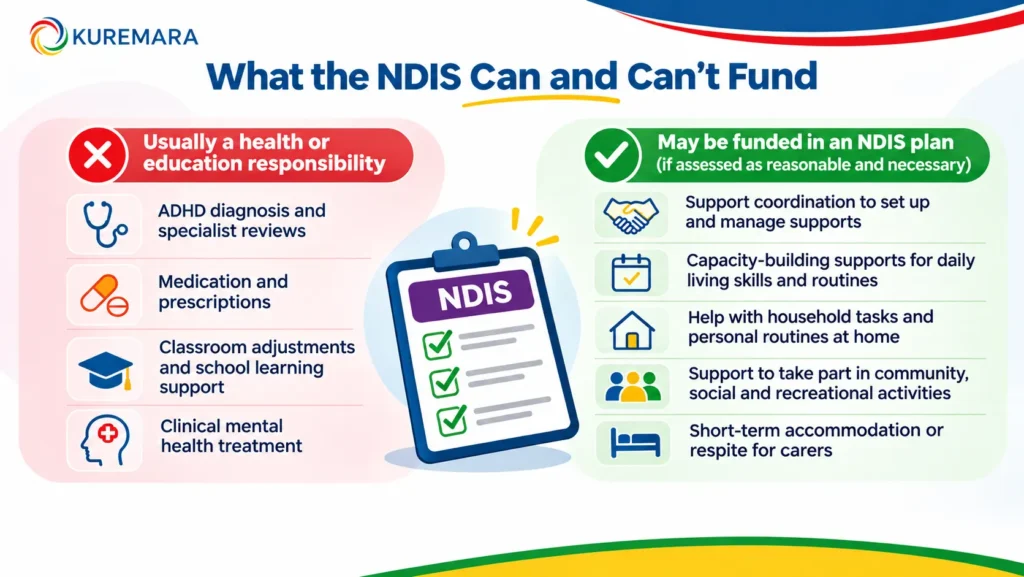 Since 3 October 2024, NDIS funding can only be spent on supports declared to be “NDIS supports” under section 10 of the NDIS Act. If a person with ADHD becomes a participant, what they receive depends on their goals and assessed needs, but it is useful to understand the boundaries.
| Usually a health or education responsibility | May be funded in an NDIS plan (if assessed as reasonable and necessary) |
| ADHD diagnosis and specialist reviews | Support coordination to set up and manage supports |
| Medication and prescriptions | Capacity-building supports for daily living skills and routines |
| Clinical mental health treatment | Help with household tasks and personal routines at home |
| Classroom adjustments and school learning support | Support to take part in community, social and recreational activities |
| Short-term accommodation or respite for carers |
The NDIS is there to address the functional impact of disability, not to replace Medicare, the PBS, schools or public mental health services.
What about children with ADHD?
For families with young children, the picture is shifting. The Australian Government’s Thriving Kids program began its first stage on 1 October 2026. It is aimed at children aged eight and under with developmental delay or autism and low to moderate support needs, delivered through places children already spend time, such as early learning centres, schools and community services.
NDIS access rules for young children are not expected to change for new applicants until 1 January 2028, and children already on the scheme are not being moved off it now. Public information about Thriving Kids focuses on developmental delay and autism and does not single out ADHD, so check with your GP, paediatrician or early childhood partner how your child’s needs fit.
We have covered these changes in full in Will My Child Stay on the NDIS? Understanding the New Access Changes for Under-8s, and the wider schedule is in our NDIS reform timeline for 2026 to 2028.
If your access request is declined
A “no” is not always the end of the road.
- Read the decision letter carefully. It should say which requirement the NDIA believes you didn’t meet, which tells you where the evidence fell short.
- Ask for an internal review. You can generally request a review of an access decision within three months of receiving it.
- Strengthen the evidence. Fill the specific gap: a fuller functional assessment, a clearer treatment history, or a professional’s statement on permanence.
- Consider an external review. If the internal review upholds the decision, you can apply to the Administrative Review Tribunal.
- Reapply later. If circumstances change, for example a new diagnosis or a decline in functioning, you can lodge a fresh access request.
Free disability advocacy services can help with reviews. You can also call the NDIS on 1800 800 110 to ask about the process.
Support outside the NDIS
If the NDIS isn’t the right fit, help is still available. Your GP can arrange a Mental Health Treatment Plan for Medicare-subsidised psychology sessions. Schools can make reasonable adjustments for students with ADHD. Workplaces can do the same for employees. Community organisations such as ADHD Australia also provide information and peer support.
How Kuremara can help
Kuremara is a registered NDIS provider supporting participants up to the age of 65, including people with mental health and psychosocial support needs. We don’t diagnose ADHD or complete access assessments, but once a participant has a plan, we can help turn it into steady, practical support:
- Support coordination to connect your plan with the right providers and keep things on track
- NDIS mental health care for participants whose ADHD occurs alongside a psychosocial disability
- In-home support with routines, household tasks and daily living
- Community access to build confidence, social connection and independence
- Short-term accommodation and respite when carers need a break
We work across South East Queensland, Sydney, Melbourne and Central Queensland. If your current arrangement isn’t working, our guide on changing support providers without gaps in care explains how to switch smoothly.
To talk through your situation, call 1300 000 799, email care@kuremara.com.au or contact our team.
Frequently asked questions
Is ADHD considered a disability under the NDIS?
ADHD can be part of an NDIS disability if it causes a permanent impairment that substantially reduces everyday functioning. The diagnosis on its own is not enough, and ADHD is not on the NDIS’s List A or List B.
Can adults with ADHD get NDIS funding?
Yes, if they meet the disability requirements and apply before turning 65. As at March 2023, 40 adults had ADHD recorded as their primary disability and 1,229 had it recorded as a secondary disability.
Does the NDIS pay for ADHD medication or assessments?
No. Diagnosis, specialist appointments and medication are health system responsibilities, generally covered through Medicare and the PBS.
Does having ADHD and autism improve my chances?
Autism is a well-established NDIS pathway, so access is often assessed through autism, with ADHD adding to the overall evidence of functional impact. Eligibility still depends on your individual evidence.
What evidence does the NDIA need for ADHD?
A formal diagnosis, a record of treatments tried and their effect, a professional’s view on permanence, and a functional assessment with real, everyday examples across the six life areas.
What can I do if my ADHD access request is refused?
Request an internal review within three months, strengthen your evidence, and if needed apply to the Administrative Review Tribunal. You can also reapply if your circumstances change.
The bottom line
The NDIS doesn’t fund ADHD as a label. It funds support for people whose permanent impairment substantially limits their everyday life. For some people with ADHD, particularly those with co-occurring conditions or severe, long-standing impact, that bar can be met with clear and thorough evidence. For others, health, education and community supports will be the better path.
Either way, you don’t have to work it out alone.
Disclaimer: This article is general information only and is not medical, legal or financial advice. NDIS rules and programs change; check current requirements with the NDIS (1800 800 110 or ndis.gov.au) or a qualified professional before making decisions.