care@kuremara.com.au
 1300 000 799
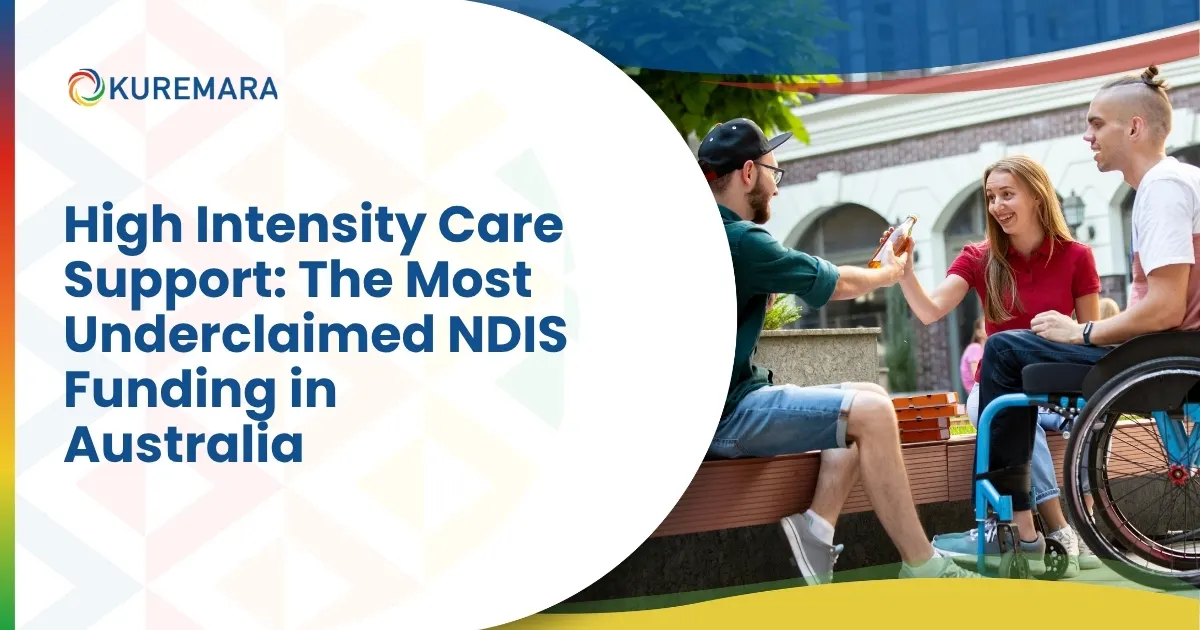
Many Australians live with complex disability-related support needs every day, yet not everyone knows that the NDIS may fund specialised help for those routines when the support is connected to disability needs and meets the funding criteria. For many participants and families, this is where confusion begins. Terms used by the system can feel technical, the evidence requirements can seem overwhelming, and people are often left wondering whether they are asking for the right thing. That is one reason ndis high intensity support is often underclaimed, even when the need is real and ongoing.
At Kuremara, we believe disability support information should be clear, inclusive, and practical. Whether you are a participant, family member, carer, or supporter trying to understand your options, this guide explains what high-intensity support means, when funding may be available, and how to take the next steps with more confidence. The goal is not just to explain the process, but to help people feel seen, informed, and better prepared to advocate for the support they need.
What Is High Intensity Daily Activity Support?
To understand high intensity care support, it helps to first understand where it lives within the NDIS framework.
The NDIS divides funding into three broad budget types: Core Supports, Capacity Building, and Capital Supports. Within Core Supports, there is a category called Daily Activities (Support Category 01). Most people are familiar with the basics of this category it funds tasks like personal hygiene, dressing, meal preparation, and domestic assistance. These are everyday supports that help a participant live as independently as possible.
But there is a subset of daily activity support that goes well beyond the everyday. When a person’s care involves clinical complexity, medical procedures, or tasks that carry a significant risk of harm if done incorrectly, that care falls under what the NDIS classifies as high-intensity daily personal activities.
This is not a different budget category. It still sits under Core Supports. But it is funded at a higher hourly rate than standard personal care, it requires support workers with verified specialist training, and it is governed by stricter clinical oversight requirements. In short, it recognises that some people’s daily care is genuinely more demanding and funds it accordingly.
What Types of Care Does It Cover?

High intensity daily activity support covers a wide range of complex care tasks, including but not limited to:
- Complex bowel management — includes manual evacuations, suppository administration, and care for participants with colostomies or ileostomies. This is one of the most commonly needed yet least-discussed high-intensity supports.
- Enteral nutrition (tube feeding) — supporting participants who receive nutrition through PEG tubes, nasogastric tubes, or jejunostomy tubes. This requires trained workers who can manage feeds, flush tubes, monitor for complications, and respond to emergencies.
- Tracheostomy management — including suctioning, stoma care, inner cannula changes, and emergency tracheostomy tube replacement. These tasks carry serious risk if performed by an untrained worker.
- Ventilator support — assisting participants who rely on non-invasive or invasive ventilation, including circuit checks, alarm management, and emergency responses.
- Subcutaneous injections — such as insulin administration for participants with diabetes alongside their disability, or other prescribed subcutaneous medications.
- Urinary catheter management — including catheter care, bag changes, suprapubic catheter management, and monitoring for signs of infection.
- Complex wound management — beyond basic first aid, including packing wounds, managing drainage systems, and following clinical wound care plans.
- Dysphagia support — assisting participants with swallowing difficulties by following modified texture or thickened fluid protocols, reducing the risk of aspiration.
- Seizure management — following prescribed seizure action plans, administering PRN medications such as midazolam, and managing post-ictal care.
This list is not exhaustive. The defining characteristic of high-intensity support is not the specific task but the level of skill, clinical knowledge, and risk awareness required to perform it safely and consistently.
Why “High Intensity” Means Higher Funding
The NDIS recognises that asking a support worker to manage a ventilator or perform bowel care is categorically different from asking them to assist with a shower or prepare a meal. It is more complex. It demands more training. It carries greater responsibility. And the consequences of poor care delivery are far more serious.
That recognition is built into the NDIS Pricing Arrangements and Price Limits, which set a higher price limit for high intensity of daily personal activities compared to standard personal care. This means providers can charge more, and participants are entitled to receive care from workers who are genuinely qualified to deliver it safely.
Who Is Eligible for High Intensity Care Support?
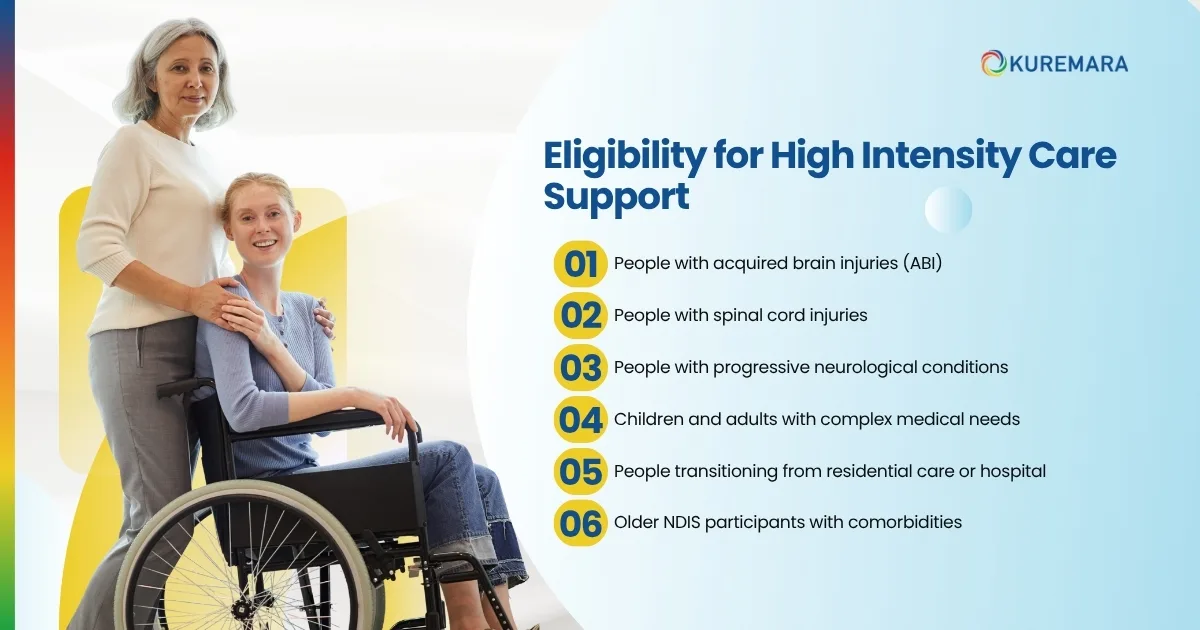
Eligibility for high-intensity daily activity support is not determined by diagnosis alone. The NDIS assesses funding based on what you need to achieve your goals and live your life, not simply what condition you have. That said, certain participant profiles are significantly more likely to require and qualify for this category of support.
Who Is Most Likely to Qualify?
-
- People with acquired brain injuries (ABI)
- People with spinal cord injuries
- People with progressive neurological conditions
- Children and adults with complex medical needs
- People transitioning from residential care or a hospital
- Older NDIS participants with comorbidities
The “Reasonable and Necessary” Test
Every dollar of NDIS funding must pass what the NDIA calls the reasonable and necessary test. For high intensity supports, this means demonstrating that the care you need:
-
- Relates to your disability — it is not medical care unrelated to your NDIS-covered condition.
- Is necessary for you to pursue your goals and participate in daily life.
- Represents value for money — the cost is justified by the benefit it delivers.
- Is likely to be effective and beneficial — there is evidence or clinical opinion that it will work.
- Takes into account what family, friends, and informal supports can reasonably provide, noting that complex clinical care cannot fairly be placed on family members who lack the training.
- Does not duplicate what should be funded through another system, such as Medicare or the health system.
The key phrase in that last point is one that many participants and families miss: the NDIS does not fund health care per se, but it does fund the support workers who help a participant manage their health-related daily activities. This distinction is subtle but critical, and it is one of the main reasons high-intensity support goes unclaimed. Participants assume their medical complexity makes it “a health issue,” when in fact much of it is entirely within the NDIS’s scope.
Where Does High Intensity Funding Sit in Your NDIS Plan?
Understanding the architecture of your NDIS plan is essential to finding and claiming the funding you need.
a. The Core Supports Budget: Your Primary Source
The vast majority of high-intensity daily activity supports are funded through your Core Supports budget, specifically within Support Category 01: Daily Activities. This is the bucket of funding that covers the hands-on, in-person support you receive at home, in the community, or in other settings.
Within this category, the key line item for high intensity personal care is High Intensity Daily Personal Activities which we have seen above.
b. Weekday, Weekend, and After-Hours Rates
One of the lesser-known features of NDIS high-intensity support funding is that it includes loading for non-standard hours. If your care needs occur on weekends, public holidays, or during overnight or early-morning hours, the applicable price limits are higher.
Participants whose high-intensity care spans multiple parts of the day, which is common, should ensure their plan includes adequate funding to cover varied rates. This is another area where underplanning frequently occurs.
c. Capacity Building Supplements
In some cases, related supports may also be claimable under the Capacity Building, Support Coordination budget or Capacity Building, Improved Daily Living budget.
The interplay between Core Supports and Capacity Building is important: the two work together to ensure participants receive not just the direct care they need, but the professional oversight and planning support to make that care effective and safe.
How to Claim High Intensity Care Support: A Step-by-Step Guide
This is the section that matters most for people who are not yet receiving the high-intensity support they need. Follow these steps carefully.
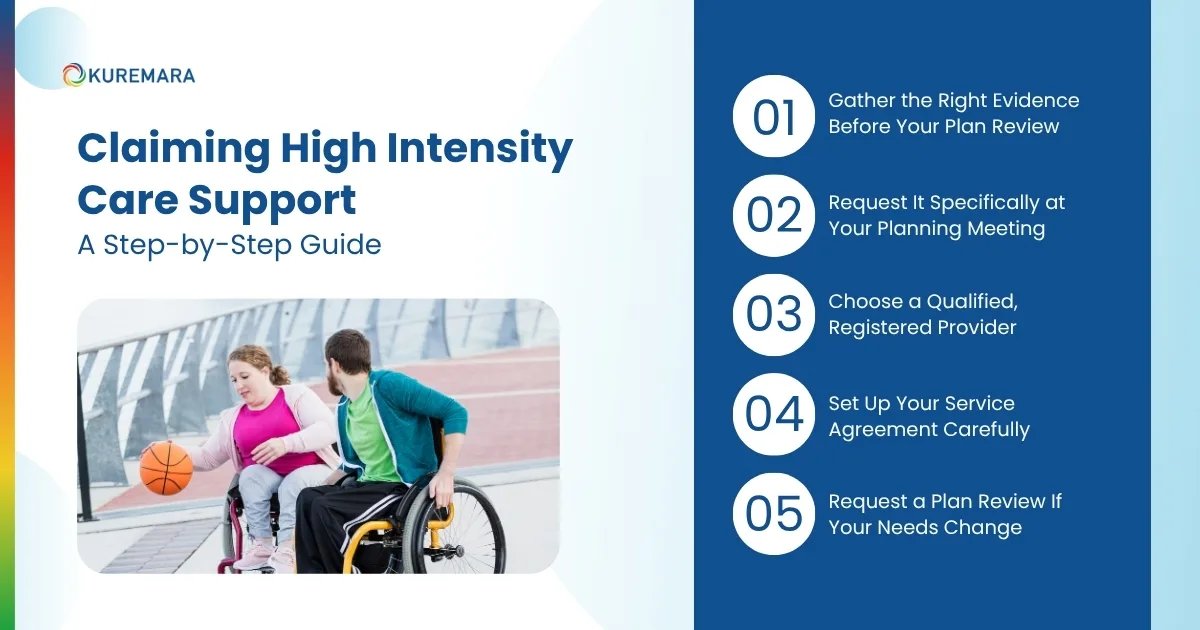
Step 1 — Gather the Right Evidence Before Your Plan Review
The NDIA does not automatically allocate high-intensity funding. You need to make the case. And the strongest cases are built on clear, specific clinical evidence.
The types of documents that support a claim for high-intensity daily activity support include:
-
-
- Functional capacity assessments conducted by an occupational therapist or allied health professional who has observed your daily care needs firsthand. The report should explicitly describe the nature, frequency, duration, and clinical complexity of each care task, and state clearly why it requires a trained, rather than standard, support worker.
- Letters or reports from your treating specialist, your neurologist, spinal specialist, respiratory physician, or GP confirming the clinical nature of your care needs. These do not need to be lengthy; a focused, specific letter that connects your diagnosis to your daily care tasks is far more useful than a general health summary.
- Current care plans: if you have been receiving nursing care in a hospital, aged care, or through the health system, bring documentation of that care plan. It demonstrates that the tasks involved are clinically recognised, not arbitrary.
- A clear written statement of your daily support needs in your own words (or written with the help of a trusted person). This personal statement gives the NDIA a direct picture of what your day actually looks like without adequate high-intensity support.
-
Step 2 — Request It Specifically at Your Planning Meeting
This step sounds obvious, but it is where many eligible participants fall short. Vague requests get vague outcomes.
When you attend your NDIS planning meeting whether in person, by phone, or via a Local Area Coordinator, do not simply describe your situation and leave it to the planner to interpret. Come prepared with:
-
-
- A written list of the specific care tasks you need, using their correct terminology (e.g., “complex bowel management,” “enteral feeding via PEG tube”)
-
-
-
- Your supporting evidence documents (see Step 1)
-
-
-
- A clear statement that you are requesting high-intensity daily personal activities funding under Support Category 01
-
-
-
- An estimate of the hours per week required for each task, broken down by time of day if relevant
-
If you have a support coordinator, bring them to the meeting or ensure they have submitted a written support needs statement in advance. If you do not yet have a support coordinator, you may also have a trusted person accompany you as a support person.
Be specific. Be persistent. And know that if the outcome of your planning meeting does not reflect your genuine support needs, you have the right to request an internal review of the decision.
Step 3 — Choose a Qualified, Registered Provider
Not every NDIS provider is equipped to deliver high intensity daily activity support. Choosing the wrong provider can mean receiving substandard care, being charged incorrectly, or, in the worst case, facing genuine safety risks.
Step 4 — Set Up Your Service Agreement Carefully
Once you have chosen a provider, a service agreement is established. This is a legally binding document that governs how your NDIS funding will be used with that provider. For high intensity supports, the service agreement needs to clearly include:
-
-
- The specific NDIS line items being claimed
-
-
-
- The applicable support hours are broken down by time of day and day of week (to ensure correct rate application)
-
-
-
- The specific care tasks to be delivered
-
-
-
- The price per hour for each shift type is consistent with NDIS price limits
-
-
-
- Cancellation and notice requirements
-
If you are self-managed or plan-managed, your plan manager will help reconcile these claims. If you are NDIA-managed, the provider claims directly through the NDIS portal.
Step 5 — Request a Plan Review If Your Needs Change
NDIS plans are not set in stone. If your care needs increase due to disease progression, a hospital admission, or a change in your living situation, you do not need to wait for your scheduled annual plan review.
You can request an unscheduled plan review (also called a review of a reviewable decision or a change-of-circumstances review) at any time. To succeed with this review, you will need updated evidence demonstrating that your circumstances have changed and that your current plan no longer meets your support needs.
This is particularly relevant for participants with progressive conditions, where high-intensity care needs may increase significantly over a relatively short period.
Why Is This Funding So Underclaimed? The Real Barriers
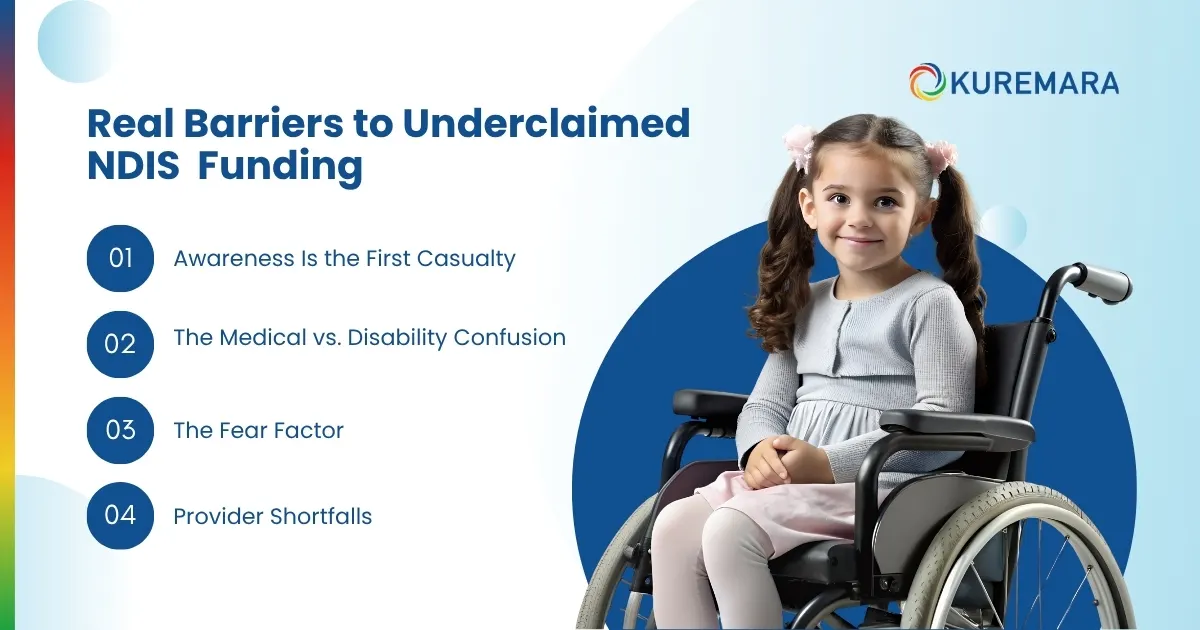
If high-intensity daily activity support exists, is funded, and is accessible, why do so many eligible Australians miss out? The answer involves a tangle of systemic, structural, and human factors.
1. Awareness Is the First Casualty
The NDIS is vast. With hundreds of support categories, thousands of line items, annual price guide updates, and a planning process that is often rushed or under-resourced, even experienced support coordinators can overlook high-intensity line items for participants who clearly need them. For families navigating the system without professional guidance, the gap in awareness is even wider.
Many participants and carers have never heard the term “high intensity daily personal activities,” even after years in the NDIS. They know they need complex care. They just don’t know there’s a specific funding category designed to pay for it at the appropriate rate.
2. The Medical vs. Disability Confusion
One of the most persistent barriers is the perception that complex clinical care is a “health issue” and therefore outside the NDIS’s scope. This misunderstanding is understandable; the line between health care and disability support is genuinely blurry in some areas, but it costs participants dearly.
The NDIS does not fund medical treatment. But it does fund the skilled support workers who help participants manage the consequences of their medical conditions in their daily lives. Administering tube feeds is a medical task when a nurse does it in a hospital. It is a funded NDIS support when a trained support worker does it at home, enabling a participant to live in the community rather than in a clinical setting.
3. The Fear Factor
The NDIS planning process can be intimidating. Participants who have already fought for their plans who have experienced plan reductions, confusing review processes, or disappointing outcomes are often reluctant to push harder. The idea of requesting additional complex funding, gathering more medical evidence, or challenging a planner’s decision feels like more than they have the energy to take on.
This is especially true for people living with highly complex conditions, who are often managing significant pain, fatigue, or psychological distress alongside their care needs. The very people who most need high-intensity support are often the least resourced to advocate for it.
4. Provider Shortfalls
Even when participants have the funding, finding a provider who can deliver high-intensity support competently is not always straightforward. In some regional and remote areas, qualified high-intensity providers are genuinely scarce. In metropolitan areas, variable quality means that not all providers who claim to offer high-intensity support have the training structures or clinical governance to back it up.
This provider gap leads to a predictable outcome: participants settle for standard personal care delivered by workers who are not adequately trained, exposing themselves to risk while their high-intensity funding goes unclaimed or is claimed at the wrong rate.
What It Actually Costs Participants
The financial cost of underclaiming is significant, but the human cost is arguably greater.
When high-intensity care is not properly funded, families step in. Mothers, partners, and siblings take on complex clinical tasks managing catheters, administering medications, performing bowel care without training, without respite, and without any formal acknowledgement of the burden they are carrying. Carer burnout in families managing complex disability is well-documented and deeply damaging. It is not an inevitable feature of disability; it is, in many cases, the direct result of inadequate funding.
Participants themselves face risks when care is delivered by inadequately trained workers: infections, aspiration, pressure injuries, medication errors, and a reduced quality of life that compounds over time.
High-intensity care support exists precisely to prevent these outcomes. When it goes unclaimed, those outcomes become someone’s daily reality.
How Kuremara Delivers High-Intensity Care Support
At Kuremara, we have built our service model around a straightforward belief: every participant with complex care needs deserves care that is as skilled as it is compassionate. High intensity daily activity support is not an add-on for us it is core to who we are and what we do.
Our Workforce
Our support workers who deliver high-intensity care undergo rigorous training that goes beyond the minimum NDIS requirements. This includes completion of the NDIS-recognised high-intensity daily activities training modules, as well as task-specific competency assessments supervised by our clinical team before any worker is cleared to deliver a specific high-intensity procedure.
We do not assign a support worker to a complex care shift simply because they are available. We assign them because they are trained, assessed, and confident in the specific tasks required for that participant.
Clinical Governance You Can Trust
Every high intensity participant at Kuremara has access to our nursing and allied health oversight team. This means:
-
-
- Initial clinical assessments to inform and verify your care plan
-
-
-
- Regular care plan reviews that respond to changes in your health and function
-
-
-
- A clear escalation pathway if any health concern arises during support delivery
-
-
-
- Documented competency records for every worker delivering your care
-
This clinical layer matters. It is the difference between a provider who delivers high intensity support in name and a provider who delivers it with the structure and accountability that complex care demands.
Support Coordination to Help You Claim What You’re Entitled To
Many participants come to us uncertain about whether their plan actually covers their high-intensity needs. Our specialist support coordination team regularly works with participants to identify underclaimed funding, support plan review requests, and connect participants with the allied health professionals needed to build a strong evidence base.
If you have never had your plan reviewed with high-intensity support in mind, that conversation is worth having. It may change your experience of care significantly.
Transparent, Fair Pricing
Kuremara’s pricing for high-intensity daily activity supports is fully aligned with the NDIS Pricing Arrangements and Price Limits. We do not charge above the price guide. We do not apply hidden fees. Every line item we claim on your behalf is clearly documented in your service agreement and accessible through your plan management records.
Transparency is not just a policy for us it is how we believe participants should be treated.
Conclusion: Your Care Is Complex, Your Funding Should Match
High-intensity care support exists in the NDIS because the people who need it have some of the most demanding daily lives of anyone in Australia. Their mornings are not simple. Their bodies require skilled, consistent, carefully trained hands. Their families carry enormous weight, and they deserve relief that is funded, appropriate, and lasting.
The funding is there. The framework is there. What has been missing for too many people, for too long, is the awareness and the advocacy to bring those two things together.
If you or someone you love has complex daily care needs and your current NDIS plan does not seem to reflect that reality, please do not accept it as the final word. Request a review. Gather your evidence. Find a provider who knows the system and knows the standard of care you deserve.
At Kuremara, we are committed to making sure no eligible participant misses out on the high-intensity care support they are entitled to. We work with participants across Australia to assess, plan, and deliver complex supports with the skill and transparency that this kind of care demands.
The most important step is simply the first one: asking whether your current plan truly reflects your needs.
Ready to explore whether you or your loved one is eligible for high intensity care support under the NDIS? Contact the Kuremara team today for a free, no-obligation conversation about your care needs and how your plan can work harder for you.