care@kuremara.com.au
 1300 000 799
Finding a Supported Independent Living (SIL) home in Melbourne is rarely a single decision. It’s a sequence of smaller ones about needs, location, housemates, support hours, funding, and trust strung together over weeks or months. Done in the right order; the process feels manageable. Done out of order, it can feel like running uphill in the rain.
This checklist walks through the ten steps Melbourne families typically need to work through, in roughly the order they need to work through them. Use it as a working document. Tick things off, add notes, share it with your support coordinator and your family. By the end, you should have a clear picture of what a “right home” looks like for your loved one, and how to actually find it.
Before you start: a quick reminder of what SIL is
Supported Independent Living Melbourne is NDIS funding for the support workers who help a participant live as independently as possible at home. It’s designed for people with higher support needs, often requiring help across the day and overnight.
Two things worth holding onto as you start:
- SIL pays for support, not housing. Rent, utilities and groceries are paid separately by the participant, usually from their income and Disability Support Pension.
- SIL isn’t the only home and living option. Individualised Living Options (ILO) Melbourne, in-home support, and Short-Term Accommodation (STA) Melbourne can be better fits for some people, and a good provider will tell you so.
Now, the ten steps.
Phase 1: Get clear on what you actually need
Step 1: Map the real support needs, not the plan’s wording
NDIS plans summarise needs. They don’t always capture them. Before you look at a single home, sit down with your loved one and the people who know their day-to-day life best, and map out:
-
-
- Personal care: showering, dressing, toileting, oral care
-
-
-
- Medication: timing, route, who currently manages it
-
-
-
- Mealtimes: cooking, eating, swallowing, allergies, cultural foods
-
-
-
- Mobility: transfers, equipment, fall risk
-
-
-
- Communication: speech, AAC, preferred methods
-
-
-
- Behaviours of concern, triggers, and what helps
-
-
-
- Health conditions: epilepsy, diabetes, mental health, complex care needs
-
-
-
- Sleep patterns and overnight needs (active vs sleepover support)
-
-
-
- Social, cultural, religious and family routines that matter
-
The more detailed this picture, the easier every later step becomes. It’s also the document your support coordinator and SIL provider Melbourne will lean on when designing a roster of care.
✅ Output of this step: A one- or two-page support profile, in plain language, that you’d be comfortable handing to a new support worker on their first shift.
Step 2: Define lifestyle and location preferences
Before you start looking at houses, decide what kind of life your loved one wants, and where in Melbourne that life happens.
Think through:
-
-
- Suburb and proximity to family. Do you want them close to a particular area Brunswick, Footscray, Box Hill, Dandenong, Sunshine, Reservoir, Cranbourne, the Mornington Peninsula? Proximity to siblings or parents matters more than most families realise once the move actually happens.
-
-
-
- Transport. Melbourne’s tram, train and bus network is dense in the inner suburbs and thinner further out. If your loved one will travel to day programs, work, therapy or family by public transport, this shapes which suburbs are realistic.
-
-
-
- Health services. Closeness to specialist clinics or hospitals (Royal Melbourne, Alfred, Austin, Monash Medical Centre, Royal Children’s, Sunshine) can matter enormously for participants with complex health needs.
-
-
-
- Community life. Faith communities, cultural groups, sporting clubs, day programs and friends. Melbourne is one of the most diverse cities in the world; the right suburb often comes down to community as much as to bricks and mortar.
-
-
-
- Type of living arrangement. Shared home with one, two or three housemates? Solo SIL? Mixed-gender or single-gender? Pets allowed?
-
✅ Output of this step: A shortlist of 2–4 suburbs or regions in Melbourne that genuinely fit your loved one’s life, not just availability.
Phase 2: Get the NDIS plan in order
Step 3: Confirm SIL is in the plan or start the process to request it
SIL isn’t a support you can just buy. It has to be specifically funded in the participant’s NDIS plan. If it isn’t yet, you’ll need to work with your NDIS planner or Local Area Coordinator (LAC) to request a plan change, supported by:
-
-
- Reports from treating clinicians (GP, specialists, OT, physio, speech, psychologist)
-
-
-
- A current functional assessment, usually completed by an OT
-
-
-
- A clear case for why daily, often 24/7, support is required at home
-
-
-
- Evidence of why other supports (in-home support, ILO) aren’t sufficient
-
This step takes time, often weeks to months. The earlier you start, the smoother every following step is.
✅ Output of this step: An NDIS plan that either includes SIL funding or a clear plan-review request lodged with evidence attached.
Step 4: Get a Support Coordinator on board
A good Support Coordinator is the most useful person in this whole process. They:
-
-
- Help you interpret the plan and understand what the funding really allows
-
-
-
- Approach SIL providers Melbourne on your behalf and gather quotes
-
-
-
- Coordinate with OTs, behaviour support practitioners, and clinicians
-
-
-
- Help compare homes and providers objectively
-
-
-
- Step in if something goes wrong
-
If your loved one has Support Coordination funded in their plan, use it fully. If they don’t, ask your LAC whether it can be added, for SIL participants; it almost always should be.
✅ Output of this step: A named Support Coordinator who knows your loved one’s situation and is actively working on the search.
Phase 3: Search and shortlist
Step 5: Shortlist NDIS-registered providers
In Melbourne, you’ll find everything from tiny boutique SIL operators to large national providers. Don’t judge by size; judge by fit, transparency, and registration.
For each provider, check:
-
-
- NDIS registration status. From 1 July 2026, registration becomes mandatory for all SIL providers. Choosing a provider that is already registered means independent audits, worker screening checks and incident reporting systems are already in place not being built on the fly.
-
-
-
- Where they operate in Melbourne. Do they actually have homes or vacancies in your shortlisted suburbs?
-
-
-
- Their experience with similar support profiles. Complex care, behaviour support, mental health, sensory needs — ask specifically about people with similar needs to your loved one.
-
-
-
- Their approach to housemate matching, family communication and transitions.
-
-
-
- Online reviews, expo presence, and word of mouth from your community.
-
✅ Output of this step: A shortlist of 3–5 registered providers worth approaching.
Step 6: Check available vacancies
Once you have a shortlist, the search becomes very concrete. Each provider should be able to show you:
-
-
- Current vacancies in their Melbourne homes (location, photos, floor plan)
-
-
-
- Existing housemates’ general profile (without breaching their privacy)
-
-
-
- Support model in the home (ratios, overnight arrangements, on-site or on-call clinical support)
-
-
-
- Whether the property is SDA, mainstream rental, or community housing
-
-
-
- Estimated weekly cost of rent, utilities and groceries
-
You can browse current SIL vacancies in Melbourne on Kuremara’s site as a starting point.
✅ Output of this step: A list of 2–4 specific homes worth visiting.
Step 7: Visit homes and meet potential housemates
This is the step that can’t be done on a website. Visit each home ideally more than once, and at different times of day.
On the visit, look and ask about:
-
-
- The physical space: bedroom size, bathroom access, kitchen layout, outdoor space, accessibility
-
-
-
- Cleanliness, smells, noise levels, sensory environment
-
-
-
- How housemates and staff interact with each other and with you
-
-
-
- A typical morning, evening, and weekend in the home
-
-
-
- House rules around visitors, food, pets, alcohol, and sleep times
-
-
-
- Emergency procedures, especially for participants with seizures, falls or complex health needs
-
-
-
- Heating and cooling Melbourne winters are damp and cold, summers can hit 40°C, and homes vary wildly in how well they handle that
-
Where possible, arrange short trial stays. A single overnight or weekend tells you more than any amount of paperwork.
✅ Output of this step: A clear front-runner home, and ideally a credible backup option.
Phase 4: Decide, sign, and settle in
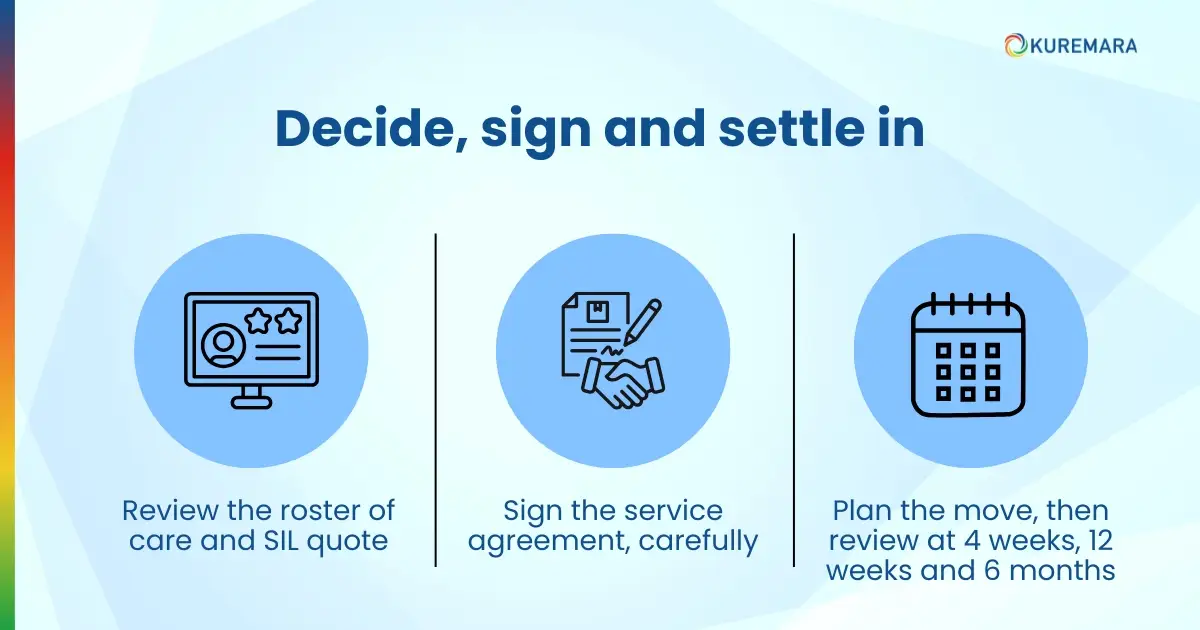
Step 8: Review the roster of care and SIL quote
Once a home is on the table, the provider will prepare a roster of care, a document mapping a typical week of support, and a SIL quote based on it. Go through this with your support coordinator. You’re looking for:
-
-
- Support hours that genuinely match the profile you built in Step 1
-
-
-
- A clear split between 1:1, shared (e.g. 1:2 or 1:3) and overnight support
-
-
-
- Sensible allowance for community access, appointments, and family time
-
-
-
- Time built in for the realities of Melbourne distances, getting from Werribee to a Parkville appointment is not a 15-minute job
-
-
-
- No surprise costs sitting in fine print
-
If something doesn’t add up, ask. A good provider welcomes the questions.
✅ Output of this step: A roster of care and quote you understand line by line, and that your support coordinator is comfortable submitting to the NDIA.
Step 9: Sign the service agreement carefully
The service agreement is the legal document that governs the relationship between your loved one and the provider. Before signing, check:
-
-
- Notice periods for ending the agreement (both sides)
-
-
-
- How fees are charged, paused (e.g., during hospital stays), and reviewed
-
-
-
- What happens if support needs increase or decrease
-
-
-
- Complaints and feedback pathways
-
-
-
- Whether the agreement reflects everything that was discussed verbally
-
If anything is unclear, ask for it in plain language. If a provider pushes back on small changes, that tells you something.
✅ Output of this step: A signed, understood service agreement kept somewhere accessible.
Step 10: Plan the move, then review at 4 weeks, 12 weeks, and 6 months
Moving day matters more than people expect. Plan:
-
-
- The order of moving belongings (familiar items first, especially for participants with autism, anxiety or sensory needs)
-
-
-
- Introductions to housemates and staff in low-pressure settings
-
-
-
- Continuity of medications, equipment, and clinical appointments
-
-
-
- Family visit rhythm for the first few weeks
-
Then, build in honest reviews at 4 weeks, 12 weeks, and 6 months. These aren’t paperwork exercises. They’re the moments to check:
-
-
- Is the support actually being delivered as the roster says?
-
-
-
- Is the home settling? Are housemate dynamics working?
-
-
-
- Are family communication channels working?
-
-
-
- Do anything in the plan, the home, or the support team need to change?
-
A good provider will lead these reviews. A great one will lead them honestly, even when the news isn’t perfect.
✅ Output of this step: A loved one who is genuinely living their life, not just being supported in a building.
A few Melbourne-specific considerations worth flagging
Some local realities that don’t always make it into national checklists:
- Climate and home comfort. Melbourne weather changes fast. Ask about heating in winter (many older Melbourne homes are poorly insulated), cooling in summer, and how staff manage on extreme heat days when day programs cancel.
- Public transport vs. drive-only suburbs. Some outer Melbourne suburbs have excellent SIL homes but poor public transport access. If your loved one wants to travel independently, factor this in early.
- Cultural and faith communities. Melbourne’s diversity; Greek, Italian, Vietnamese, Sudanese, Indian, Chinese, Lebanese, Pacific Islander and many more communities, means matching a participant with workers, housemates and a neighbourhood that fits their background can be genuinely possible. Ask providers how they do this in practice.
- Health system links. Strong working relationships with local clinicians and hospitals matter, especially for complex care Melbourne and community nursing Melbourne needs. Ask who the provider has worked with, not just who they can call.
- Distance from family. Melbourne’s metro area sprawls more than 100 km end to end. A home that’s “in Melbourne” can still be a 90-minute drive away. Use a map honestly.
How Kuremara approaches SIL in Melbourne
Kuremara is a registered NDIS provider with a Melbourne team based at Level 2, 1 Southbank Blvd, Southbank. Across the Greater Melbourne area, our SIL service is built around the kind of step-by-step process this checklist describes, because in our experience, it’s the families that work through it carefully who end up in homes that genuinely fit.
That means:
- Honest conversations about whether SIL is the right next step.
- Person-centred matching, with trial stays and clear processes if a home isn’t working.
- Rosters of care designed around the participant’s real week community, faith, family, culture and all.
- Trained, screened support workers and a consistent core team around each home.
- Open communication with families, and reviews that genuinely change things when they need to.
If you’d like to walk through this checklist with our Melbourne team, see current vacancies or talk about whether SIL is the right move for your loved one, get in touch.
You can also read our companion guide for Sydney families: Choosing Supported Independent Living: 8 Key Questions for Sydney Families.