care@kuremara.com.au
 1300 000 799
Moving a son, daughter, brother, sister or partner into a Supported Independent Living (SIL) home is one of the biggest decisions a family will ever make. It’s not just about finding a place to live. It’s about handing over the rhythm of someone’s daily life; their meals, their medications, their morning routines, their friendships to a team you have to trust.
In a city like Sydney, where SIL options stretch from the Inner West to the Hills District, from Parramatta to the Sutherland Shire, families can feel overwhelmed by the number of providers, brochures and tours. The names start to blur. Every website talks about “choice” and “independence.” So how do you actually tell a good provider from a great one?
The answer is in the questions you ask. Below are eight questions that cut through the marketing and get to the things that genuinely matter for your loved one’s quality of life.
A quick refresher: what SIL actually is
Before we get into the questions, it helps to be clear on what you’re choosing.
Supported Independent Living Sydney is a category of NDIS funding that pays for the support workers who help a participant live as independently as possible at home. It’s typically for people with higher support needs who require help, often 24 hours a day with daily tasks such as personal care, cooking, medication, getting to appointments and connecting with the community.
A few things SIL is not:
- SIL is not rent. It funds the support, not the housing itself. Rent, utilities and groceries are paid separately by the participant, usually from their Disability Support Pension and any other income.
- SIL is not SDA. Specialist Disability Accommodation (SDA) is funding for the physical home for people with very high support needs. Some participants have both SIL and SDA; many only have SIL.
- SIL is not the only option. Individualised Living Options (ILO) Sydney, in-home support and Short-Term Accommodation (STA) can be better fits for some people.
With that out of the way, here are the eight questions every Sydney family should bring to a provider conversation.
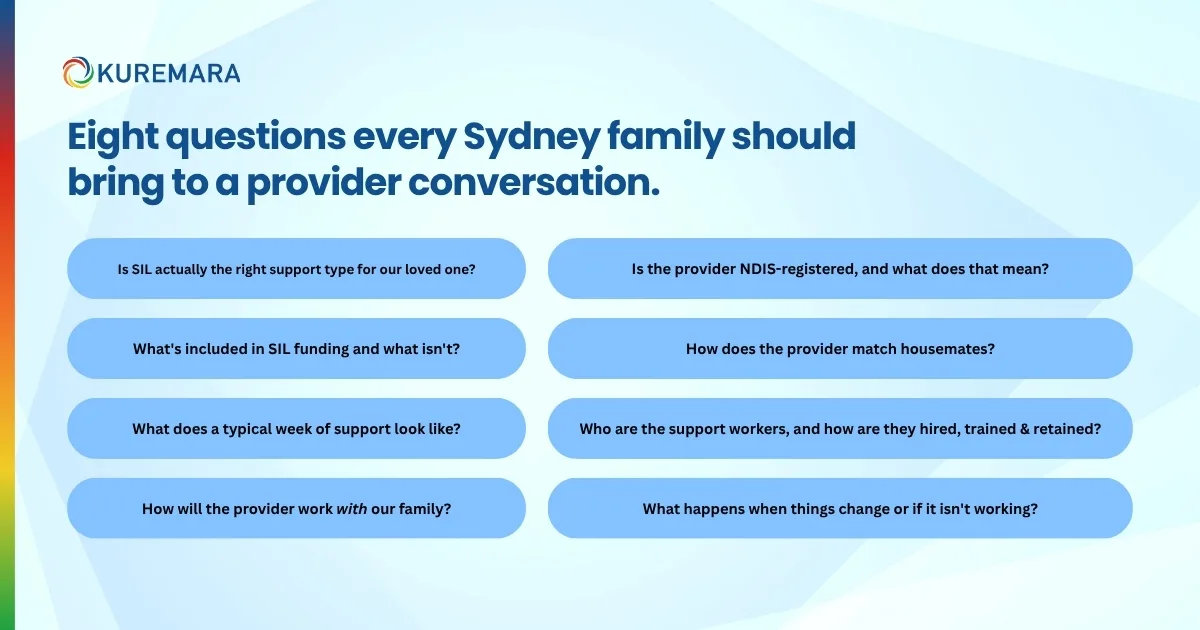
1. Is SIL actually the right support type for our loved one?
It sounds obvious, but it’s the question many families skip. SIL works best for people who need a consistent level of daily support and who are well-suited to a shared living environment (or to a solo arrangement with regular workers coming in).
If your loved one is largely independent but needs help a few hours a week, in-home support or ILO may be a better and more flexible match. If they need a short break, holiday or trial of independent living before a long-term decision, STA can be a useful stepping stone.
A good provider won’t push SIL on you. They’ll ask questions back. They’ll want to understand the person’s daily life, their goals, their relationships and the level of support they actually use day to day not just what’s written in the plan.
What to listen for: A provider that openly talks about alternatives, including the ones they don’t offer.
2. Is the provider NDIS-registered, and what does that mean?
Registration matters. NDIS-registered providers are audited against the NDIS Practice Standards, screened through the NDIS Worker Screening Check, and accountable to the NDIS Quality and Safeguards Commission for incident reporting and complaints.
This is especially important for SIL right now. From 1 July 2026, registration becomes mandatory for all SIL providers across Australia. Choosing a provider that is already registered means you won’t be scrambling to switch later, and that the systems for quality, safety and oversight are already embedded not bolted on at the last minute.
What to listen for: A clear, confident answer about their registration status, the standards they’re audited against, and how they handle complaints and incidents. As a registered NDIS provider, Kuremara has those systems in place today.
3. What’s included in SIL funding and what isn’t?
This is where many families get an unwelcome surprise months in. SIL pays for support workers. It does not pay for:
-
-
- Rent, utilities, internet or groceries
-
-
-
- A participant’s share of household consumables
-
-
-
- Activities or supports outside the home (those usually come from the Core or Capacity Building budgets)
-
-
-
- Specialist clinical supports such as physiotherapy or behaviour support
-
A good provider will walk you through a clear breakdown of what SIL covers in your specific situation, what your loved one will pay from their own income, and how those costs compare across different homes and locations in Sydney. They’ll also explain how the roster of care, the document that maps out a typical week of support, translates into the funding that gets quoted to the NDIA.
What to listen for: Plain-English explanations. If a provider can’t make the funding model clear, that’s a red flag, not a sign of how complex it is.
4. How does the provider match housemates?
For most SIL participants, the people they live with shape their experience more than any policy or plan. A thoughtfully matched home feels like a share house. A poorly matched home feels like a waiting room.
Sydney is one of the most culturally and linguistically diverse cities in the world, and that diversity should be reflected in how providers match people. Language, faith, food, gender, age, sleep patterns, sensory needs, communication styles, behaviours of concern, interests, pets, all of these matter.
Ask how the provider handles compatibility assessments before a move, what trial stays look like, and what happens if a match isn’t working three or six months in.
What to listen for: A real process, not a vibe. Look for trial visits, structured compatibility checks, and a track record of moving people when a home isn’t right for them.
5. What does a typical week of support look like?
Ask the provider to walk you through a sample roster of care ideally for a participant whose support profile is similar to your loved one’s. You’re looking for:
-
-
- The total support hours across a typical week
-
-
-
- Active overnight vs. sleepover support (and the difference in cost and supervision)
-
-
-
- Ratios: for example, 1:2 or 1:3 during the day, 1:4 overnight
-
-
-
- How shared and one-to-one supports are blended
-
-
-
- How appointments, community access and family visits are built in
-
In Sydney specifically, ask how the roster accounts for travel time. Getting to a specialist appointment in Westmead from the Hills, or to a community group in Bankstown from the Northern Beaches, can eat half a day. A good provider plans for that; a careless one doesn’t.
What to listen for: A roster that reflects the person’s actual life, not a generic template with the name changed at the top.
6. Who are the support workers, and how are they hired, trained, and retained?
Support workers are the SIL service. Everything else; the policies, the property, the brochures are scaffolding around what those workers do, every shift, in your loved one’s kitchen and bathroom.
Some questions worth asking:
-
-
- What screening and checks does every worker complete before starting?
-
-
-
- What training is mandatory manual handling, medication, mealtime support, epilepsy, choking, behaviour support, mental health first aid?
-
-
-
- What ongoing training is provided as a participant’s needs change?
-
-
-
- How does the provider try to keep a consistent core team around each participant, instead of a rotating cast of strangers?
-
-
-
- How does the provider match workers to the specific cultural, language or gender preferences of the household?
-
-
-
- What’s the staff turnover rate, and what’s being done about it?
-
What to listen for: Specific answers and named training programs, not “all our staff are highly qualified.”
7. How will the provider work with our family?
Once your loved one moves in, your role doesn’t end it changes. A strong provider treats families as partners, not as visitors.
Ask:
-
-
- How often will we get updates, and through what channels (phone, email, an app, a shared journal)?
-
-
-
- Who is our main point of contact, and who covers them when they’re on leave?
-
-
-
- How are we involved in goal-setting, plan reviews and health appointments?
-
-
-
- How will we be notified of incidents, hospital admissions or significant changes?
-
-
-
- What does the complaints and feedback process look like, and what happens if we raise something serious?
-
This is also the moment to ask about culturally responsive support. Many Sydney families come from communities where care decisions involve extended family, religious leaders or community elders. A provider that understands this and builds it into how they communicate will save you a lot of friction.
What to listen for: A clear communication rhythm and a genuine welcome of family input, including disagreement.
8. What happens when things change or if it’s not working?
People’s needs change. A participant’s epilepsy might become more complex. A housemate might move out. A parent’s health might shift. A new behaviour support plan might come in.
Ask the provider:
-
-
- How do you reassess support needs over time?
-
-
-
- If our loved one’s support needs increase, can you scale up or will we be looking for a new home?
-
-
-
- If a housemate leaves, who finds a replacement, and how long can the home sit at reduced occupancy?
-
-
-
- If we’re not happy, what’s the process for transitioning to another provider? Will you help us, or hold us back?
-
The willingness to talk openly about leaving is, paradoxically, one of the best signs that a provider is confident in the quality of their service.
What to listen for: A provider that treats your loved one’s home as theirs, not as a customer slot to be defended.
Next steps for Sydney families
-
-
- Visit homes: Arrange at least one in-person visit during different times of day if possible.
-
-
-
- Talk to others: Ask for references from current participants or families and speak with support coordinators who have referred clients.
-
-
-
- Document everything: Keep copies of support plans, policies, and any agreements.
-
-
-
- Involve the participant: Wherever possible, include the participant’s voice in meetings and decisions.
-
-
-
- Book an assessment: If you’d like an expert review of suitable SIL options, contact local registered NDIS providers for a consultation.
-
A few extras Sydney families should keep in mind
Beyond the eight questions, there are some Sydney-specific factors worth weighing:
- Location and transport. Proximity to major hospitals (Westmead, RPA, St Vincent’s, Liverpool), community centres and public transport can shape day-to-day life enormously. Our disability transport and community access services exist precisely because getting around Sydney is rarely simple.
- Climate and home design. Sydney summers are hot and humid; bushfire smoke days are increasingly common. Ask about air-conditioning, ventilation, sensory-friendly spaces and emergency planning.
- Health system coordination. A good SIL provider Sydney has working relationships with local LHDs, GPs and allied health professionals, not just contact numbers. Ask who they’ve already worked with.
- Cultural and language matching. With Greater Sydney’s diversity, this isn’t a “nice to have.” It’s a quality marker.
How Kuremara approaches SIL in Sydney
At Kuremara, our Sydney team operates from Level 14, 3 Parramatta Square, and we support participants across the metro area. Our SIL service is built around the questions above, but because every one of them came up the hard way, from real families navigating real decisions.
That means:
- Honest conversations about whether SIL is the right fit, before anyone signs anything.
- Person-centred matching, with trial stays and clear processes if a home isn’t working.
- Rosters of care designed around the participant’s actual week, including community, family and culture.
- Trained, screened support workers and a consistent core team around each home.
- Open, regular communication with families and a willingness to listen when something isn’t right.
If you’d like to talk through whether SIL is the right next step for your loved one, or see what’s currently available, you can browse our current SIL vacancies in Sydney or get in touch directly.
No pressure. No sales pitch. Just a conversation about what your family needs next.