care@kuremara.com.au
 1300 000 799
For many families, the question of whether complex disability care can be provided safely at home comes up during a major change, such as after a hospital stay, when a participant’s health needs increase, or when their existing disability support is no longer enough. A participant may need PEG feeding, seizure management, complex bowel care, catheter support, tracheostomy care or other specialised daily assistance. When these needs become more complex, families may naturally wonder whether remaining at home is still a safe and practical option.
With the right planning, trained staff and clinical oversight, complex disability care at home can often be delivered safely. However, safe home-based care does not happen simply because support workers are available. It requires an organised system built around the individual participant, including appropriate care plans, worker training, emergency procedures, clinical input and regular communication. Understanding these safeguards can help participants, families and support coordinators make more informed decisions about complex care.
What Does Complex Care Mean Under the NDIS?
Complex care is more than simply providing additional hours of everyday disability support. Some participants have disability-related health needs that require workers to perform specialised tasks where appropriate training, competency and clear procedures are particularly important. The NDIS Quality and Safeguards Commission identifies a number of these supports as high-intensity daily personal activities.
Depending on the participant’s individual needs, these supports may include complex bowel care, enteral feeding and management, tracheostomy management, ventilator management, urinary catheter management, subcutaneous injections, complex wound management and severe dysphagia management.
These types of high-intensity supports require a different approach from standard personal care. A participant may need support workers who understand their individual routines, equipment, health risks, warning signs and escalation procedures. The NDIS Commission explains that these supports do not necessarily have to be delivered by a nurse or allied health practitioner; appropriately trained and competent workers may deliver them where relevant requirements are met. This is why participant-specific training, planning and oversight are so important.
Can Complex Disability Care Be Safely Provided at Home?
For many participants, home-based complex care can be an appropriate option when the right safeguards are in place. Home provides something particularly valuable: familiarity. Participants can remain within their own routines, surroundings, and community rather than having their everyday life shaped around an unfamiliar environment. Family members and informal supports may also remain involved in ways that suit the participant’s preferences.
For some people, receiving appropriate support in familiar surroundings can improve comfort and reduce disruption to everyday life. However, the home itself does not make complex care safe. Safety comes from the support system surrounding the participant. A suitable home environment, properly trained workers, participant-specific care plans, reliable equipment, emergency procedures and appropriate clinical oversight all contribute to safer support.
The NDIS also provides different home and living support options, depending on a participant’s individual needs and circumstances. For participants and families on the Gold Coast, receiving the right support at home can therefore be an option worth exploring where the participant’s disability needs, health circumstances and living environment make it appropriate.
7 Essential Safeguards for Complex Care at Home
Safe complex care depends on multiple systems working together. Participants and families should look beyond the number of support hours being offered and consider how a provider manages clinical risk, worker competency, emergencies and changes in the participant’s needs.
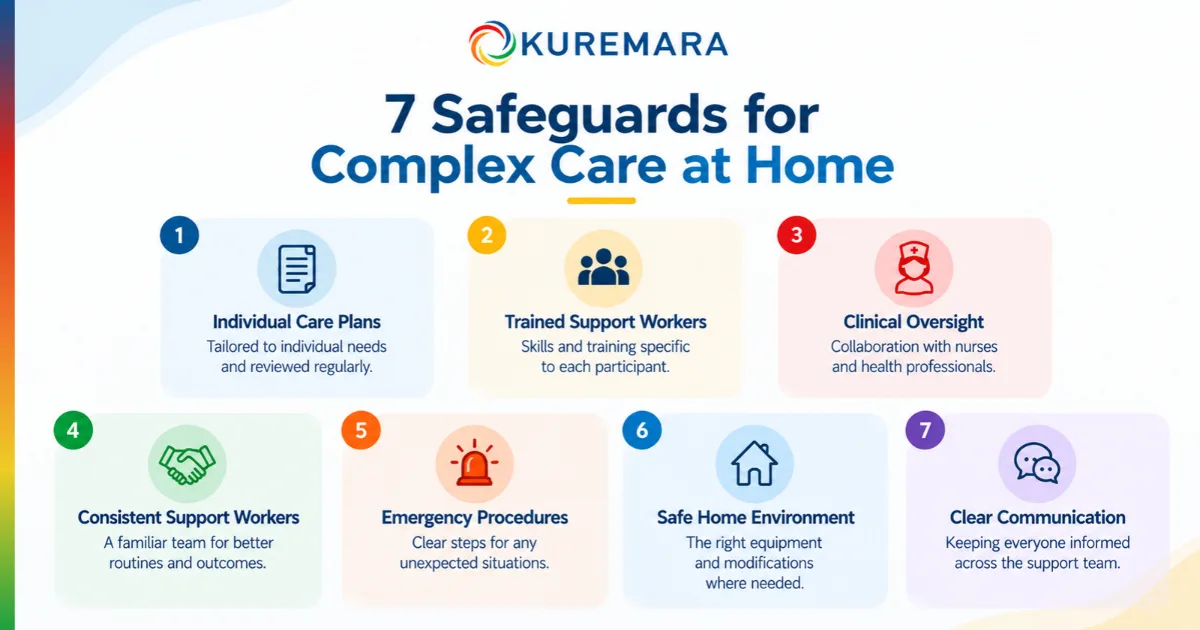
1. Participant-Specific Care Plans
Generic procedures are not enough when someone has complex health and disability support needs. Each relevant high intensity support should be guided by a plan tailored to the individual participant and developed with appropriate professional input. The plan should clearly explain the participant’s usual routine, how support should be provided, what workers should monitor, and what changes require escalation. Care plans should also be accessible to workers and reviewed when the participant’s needs change.
2. Workers Trained for the Individual Participant
General training is valuable, but complex support also requires workers to understand the specific needs of the person they are supporting. Two participants who both receive PEG feeding support, for example, may have very different routines, equipment and clinical instructions. The NDIS Commission’s High Intensity Support Skills Descriptors provide guidance about the skills and knowledge expected when delivering these supports. Workers should receive training relevant to the participant and the particular high intensity support they will provide, with competency assessed where required before providing specialised support independently.
3. Appropriate Clinical Oversight
Complex disability support often involves collaboration between disability support workers and health professionals. Depending on the participant’s circumstances, registered nurses or other appropriately qualified health practitioners may contribute to developing support plans, reviewing health-related procedures, providing training and reassessing care when needs change. Access to appropriate in-home nursing care may also form part of a participant’s support arrangement where it is suitable for their needs and included in their funding.
4. Consistent and Well-Matched Support Workers
Staff consistency is especially valuable when supporting people with complex needs. Workers who regularly support the same participant become familiar with their routines, communication preferences, equipment and typical presentation. This familiarity can help workers recognise when something appears different and follow the appropriate escalation process. Providers should therefore consider continuity when building complex care teams and maintain appropriately trained backup workers for unexpected absences.
5. Clear Emergency and Escalation Procedures
Workers need to know what to do when something changes. Emergency and escalation procedures should cover situations relevant to the participant’s individual risks and support plans. Depending on the person’s needs, this might include what to do if equipment stops functioning, a health concern develops or a worker notices a significant change from the participant’s usual presentation. Workers should know who to contact, what information needs to be provided and when additional clinical or emergency assistance is required.
6. Appropriate Equipment and Home Environment
Safe support also depends on the environment where care is being provided. A participant may require assistive technology, mobility equipment, pressure-care equipment or home modifications depending on their disability and support needs. Equipment should be available, appropriately maintained and used according to relevant instructions. Where appropriate, occupational therapists and other professionals may assess the environment and recommend changes. The NDIS also has specific processes for assessing home modifications where these supports meet the applicable funding criteria.
7. Communication Across the Support Team
Complex care rarely involves just one person or service. A participant may have support workers, nurses, GPs, specialists, allied health professionals, family members and support coordinators involved in different parts of their care. Clear communication between relevant people, with the participant’s consent, can reduce gaps and help ensure important changes are not missed. Structured handovers, accurate progress notes, incident reporting and agreed escalation processes can all contribute to better continuity.
When Might Home Not Be the Right Option Yet?
Home-based complex care may be appropriate for many people, but there can also be circumstances where additional planning or another setting is needed first. For example, a participant may still require hospital-level medical treatment, their condition may not yet be clinically stable, or their home may require modifications before appropriate support can be established.
Workforce availability is another important consideration. If a participant requires continuous support but an appropriately trained team cannot yet be established, rushing the transition home may create unnecessary risk. Informal supports should also be considered, as families should not be expected to fill significant gaps in complex care simply because formal arrangements are not yet ready.
In these circumstances, additional preparation or a staged transition may be required. Depending on the participant’s individual circumstances and NDIS plan, different home and living arrangements may need to be explored while longer-term support is established. Participants leaving hospital can also prepare for the transition using our NDIS hospital-to-home checklist, which covers some of the important considerations before discharge.
Understanding NDIS Funding for Complex Care at Home
There is no single funding arrangement that applies to every participant requiring complex care. NDIS funding is individualised, and the supports included in a participant’s plan depend on their disability-related needs and whether those supports meet the relevant reasonable and necessary criteria.
Depending on the participant’s plan and circumstances, disability-related complex care may involve relevant daily living supports alongside other funded supports. These may include disability-related nursing supports, assistive technology, home modifications or other supports where they meet NDIS requirements. It is also important to distinguish between disability-related supports that may be funded through the NDIS and medical treatment or services that are the responsibility of the broader health system.
Evidence can play an important role when requesting support. The NDIS advises participants requesting home and living supports to provide evidence about their disability-related support needs, how often support is required and the impact of their disability on everyday life. Relevant evidence may come from treating health professionals depending on the support being requested.
Participants, families and support coordinators can therefore work with relevant professionals to ensure the supporting evidence accurately reflects the person’s circumstances.
5 Questions to Ask a Complex Care Provider
Not every disability provider will have the same experience, workforce or systems for supporting participants with complex needs. Before choosing a provider, asking specific questions can help participants and families understand how the service will work in practice.
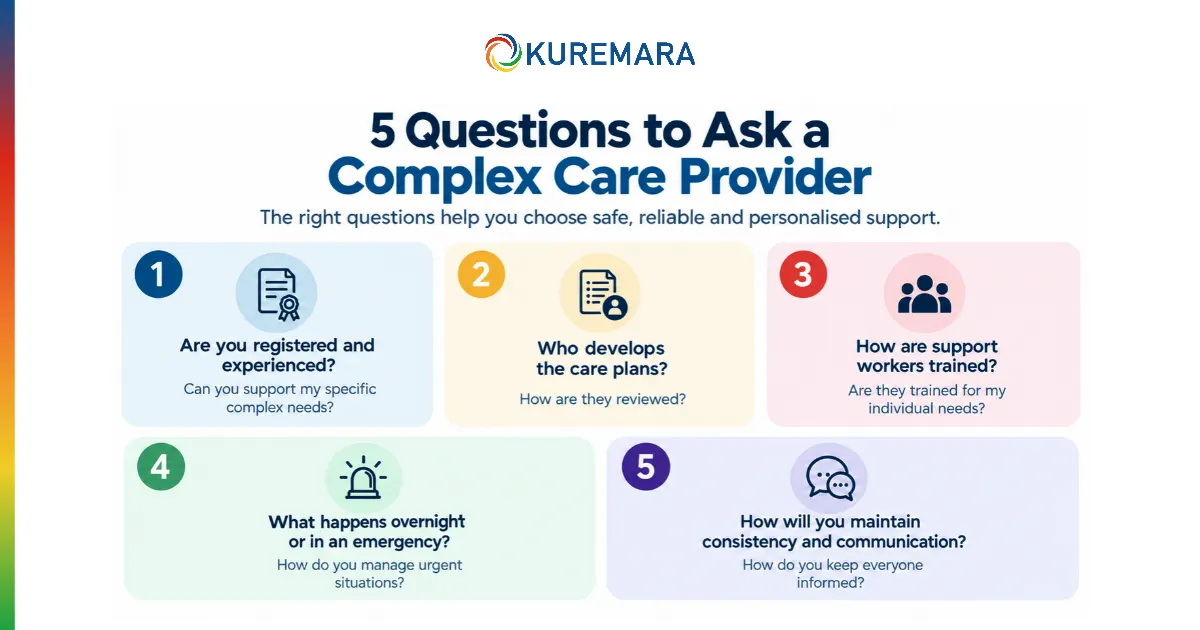
1. Are You Appropriately Registered and Experienced for My Support Needs?
Start by discussing the participant’s actual support requirements rather than simply asking whether the provider offers “complex care.” Ask about the provider’s registration, experience, and ability to support the particular high-intensity needs involved. For registered providers delivering high-intensity daily personal activities, the NDIS Commission requires the relevant registration and practice standards to be met.
2. Who Develops and Reviews the Care Plans?
Ask who is responsible for developing participant-specific health-related support plans and how relevant health professionals are involved. There should also be a process for reviewing plans when the participant’s circumstances change. A provider should be able to clearly explain how this process works and who is responsible for overseeing it.
3. How Are Support Workers Trained and Assessed?
Ask what training workers receive before supporting the participant independently. For high intensity supports, it is useful to understand whether training is participant-specific, who provides the training and how worker competency is assessed. The provider should also be able to explain what happens when a new worker joins the participant’s support team.
4. What Happens Overnight or During an Emergency?
Complex support needs do not disappear outside normal office hours. Ask how the provider manages overnight support, unexpected staff absences, urgent concerns and emergencies. Workers should have clear escalation procedures and understand who to contact when they require additional assistance.
5. How Will You Maintain Consistency and Communication?
Ask how the provider builds the participant’s regular support team and what happens when usual workers are unavailable. It is also worth discussing how progress notes, incidents, changes in health and other important information are communicated to the participant, family and relevant professionals, subject to the participant’s consent.
What Does Good Complex Care Look Like Day to Day?
Consider an illustrative example of a participant living at home after a brain injury. He receives nutrition through a PEG, has epilepsy with an individual seizure management plan and requires assistance with transfers. A structured support arrangement might involve an appropriately qualified health practitioner contributing to his relevant support plans and training workers in his individual requirements.
A small group of regular support workers could learn his routines and complete relevant competency requirements before working independently. At each shift, workers receive a clear handover, while relevant information is documented consistently so changes can be identified and escalated according to his support plans. His support team understands the relevant response procedures and knows where important emergency information is kept.
The aim, however, is not simply to complete health-related tasks. Good complex care should also support the participant’s everyday life, including maintaining routines, participating in the community, spending time with family and pursuing activities that matter to them. Complex care should be built around the person rather than expecting the person’s life to revolve around their care.
Complex Care Support with Kuremara
Kuremara is a registered NDIS provider supporting participants with a range of disability and complex support needs. We provide support in participants’ homes and supported living environments, with an approach centred around the individual’s needs, routines, goals and preferences.
For participants requiring high intensity support, our focus is on participant-specific planning, appropriately trained workers, consistent support and collaboration with relevant health professionals. We understand that changing needs can also mean changing support requirements. Whether a participant is preparing to leave hospital, experiencing an increase in support needs or considering changing providers, the first step is understanding what their everyday support actually requires.
For participants and families looking for complex care on the Gold Coast, our team can discuss current support arrangements, high intensity needs and the practical steps involved in establishing an appropriate care team.
Can Complex Care Really Work Safely at Home?
Complex disability care can often be delivered safely at home when appropriate systems are built around the participant. Safety depends on much more than having a support worker present. Participant-specific care plans, appropriately trained workers, clinical input, emergency procedures, suitable equipment, consistent staffing and clear communication all contribute to a stronger support arrangement.
Most importantly, complex care should remain person-centred. A participant’s health needs may be complex, but those needs are only one part of their life. The goal is to create support that manages disability-related needs appropriately while helping the participant maintain their routines, relationships, independence and connection with their community.
If your needs have become more complex, or your current support arrangement is no longer keeping up, talk to Kuremara about complex care options on the Gold Coast and support that can adapt with you.