care@kuremara.com.au
 1300 000 799
Common signs that a living arrangement no longer works include support that no longer matches your needs, ongoing isolation, constant tension with housemates or support workers, stalled independence, a home that feels unsafe or inaccessible, and goals that have outgrown your environment. If several of these feel familiar, it may be time to explore a Supported Independent Living (SIL) or Individualised Living Options (ILO) arrangement that fits you better.
Home should feel steady. It should be the place where you can exhale at the end of the day, where the support around you matches the life you actually want to live. But living arrangements aren’t fixed forever, and what suited you a few years ago may quietly stop fitting the person you are today.
For many NDIS participants, recognising that a home has stopped working is harder than it sounds. Change can feel daunting, and it’s easy to talk yourself into “making do.” Yet the right living arrangement, whether that’s SIL or ILO, can be the difference between simply getting through the day and genuinely thriving. In our years supporting participants across Australia, the Kuremara team has seen how much changes when someone moves from a home they tolerate to one that truly fits.
Below are the signs worth paying attention to, along with what your options might look like next.
What does it mean when a living arrangement “isn’t working”?
A living arrangement isn’t working when it stops supporting your health, safety, independence, relationships, or goals, even if it once suited you well. This can happen gradually as your needs evolve, or after a specific change such as a shift in health, a new goal, or a change in the people you live with. Noticing it early gives you more time and more choice about what comes next.
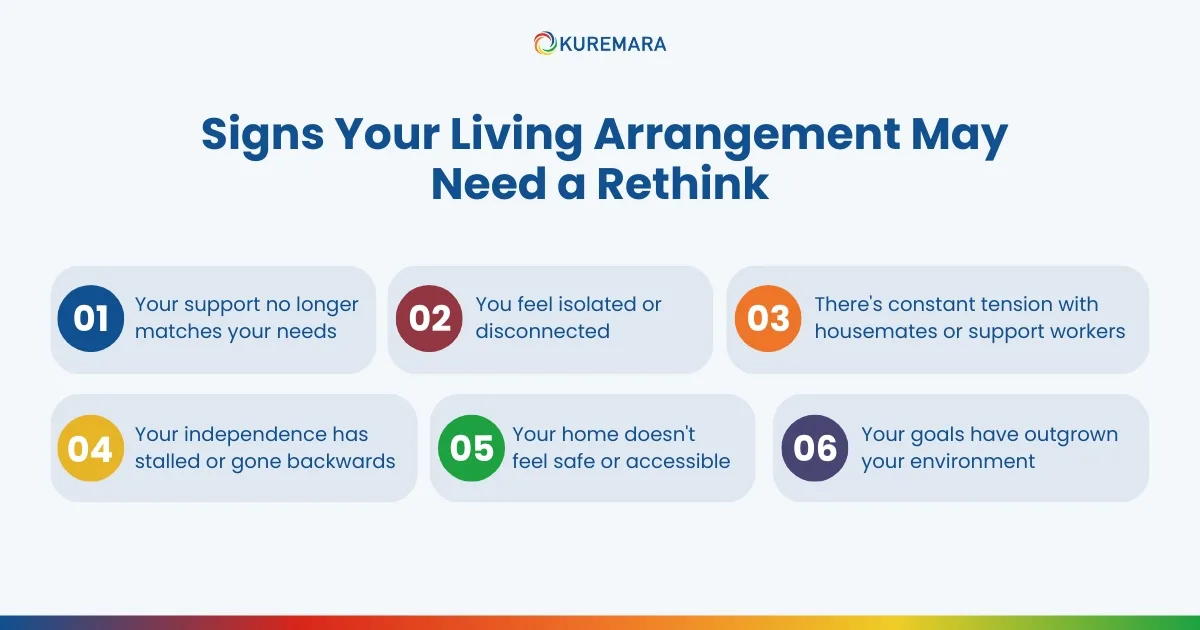
1. Your support no longer matches your needs
Needs change over time. Your health may have shifted so that you now need more hands-on assistance. Or the opposite may be true, and you’ve built new skills that make your current level of support feel heavy, even limiting.
When support and needs drift out of alignment, daily life starts to feel like a struggle in one direction or the other. Too little support can leave you unsafe or overwhelmed. Too much can chip away at confidence and independence. A living arrangement that once fit well should keep growing alongside you.
2. You feel isolated or disconnected
A house can tick every practical box and still feel lonely. If you find yourself withdrawing, spending long stretches without meaningful connection, or feeling like you don’t quite belong where you live, that’s worth taking seriously.
For some people, an ILO arrangement built around chosen housemates or a host arrangement brings the companionship they’ve been missing. For others, a well-matched SIL home offers a shared rhythm and the reassurance of people nearby. The goal is the same: a home where you feel part of something, rather than on the outside of it.
3. There’s constant tension with housemates or support workers
Occasional friction is normal in any shared space. Ongoing tension is a different story. If you dread coming home, feel unheard, or clash regularly with the people you live alongside or the workers who support you, the environment may be the issue, not you.
Compatibility matters enormously. The people around you shape your mood, your safety, and your sense of ease. When those relationships consistently drain rather than sustain you, it’s a strong sign the arrangement needs a rethink.
4. Your independence has stalled or gone backwards
One of the clearest signals is your own growth. Ask yourself honestly: am I building skills and confidence, or am I stuck? A good living arrangement should open doors, encouraging you to cook, manage routines, make choices, and take on more of your own life over time.
If your independence feels like it’s shrinking, or you’re being “helped” with things you’d rather do yourself, the setup may be working against you. This is often where a shift between SIL and ILO, or a change in provider, can reopen the path forward.
5. Your home doesn’t feel safe or accessible
Safety is non-negotiable. That includes physical accessibility, such as ramps, bathroom modifications, and layouts that work for your mobility. It also includes emotional safety. You should feel secure, respected, and comfortable being yourself at home.
If the space no longer suits how you move through it, if you’re navigating hazards daily, or if you simply don’t feel at ease within your own four walls, these are signals that shouldn’t be ignored.
6. Your goals have outgrown your environment
People change, and so do their plans. You might want to live closer to family, work, study, or community activities. You might be ready for more privacy, or ready to share life with others after a stretch on your own. Perhaps the location that once worked no longer connects you to the things you care about.
When a living arrangement holds you back from the life you’re reaching toward, that friction tends to show up everywhere. Your home should support your goals, not quietly compete with them.
SIL vs ILO: which might suit you better?
Both SIL and ILO are funded supports under the NDIS, but they work differently:
- Supported Independent Living (SIL) provides structured, often shared support with assistance available throughout the day and, where needed, overnight. It can suit people who want regular, reliable help close at hand, frequently in a shared home.
- Individualised Living Options (ILO) is a more flexible, tailored approach shaped around your choices, relationships, and the exact life you want to build. It can involve living alone, with chosen housemates, or with a host, and focuses on designing supports around you.
The right choice depends on your needs, your goals, and how you want your daily life to feel. There’s no single correct answer, and it’s worth talking your options through with people who understand both models.
What to do if your living arrangement isn’t working
Noticing these signs isn’t a failure. It’s self-awareness, and it’s the first step toward something better. A few practical next steps:
- Write down what’s not working. Being specific helps you and your support network see the pattern clearly.
- Revisit your NDIS goals. Consider whether your current home still supports the life you’re working toward.
- Explore SIL and ILO options. Learn how each model could match your needs.
- Talk to a registered NDIS provider or your support coordinator. They can help you understand your funding and the practical steps involved.
- Take your time. A good move is worth planning carefully, at a pace that feels right for you.
The most important thing to remember is that you have the right to a home that fits, not one you simply tolerate.
How Kuremara can help
Kuremara is a registered NDIS provider that works alongside participants across Australia to find living arrangements that genuinely suit them, not just on paper, but in everyday life. Whether you’re exploring SIL, considering an ILO arrangement, or unsure which direction is right, our team can help you weigh your options, understand your funding, and take the next step at a pace that feels comfortable.
If your current living situation isn’t working anymore, let’s talk about what could work better. Contact Kuremara today to start a conversation about a home that truly supports you.
Frequently asked questions
1. How do I know if I should move to SIL or ILO?
Start with what isn’t working now. If you need reliable, day-to-day support and are open to a shared home, SIL may suit you. If you want a more tailored setup built around your relationships and choices, ILO may be a better fit. A support coordinator or registered provider can help you compare both against your goals and funding.
2. Can I change my living arrangement while on an NDIS plan?
Yes. The NDIS is designed to be flexible, and your supports can change as your needs and goals change. You may need updated evidence and a conversation with your planner or support coordinator, but changing where and how you live is a normal part of the process.
3. Is it normal to feel unsure about leaving my current home?
Completely. Uncertainty is a natural part of any big change. Taking small steps, gathering information, and talking things through with people you trust can make the decision feel far more manageable.
4. Who can help me explore my options?
Your support coordinator, your local area coordinator, and registered NDIS providers can all help. A provider experienced in both SIL and ILO can walk you through what each would look like in practice.
This article is general information only and does not replace personalised advice. For guidance specific to your situation, speak with your support coordinator or a registered NDIS provider.