care@kuremara.com.au
 1300 000 799
“NDIS complex care is not about being ‘too hard’ — it’s about receiving support that is genuinely matched to the reality of your life. For thousands of Australians, that distinction changes everything.”
What Does “Complex Care” Actually Mean Under the NDIS?
The term NDIS complex care is often used loosely, but within the framework of the National Disability Insurance Scheme, it has a specific and meaningful definition. It refers to support needs that go beyond routine disability assistance, situations where a participant’s health, medical, behavioural, or psychosocial circumstances require a coordinated, skilled, and clinically informed response.
Unlike standard support work, complex care typically involves registered nurses, allied health professionals, and highly trained disability support workers operating within carefully designed care frameworks. It is not simply “more hours” of support, it is a fundamentally different kind of support.
The NDIS recognises complex care under several categories, including high-intensity daily activities and specialist disability accommodation, and it funds these supports when a participant’s plan reflects a genuine need for them. Understanding where standard support ends and complex care begins is the first step toward accessing what you or your loved one truly needs.
NOTE: Standard NDIS supports help people participate in daily life. Complex NDIS care supports people whose medical, behavioural, or psychosocial needs mean that standard supports alone cannot safely or adequately meet their requirements.
Six Signs You May Need Complex Care NDIS Supports
It can be difficult to know when the level of care a person is receiving has fallen short of what they genuinely need. Families and participants sometimes adapt to inadequate support without realising there is something better available. Here are clear indicators that complex care NDIS funding may be appropriate:
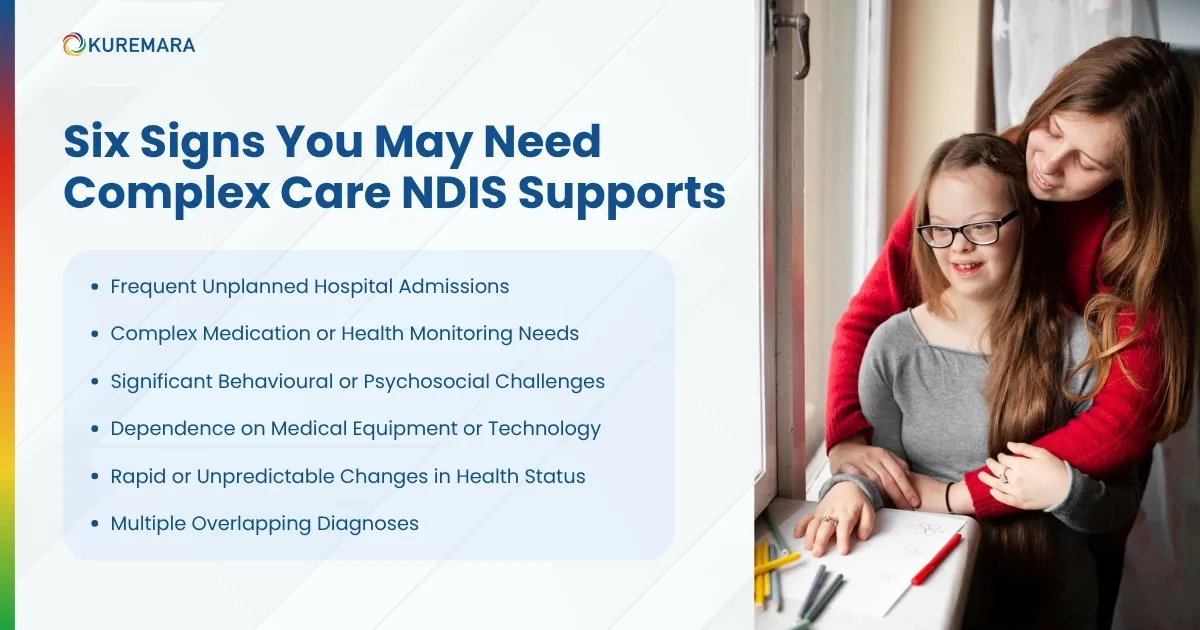
- Frequent Unplanned Hospital Admissions – If a participant is regularly presenting to emergency departments or being hospitalised for issues that could potentially be managed in the community with the right clinical support, this is a strong signal that current care arrangements are insufficient.
- Complex Medication or Health Monitoring Needs – When daily life involves complex medication regimes, wound care, catheter management, PEG feeding, or monitoring of chronic health conditions, these tasks require trained clinicians, not standard support workers operating beyond their scope.
- Significant Behavioural or Psychosocial Challenges – Behaviours of concern that put the participant or others at risk, or complex mental health needs layered with physical disability, often require specialist behavioural support practitioners and careful, trauma-informed care planning.
- Dependence on Medical Equipment or Technology – Participants who rely on ventilators, suction machines, feeding pumps, or other complex assistive technologies need support workers and nurses specifically trained and competency-assessed to operate this equipment safely.
- Rapid or Unpredictable Changes in Health Status – Some disabilities and conditions cause sudden, significant fluctuations in a person’s health. When a participant’s day-to-day status can change quickly, the care environment must be able to respond clinically not simply call an ambulance every time.
- Multiple Overlapping Diagnoses – A participant living with a physical disability alongside acquired brain injury, epilepsy, and mental health challenges is an example where overlapping needs create a complexity that standard support coordination cannot adequately address alone.
Understanding NDIS Complex Nursing Care
One of the most critical and often misunderstood components of complex NDIS support is NDIS complex nursing care. This refers to clinical nursing services delivered within a participant’s daily support environment, whether that is their family home, supported independent living accommodation, or another community setting.
Complex nursing care goes well beyond what a general support worker can provide. It encompasses:
- Tracheostomy care and management
- Enteral and parenteral feeding support
- Complex wound and pressure injury care
- Urinary and bowel management programs
- Subcutaneous and intravenous medication administration
- Ventilator and respiratory support management
- Diabetes and insulin management
- Seizure management protocols
- Clinical risk assessment and documentation
- Liaison with treating medical teams
In Australia, NDIS complex nursing care must be delivered by registered or enrolled nurses who hold current AHPRA registration and the competencies required for each specific clinical procedure. At Kuremara, our nursing team works within a clinical governance framework that ensures every participant receives care that is safe, evidence-based, and properly documented.
“Receiving clinical-grade nursing support at home rather than in a hospital ward can make an extraordinary difference to a person’s quality of life, independence, and sense of dignity.”
How Complex Care Sits Within Your NDIS Plan
Many participants and families are surprised to learn that complex care supports are fully fundable under the NDIS, but they do require the right evidence and planning to be included. Understanding how the funding framework works is essential for ensuring your plan actually reflects your needs.
1. High-Intensity Daily Activities
The NDIS funds complex care primarily through the High-Intensity Daily Activities support category under Core Supports. This covers complex support worker activities that require specific competency, such as complex bowel care, dysphagia management, and complex medication administration, as well as nursing supports delivered by registered or enrolled nurses.
2. Capacity Building: Support Coordination
Participants with complex needs are often eligible for Specialist Support Coordination funded under Capacity Building. A specialist support coordinator works to design, implement, and monitor complex care arrangements, ensuring that multiple providers, clinicians, and services are integrated around the participant’s goals, not operating in silos.
3. Supported Independent Living (SIL) with Complex Needs
For participants living in supported accommodation settings, complex care can be incorporated into a Supported Independent Living arrangement, allowing 24-hour, on-site access to skilled staff and nursing professionals who understand both the person’s disability and their clinical requirements.
Kuremara’s approach: Our team works directly with participants, their families, support coordinators, and NDIA planners to ensure complex care needs are clearly documented, clinically justified, and appropriately funded. We help participants avoid the frustrating cycle of under-funded plans that leave real needs unmet.
The Real-World Impact of Getting Complex Care Right
When NDIS complex care is properly designed and delivered, the outcomes for participants can be transformative. This is not abstract, the difference between adequate and excellent complex care plays out in very concrete ways in everyday life.
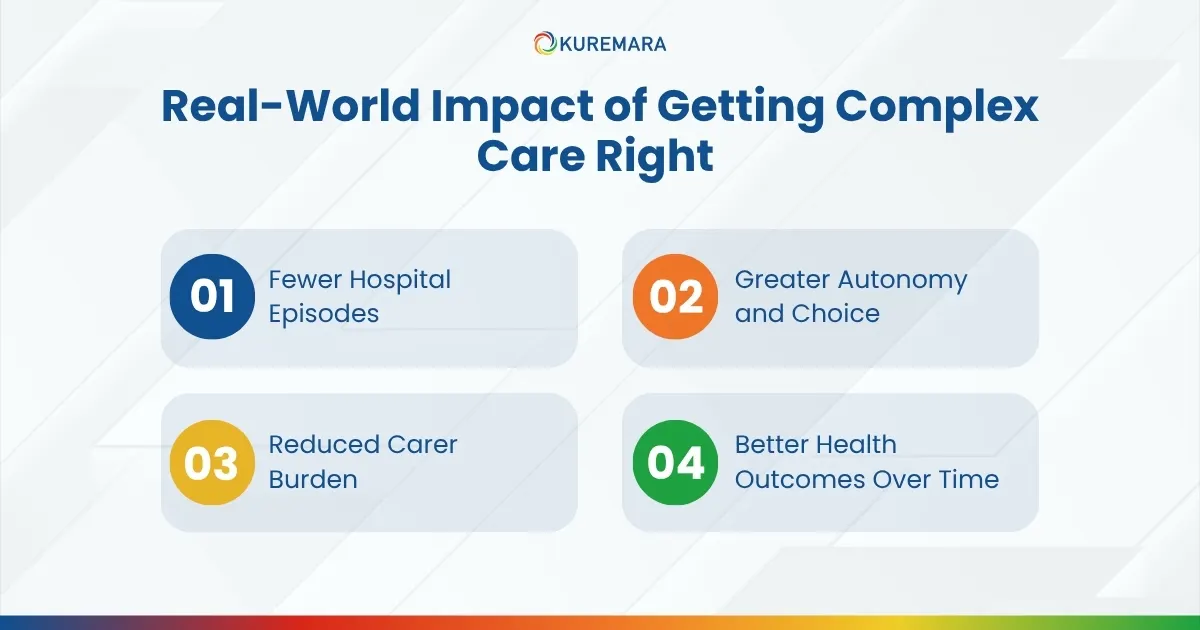
1. Fewer Hospital Episodes
Participants with well-managed complex nursing care at home experience measurably fewer emergency hospital presentations. Clinical issues are identified and managed early, within the home environment, rather than escalating to crisis points that require acute care intervention.
2. Greater Autonomy and Choice
Being able to live in a community setting rather than a residential aged care facility or long-stay hospital ward is a right that the NDIS was designed to protect. Robust complex care arrangements make it possible for more Australians with high-level needs to exercise genuine choice about where and how they live.
3. Reduced Carer Burden
Families and informal carers supporting a person with complex needs often carry an enormous load. When professional complex care supports are in place, family members can step back from clinical and personal care tasks, maintaining their relationship with their loved one rather than becoming full-time carers at the cost of their own well-being.
4. Better Health Outcomes Over Time
Continuity of care provided by familiar, skilled clinicians who understand a participant’s specific needs, preferences, and history produces better clinical outcomes than fragmented, reactive care. Complex care under the NDIS, when delivered by a committed and consistent team, becomes a genuine platform for improved long-term health.
What to Look for in a Complex Care NDIS Provider
Not all NDIS providers are equipped to deliver genuine complex care. The stakes are high clinical errors in complex care environments can have serious consequences. When selecting a provider for yourself or a family member, consider the following criteria carefully:
1. NDIS Registration in High-Intensity Supports
Confirm the provider holds a current NDIS registration specifically for high-intensity daily activities and complex nursing care. This registration requires providers to meet rigorous standards set by the NDIS Quality and Safeguards Commission.
2. Qualified, AHPRA-Registered Clinical Staff
All nursing staff involved in complex care should hold current AHPRA registration and be able to demonstrate the specific competencies required for your care needs. Ask providers how they assess and maintain clinical competency.
3. Robust Clinical Governance Frameworks
The provider should have clear policies, incident reporting processes, risk management systems, and clinical supervision structures in place. Complex care cannot be delivered safely in the absence of strong clinical governance.
4. Person-Centred, Goal-Oriented Planning
Good complex care is built around the participant’s goals and preferences, not just their clinical diagnoses. Providers should involve participants and families meaningfully in care planning and review, and regularly assess whether care arrangements are helping the person move toward their goals.
5. Clear Communication and Coordination
Complex care invariably involves multiple services, clinicians, and stakeholders. The provider should demonstrate a clear approach to coordinating with GPs, specialists, allied health professionals, and family members, ensuring everyone is working from the same care framework.
How Kuremara Delivers Complex Care Across Australia
At Kuremara, we are a registered NDIS provider with extensive experience delivering complex care NDIS supports to participants with high and complex needs across Australia. Our services are built on a foundation of clinical excellence, genuine person-centredness, and a deep commitment to helping participants live the lives they choose.
We understand that no two participants are the same. That is why every Kuremara complex care arrangement begins with a thorough needs assessment conducted by our clinical team in partnership with the participant, their family, and existing treating professionals. From there, we develop an individualised care plan that maps clinical supports to personal goals, reviewed regularly to ensure it evolves as the person’s needs and aspirations change.
Our teams in Brisbane, Melbourne, and Sydney bring local knowledge alongside national clinical standards, meaning participants across our key locations benefit from consistent, high-quality complex care delivered by people who understand their communities.
Taking the Next Step
If you recognise the signs described in this guide, in your own life or in the life of a family member, the most important thing you can do is seek a proper assessment of current and future care needs. This does not have to be an overwhelming process, and you do not have to navigate it alone.
Talk to your GP or specialist about documenting the clinical complexity of your needs in functional reports that can support an NDIS plan review. Engage a specialist support coordinator if you do not already have one their role exists specifically to help participants with complex needs access the right level of support. And reach out to a provider like Kuremara, who can help you understand what is possible and how to access it.
The NDIS exists because Australians with disability deserve support that genuinely matches their needs. When standard support just isn’t enough, complex care under the NDIS is not a luxury, it is exactly what the scheme was built to provide.