care@kuremara.com.au
 1300 000 799
If you receive NDIS funding, support someone who does, or work in disability services, the past few months have likely raised more questions than answers. The National Disability Insurance Scheme is going through the biggest change in its history, and the headlines “cuts,” “savings,” “tightened eligibility” land hard when you are talking about the supports that hold someone’s week together.
So let’s slow it down: what is genuinely happening, what is still being decided, and what it means for you.
First, the reassurance that matters most: nothing about your current plan changes overnight. The National Disability Insurance Agency has confirmed that existing plans, eligibility, and rules stay in place until you are personally notified. The reforms are real, but they roll out in stages between 2026 and 2030, and most of the big shifts are still moving through Parliament and consultation.
Why is the NDIS changing at all?
The Scheme was designed to support around 410,000 Australians. Today, it supports roughly 760,000 and costs more than Medicare and the Pharmaceutical Benefits Scheme combined; on its current path, Government modelling pointed toward about $70 billion a year by 2030.
In his National Press Club address on 22 April 2026, Minister Mark Butler framed this as a sustainability problem. The Government wants to slow the Scheme’s annual growth, find around $15 billion in savings by 2030, and bring participant numbers to roughly 600,000 by the end of the decade.
That case deserves to be taken seriously, and so does the other side. A 600,000 target implies around 160,000 people moving off the Scheme over time. Advocates, including People with Disability Australia, have warned against removing supports “before alternatives exist,” and have questioned new ministerial powers to adjust funding and the expanded use of automated decision-making. The sector keeps returning to the Government’s own commitment: “Nothing about us, without us.” Both the financial pressure and the community’s anxiety are real.
The four pillars: a quick map of the reforms
The Government has packaged its plan as “Securing the NDIS for future generations,” and it rests on four pillars. These will be given legal effect through the National Disability Insurance Scheme Amendment (Securing the NDIS for Future Generations) Bill 2026, which is expected to be introduced to Parliament following the 2026–27 Budget. Until that legislation passes, many of the announced changes cannot take legal effect.
The four pillars are:
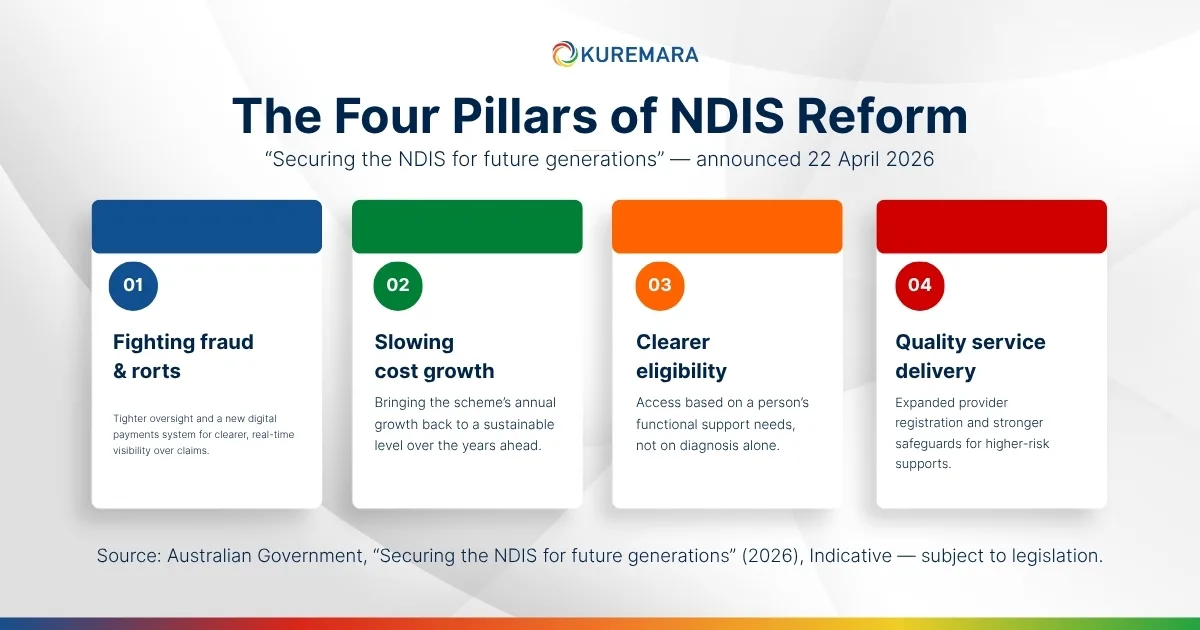
- Fighting fraud and rorts — tightening oversight of how money is claimed and spent, including a new digital payments system designed to give the Agency clearer, real-time visibility over claims.
- Slowing cost growth — bringing the rate at which the Scheme expands back to a more sustainable level.
- Clearer eligibility — moving away from diagnosis-driven access toward an assessment of a person’s actual functional support needs.
- Quality service delivery — lifting standards through expanded provider registration and more direct Government commissioning of certain high-risk supports.
Each of these touches participants and providers differently. Let’s look at the ones most likely to affect your day-to-day life.
The biggest shift: from diagnosis to function
This is the change that reshapes the Scheme the most. Access can currently rest on a diagnosis from a recognised list. Under the reforms, eligibility will be based on a standardised assessment of how an impairment affects daily life, alongside a person’s environment and goals, with the Government indicating the I-CAN Support Needs Assessment, developed with the University of Melbourne, as the basis.
In plain terms, the question moves from “What is your diagnosis?” to “What can you do, what do you struggle with, and what support do you need?” The evidence that will carry the most weight is the kind that documents impact, for example, an occupational therapist’s report explaining that a person needs physical assistance to shower safely, cannot prepare a hot meal unsupervised, and cannot travel on public transport independently. These eligibility changes apply to new applicants from 1 January 2028, then roll through to existing participants over a transition period.
A new layer of support: Foundational Supports and Thriving Kids
A major piece of the reform sits outside the NDIS. Under the National Agreement on Foundational Supports 2026–31 (commenced 2 February 2026), the Commonwealth and states are funding a layer of support that does not require an individual plan, general supports (information, advice, capacity building), and targeted supports (sitting between mainstream services and NDIS specialist supports). States and territories will deliver much of this, with full implementation expected by January 2028.
Its first phase is Thriving Kids: $4 billion over five years for children aged eight and under with developmental delay and/or autism and low to moderate support needs, plus their families. From 1 October 2026, these children begin accessing Thriving Kids, with full rollout by 1 January 2028, at which point this group is intended to be supported through mainstream and Foundational Supports rather than the NDIS, while children with higher needs continue on the Scheme.
How plans will be built: New Framework Planning
Alongside who gets access, the way plans are created is changing too, through what the Government calls New Framework Planning.
The current approach, which many participants experience as a list of separately funded line items, is being replaced by a model built around a whole-of-person needs assessment, with budgets shaped around your assessed support needs and goals. The aim is more consistency and less of the postcode lottery that sees similar people receive very different plans.
New Framework Planning was originally flagged for mid-2026, but it has been rescheduled to allow more time for consultation, and is now expected to begin rolling out in 2027. It will be introduced gradually, starting with a selection of participants, with a transition period running for several years toward 2030. If you are an existing participant, you will not be switched over without warning, and there will be a transition rather than a hard cutover.
More providers under the microscope
The fourth pillar is about quality, and it changes the landscape for providers as much as participants.
From 1 July 2026, mandatory registration begins for Supported Independent Living (SIL) and platform providers. This is the leading edge of a much bigger shift. The Government has signalled an expansion of mandatory registration across higher-risk supports, such as personal care, overnight supports, and services delivered in closed settings or involving behaviour support. Minister Butler has indicated he expects around 90 per cent of providers to be registered under the new regime, compared with an estimated 6 per cent today. The Government has also flagged that it will directly commission some services, including supported independent living, plan management, and support coordination, rather than relying on a market it considers is not working well in those areas.
For participants, this is meant to be reassuring. SIL and similar supports happen in people’s homes, around their personal routines and their most private moments, and stronger oversight by the NDIS Quality and Safeguards Commission is squarely aimed at safety.
From our vantage point, delivering these supports every day, the change is significant but not mysterious. Registration readiness is built on the same foundations good providers should already have: current worker screening, robust incident management, clear complaints handling, sound service agreements, proper documentation, and the right processes around restrictive practices where they apply. We have been preparing our SIL and support coordination services for this environment for some time, because the direction of travel has been visible for a while. The practical takeaway for participants is simple: as registration expands, ask your providers where they are up to. A provider who can answer that question clearly is a provider taking your safety seriously.
A practical timeline: what happens when
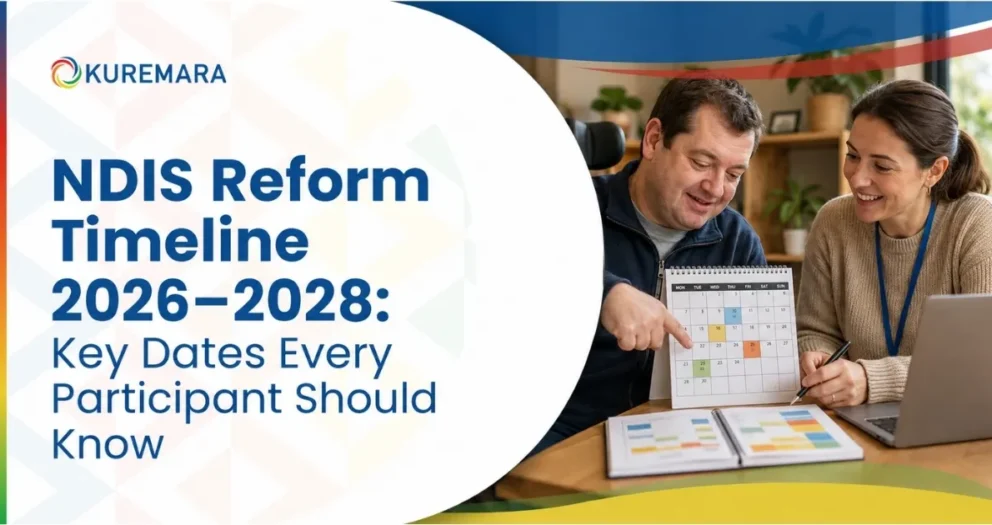
It is easy to panic about everything at once, so here is a rough sequence of the changes the Government has flagged. Treat these dates as the current plan rather than a guarantee, since several depend on legislation passing and on consultation still underway.
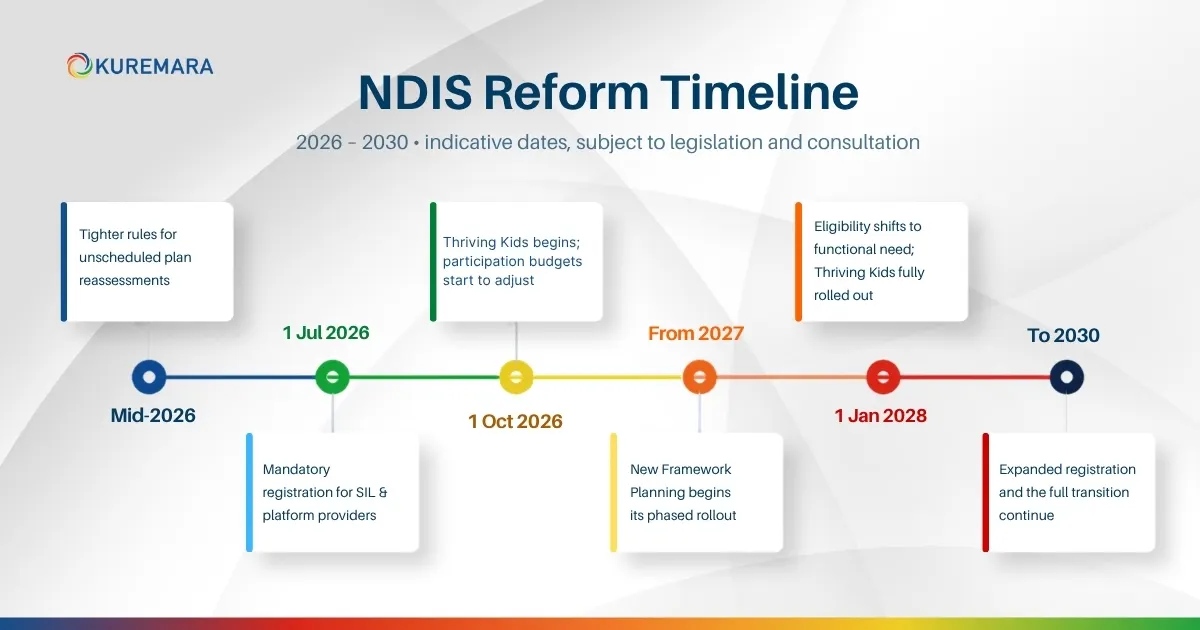
- Mid-2026: Tighter criteria for unscheduled plan reassessments take effect.
- 1 July 2026: Mandatory registration begins for SIL and platform providers.
- 1 October 2026: Thriving Kids state services begin; participant budgets for social, civic, and community participation begin to be progressively adjusted.
- From 2027: New Framework Planning begins to roll out, starting with a selection of participants, with a transition period running for several years.
- 1 January 2028: NDIS eligibility changes apply to new applicants, then roll through to existing participants over a transition; Thriving Kids reaches full national rollout.
- Through to 2030: Expanded provider registration and the broader transition to the new model continue.
The headline is reassuring once you see it laid out: a lot of this is 2027 and 2028 territory. There is time to prepare rather than react.
What this actually means for you
Let’s bring it back to your situation, because that is what matters most.
If you are a current participant, your plan continues as it is until you are personally contacted. The single most useful thing you can do is start building a clear, function-focused picture of your support needs, through current assessments and reports that describe how your disability affects your daily life. When your reassessment or transition to the new framework eventually comes, that evidence is what will do the heavy lifting.
If you are thinking about applying, know that the door is changing. New applicants face the new eligibility approach from 2028, and for some people, the right pathway may be Foundational Supports rather than the NDIS. That is not a brush-off; for lower or emerging needs, a well-built foundational system can mean faster, more appropriate help. Gather functional evidence early either way.
If you are a parent of a young child, watch the Thriving Kids rollout closely, especially if your child is eight or under with developmental delay or autism. From late 2026 onward, the support your family is offered may run through these new services. Stay connected to your early childhood partner and ask specifically how the transition applies to your child.
If you use SIL, plan management, or support coordination, expect more structure, more oversight, and in some cases more direct Government involvement in how these services are commissioned. This is intended to lift quality and safety. Choosing registered, well-run providers becomes more important than ever.
For everyone, keep your records organised, keep your evidence current, and engage with the public consultations where you can. The Government has committed to co-design with the disability community, and that only works if the community shows up.
How to prepare with confidence
The reforms can feel overwhelming, but preparation comes down to a few steady habits. Keep your assessments and reports up to date, with a focus on documenting function rather than just diagnosis. Understand which parts of your current plan fall into the categories most affected by change. Ask your providers direct questions about their registration status and how they are getting ready. And give yourself permission to take it one step at a time, because the timeline is built in stages for exactly that reason.
This is also where the right support partner makes a real difference. At Kuremara, a registered NDIS provider delivering Supported Independent Living, support coordination, complex care, community nursing, and in-home support across Australia, we have spent close to a decade walking alongside participants through change, and we are actively preparing our services for the new registration and planning environment. Our role is to help you understand how these reforms apply to your situation, keep your supports stable through any transition, and make sure your voice stays at the centre of your own plan. If you are unsure what the changes mean for you specifically, that is a conversation worth having sooner rather than later.
The bottom line
The future of the NDIS is being rewritten, and there is no point pretending otherwise. The Scheme is moving toward function-based eligibility, a new layer of Foundational Supports outside the NDIS, a redesigned planning framework, and far stronger oversight of providers, all rolled out in stages between now and 2030.
It is a lot. But the changes are not arriving all at once; your current plan is protected until you are personally notified, and the path forward is one you can prepare for rather than fear. The Scheme that emerges is meant to be more sustainable, more consistent, and safer, while still doing what it was always meant to do: support Australians with significant and permanent disability to live the life they choose.
Stay informed, keep your evidence current, ask good questions of your providers, and make your voice heard in the consultations that will shape the details. The reforms may be designed in Canberra, but the future of the NDIS belongs to the people who live it.
Disclaimer:
This article is general information based on the Australian Government’s “Securing the NDIS for future generations” announcement of 22 April 2026, the National Agreement on Foundational Supports 2026–31, and related public materials available at the time of writing. Reform details are still subject to legislation and consultation and may change. It is not legal, medical, or financial advice. For guidance specific to your circumstances, speak with a qualified professional or refer to official sources at ndis.gov.au and health.gov.au.