care@kuremara.com.au
 1300 000 799
When your NDIS plan is approved, one of the first big decisions you’ll face isn’t what supports to use it’s how you’ll manage the funding behind them. The National Disability Insurance Scheme gives every participant a say in this, and the option you choose shapes how much control, flexibility, and paperwork lands on your plate.
Self-management sits at the most independent end of that scale. It can be liberating for some participants and overwhelming for others, and the honest answer to “should I do it?” depends entirely on your circumstances. This guide walks through what self-management really involves in 2025, the genuine upsides and trade-offs, and the questions worth asking yourself before you decide.
The three ways to manage your NDIS funding
Before zooming in on self-management, it helps to see where it fits. The NDIS offers three approaches, and you can even mix them across different parts of your plan:
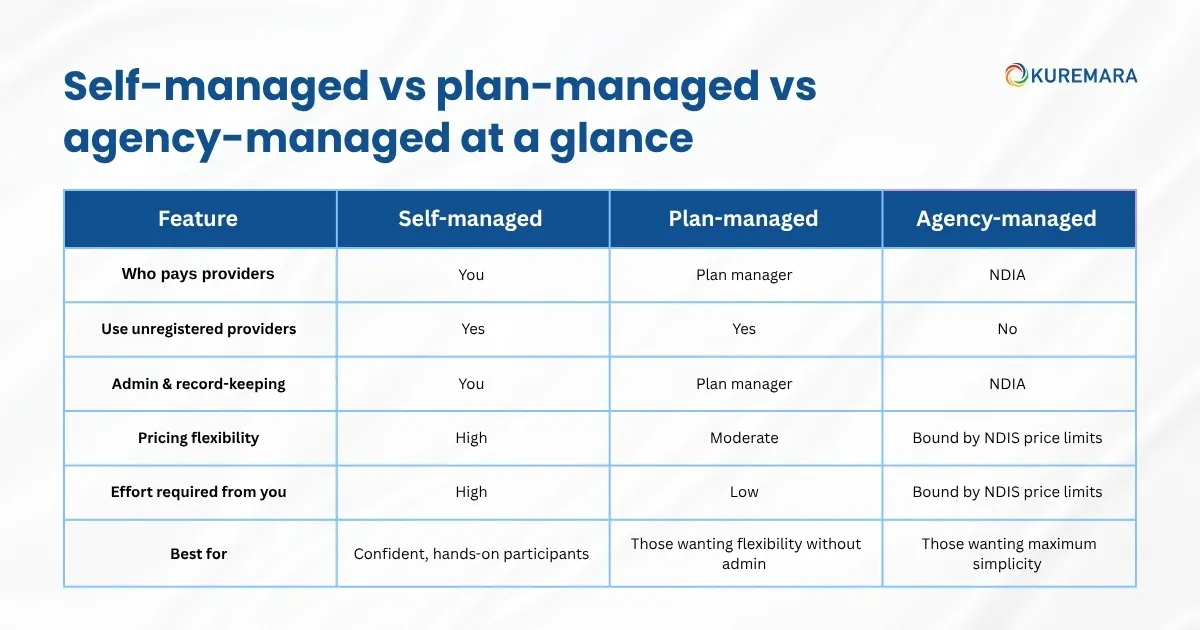
- Agency-managed (NDIA-managed): The NDIA pays your providers directly. You can only use registered providers, and claims are handled for you. It’s the simplest option administratively, but the most limited in terms of choice.
- Plan-managed: A registered plan manager handles invoices, payments, and record-keeping on your behalf. You get to use both registered and unregistered providers, with someone else doing the financial admin. The plan management fee is funded separately and doesn’t come out of your support budgets.
- Self-managed: You take full control of the funding, choosing providers, paying them, claiming reimbursements, and keeping your own records.
Each option is valid. The “right” one is simply the one that matches how much control you want against how much responsibility you’re ready to carry.
What does NDIS self-management actually mean?
Self-management means you (or a nominee you trust, such as a family member) take charge of the money in your plan. Rather than the NDIA paying providers for you, your funding is made available to you, and you organise and pay for your supports yourself.
In practical terms, self-managing gives you the freedom to:
- Choose any provider, whether they’re NDIS-registered or not, as long as the support aligns with your plan goals.
- Negotiate price and tailor arrangements to suit your needs.
- Directly employ your own support workers or engage independent contractors if you wish.
- Decide how, when, and from whom you buy your supplies.
With that freedom comes accountability. You’re responsible for making sure every dollar is spent in line with your plan, that you can show where the money went, and that your supports are reasonable, necessary, and on the NDIS supports list. It’s worth remembering that all providers, registered or not, must follow the NDIS Code of Conduct, so quality and safety expectations don’t disappear just because you’re self-managing.
How self-management works day to day
Understanding the mechanics removes a lot of the mystery. Here’s the typical flow:
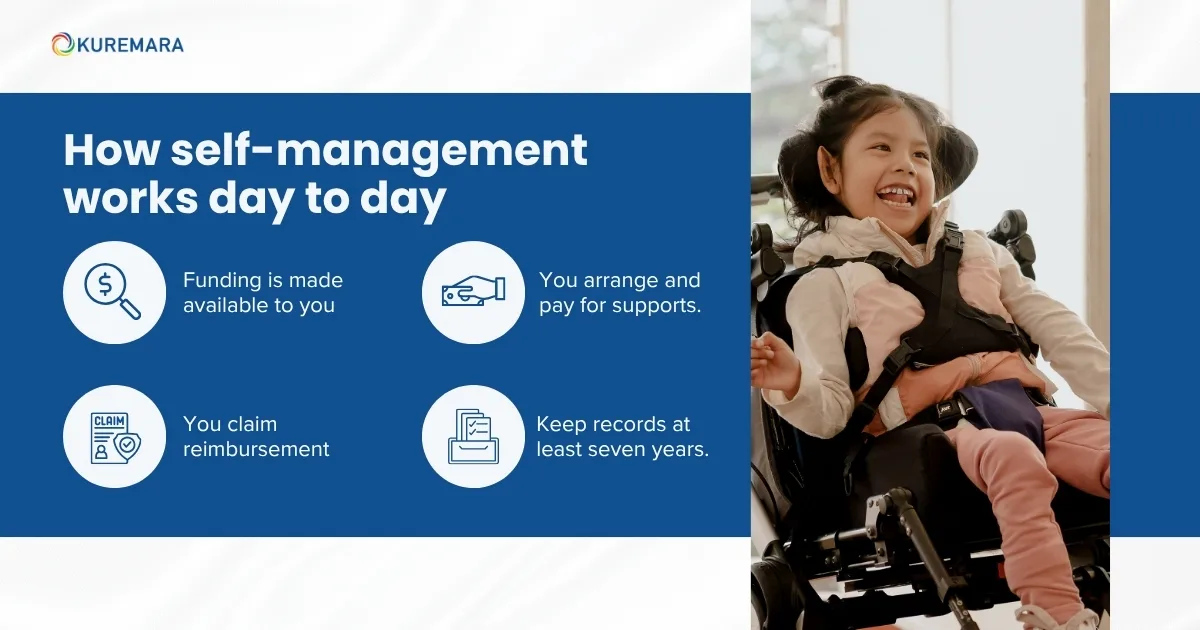
- Funding is made available to you. Your NDIS funds are paid into a bank account managed by you, your plan nominee, or a child representative if the participant is under 18. Many people open a separate account just for NDIS money to keep things tidy.
- You arrange and pay for support. After a service is delivered, you pay the provider, contractor, or worker directly. The NDIA cannot pay them for you. If invoices go unpaid, providers may stop services, pursue the debt, or report non-payment, so staying on top of payments matters.
- You claim reimbursement. Once you’ve paid (or received an invoice), you claim through the my NDIS portal or the my NDIS app, which is the quickest route. There’s also a manual claim form when the portal isn’t an option.
- You keep records. Hold on to invoices, receipts, and statements. If you directly employ staff, records like payslips, tax, and superannuation should be kept for at least seven years.
Two timing rules are easy to overlook but important: you generally have two years from the support start date to submit a claim, and you should only ever claim after a support has been provided. Building a simple routine file the invoice, pay it, claim it, log it keeps everything manageable.
The benefits of self-managing your plan
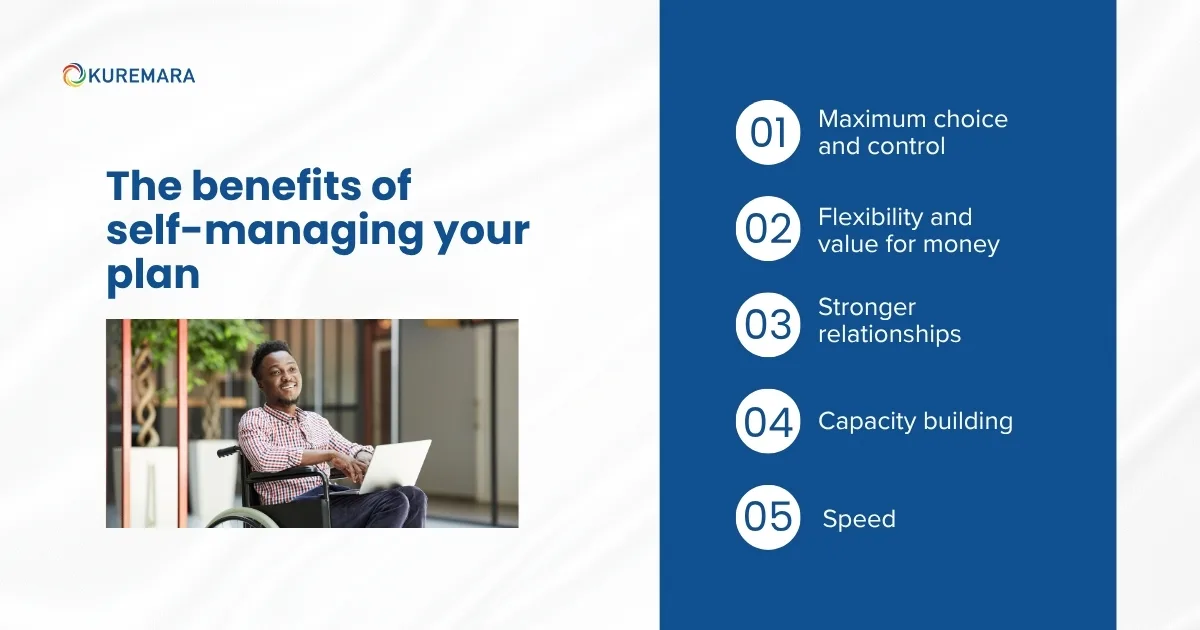
For the right person, self-management can be genuinely empowering. The most commonly cited advantages include:
- Maximum choice and control. You’re not limited to registered providers, which widens your options considerably particularly helpful in regional areas or for niche supports.
- Flexibility and value for money. You can shop around, compare prices, and structure supports creatively to get more from your budget.
- Stronger relationships. Choosing and working directly with your own workers often leads to more consistent, personalised care.
- Capacity building. Many participants find that managing their own plan grows their confidence, financial skills, and sense of independence over time.
- Speed. When you control payments, you’re not waiting on a third party to process invoices.
In short, self-management hands you the steering wheel. For people who value autonomy and feel comfortable with budgets and records, that control is the whole appeal.
The responsibilities and realities to weigh up
Honesty matters here, because self-management isn’t a fit for everyone and a trustworthy picture includes the challenges, not just the perks.
- It takes time. Tracking budgets, chasing invoices, making claims, and keeping records is ongoing admin. For a busy household, that workload is real.
- You carry the financial responsibility. Overspending early, miscalculating a budget, or paying for something outside your plan can create genuine problems, including having to repay funds.
- You need to know the rules. Understanding what is and isn’t claimable and keeping up with the official NDIS supports lists is on you.
- Employer obligations. If you directly engage workers, you may take on responsibilities around insurance, tax, superannuation, and work health and safety.
- No third party to lean on. Unlike plan management, there’s no professional processing of payments or flagging mistakes on your behalf.
None of this is meant to discourage you; plenty of participants self-manage happily for years. It’s simply the reality check worth doing before you commit.
What changed in 2025 (and why it matters)
The rules around self-management tightened in 2025, so any decision today should account for the current framework rather than older guidance.
From 4 March 2025, the NDIA introduced clearer capability and eligibility criteria for participants who want to self-manage. Most of the time the NDIA must honour your choice of how to manage your plan, but the updated legislation expanded the circumstances in which it can decline. Broadly, the agency now considers:
- Your financial history with your plan — for example, whether there’s been overspending or misuse in the past.
- Your financial and legal situation — such as bankruptcy, insolvency, or being under administration.
- Whether certain criminal convictions apply (for instance, offences involving fraud or dishonesty).
- Whether self-managing would pose an “unreasonable risk” to you.
Importantly, concerns don’t automatically mean a flat “no.” The NDIA may instead offer support, such as training, a shorter plan duration, or starting with partial self-management and building up. The agency also now has clearer authority to change a participant’s management type if a genuine risk is identified.
Two wider 2025 reforms also affect self-managers. Funding can only be spent on items on the official NDIS supports list (with a separate list of what can’t be claimed and a limited replacement-support rule), and in newer or reassessed plans, funding is increasingly released in scheduled instalments across the year rather than all at once, which makes careful, paced budgeting more important than ever. Because these rules continue to evolve, it’s always wise to confirm the current details with the NDIS or your My NDIS contact.
Self-managed vs plan-managed vs agency-managed at a glance
So, is self-management right for you?
There’s no universal answer, but a few honest questions can point you in the right direction.
Self-management may suit you well if:
-
-
- You’re comfortable with budgeting, basic bookkeeping, and digital tools.
-
-
-
- You want the widest possible choice of providers and workers.
-
-
-
- You have the time (or a reliable nominee) to handle ongoing admin.
-
-
-
- You value independence and want to build your own capacity.
-
It may be worth reconsidering or starting with a partial or plan-managed approach if:
-
-
- The idea of tracking invoices and budgets feels stressful or unmanageable.
-
-
-
- You’d rather spend your energy on supports and goals than on paperwork.
-
-
-
- Your situation is complex, and you’d benefit from professional oversight.
-
Remember, this isn’t all-or-nothing. You can self-manage one part of your plan while having another part plan- or agency-managed, easing into it as your confidence grows.
How to start or switch
If you’d like to self-manage, you can raise it during your planning meeting or plan reassessment, or discuss it with your NDIS contact at any time. You’ll provide your bank details for funding to be released, set up a simple record-keeping system, and familiarise yourself with the my NDIS portal or app for claims. Starting small, self-managing a single support category first, is a perfectly sensible way to test the waters.
How Kuremara can support your self-management journey
Choosing to self-manage doesn’t mean going it alone. As a registered NDIS provider with more than a decade of experience supporting participants across South-East Queensland, Central Queensland, Sydney, and Greater Melbourne, Kuremara helps people navigate the practical side of their plans with confidence. Through services such as Support Coordination, our team can help you understand your options, connect with quality providers, and build the skills to manage your funding well, whether you’re fully self-managing, partially self-managing, or simply weighing it up. Alongside coordination, Kuremara delivers person-centred supports including Supported Independent Living (SIL), Short-Term Accommodation, In-Home Support, Disability Transport, Complex Care, and Community Nursing, so the right help is there as your needs change.
Final thoughts
Self-management can be one of the most empowering choices an NDIS participant makes, offering real freedom, flexibility, and control. It also asks more of you in return, and the 2025 changes mean it’s worth approaching with clear eyes and current information. The best decision is an informed one: weigh the control you want against the responsibility you’re ready to take on, lean on trusted guidance where you need it, and remember you can always adjust your approach as your circumstances evolve.
This article is general information only and is current as of 2025–2026. It is not financial, legal, or professional advice. NDIS rules can change, so always confirm the latest details with the NDIS (ndis.gov.au) or your my NDIS contact before making decisions about your plan.
Frequently asked questions
1. Can I self-manage only part of my plan?
Yes. You can self-manage some support categories while having others plan-managed or agency-managed. This is a popular way to ease in.
2. Can I use unregistered providers if I self-manage?
Yes, self-managing lets you choose registered or unregistered providers, as long as the support aligns with your plan and the NDIS rules. All providers must still follow the NDIS Code of Conduct.
3. How long do I need to keep records?
Keep invoices and receipts for your support, and if you directly employ workers, keep employment records for at least seven years.
4. Is there a deadline to claim?
Generally, you have two years from the date support started to submit your claim, and you should only claim after the support has been delivered.
5. Can the NDIA refuse to let me self-manage?
In most cases, the NDIA must honour your choice, but under the rules updated in March 2025, it can decline or change your management type in specific circumstances, such as insolvency, certain criminal convictions, or where self-managing would pose an unreasonable risk.