care@kuremara.com.au
 1300 000 799
Picture this: You’ve just spent three weeks in hospital following a stroke. The doctor walks in on a Tuesday morning and tells you You’re being discharged on Thursday. Two days. That’s all the time you have to figure out how you’re going to get home, who’ll be there to help you settle in, how your medications will be managed, and whether your home environment works for you right now.
For thousands of Australians with disability and for the people who love and support them, this moment arrives without much warning. And far too many people leave the hospital without the support they’re legally entitled to, simply because nobody explained that an NDIS checklist exists.
This is the guide you wish someone had placed in your hands before discharge day. Whether you’re a person with disability planning ahead, a family member or chosen support person helping someone through this transition, a support worker, or a health professional, here is everything you need to know about NDIS hospital discharge support in Australia. Clearly, practically, and without the jargon.
The Reality of Coming Home from the Hospital
Discharge day can bring a mix of feelings, relief, hope, uncertainty, and sometimes anxiety about what comes next. That is completely understandable. What many people don’t realise is that the NDIS has been designed to help bridge exactly this gap: between the clinical setting and the everyday life you want to return to.
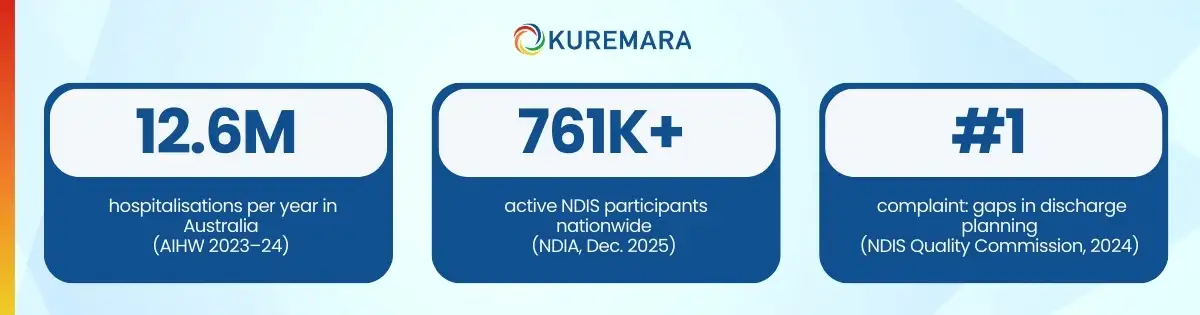
A 2024 report by the NDIS Quality and Safeguards Commission found that gaps in discharge planning remain one of the most consistent concerns raised by participants and their families. People with disability leave the hospital without knowing their NDIS plan can be activated, adjusted, or redirected to fund the care after hospital discharge they need and are entitled to.
When those supports aren’t in place, the impacts ripple outward, including increased readmissions, stretched family carers, and people who could be living well at home instead of spending weeks without the right support around them. The NDIS has pathways and funding provisions for exactly this moment. Most people just haven’t been told they exist. That changes here.
What Is NDIS Hospital Discharge Support — And Who Is It For?
Hospital discharge support under the NDIS refers to a suite of funded services that help eligible participants move safely and confidently from hospital or rehabilitation back to their home and community. It’s not one service; it’s a layered framework shaped around your individual needs, goals, and living situation:
- Support Coordination to organise your transition plan before you leave
- In-home personal support — help with daily routines like showering, dressing, and meals
- Allied health services, including physiotherapy, occupational therapy, and speech pathology
- Assistive technology assessments and provision of the right equipment
- Home modifications that make your environment work for you
- Community nursing for wound care, medication management, and clinical monitoring
- Respite and carer support to give your chosen support people time to rest
- Psychosocial support, including counselling, social work, and peer connection
This framework is for a wide range of people. You may already be an NDIS participant. You may be applying for the first time after a newly acquired disability. You may be a family member, partner, friend, or chosen carer walking alongside someone through this. You may live in a regional or remote community or come from a culturally and linguistically diverse background. You may be a health professional looking for better answers to share with your patients.
This checklist is for all of you
For Aboriginal and Torres Strait Islander communities: The My Aged Care pathway is available from age 50 (not 65) for First Nations Australians. Many communities also have dedicated Aboriginal Community Controlled Health Organisations (ACCHOs) that can support culturally safe coordination of post-discharge care.
Not sure where to start? Contact the NDIA directly at 1800 800 110. Interpreter services are available at no cost. Many larger hospitals also have an NDIS Liaison Officer whose role is specifically to support this kind of transition; ask for them by name.
The NDIS Hospital Discharge Checklist Most Australians Miss
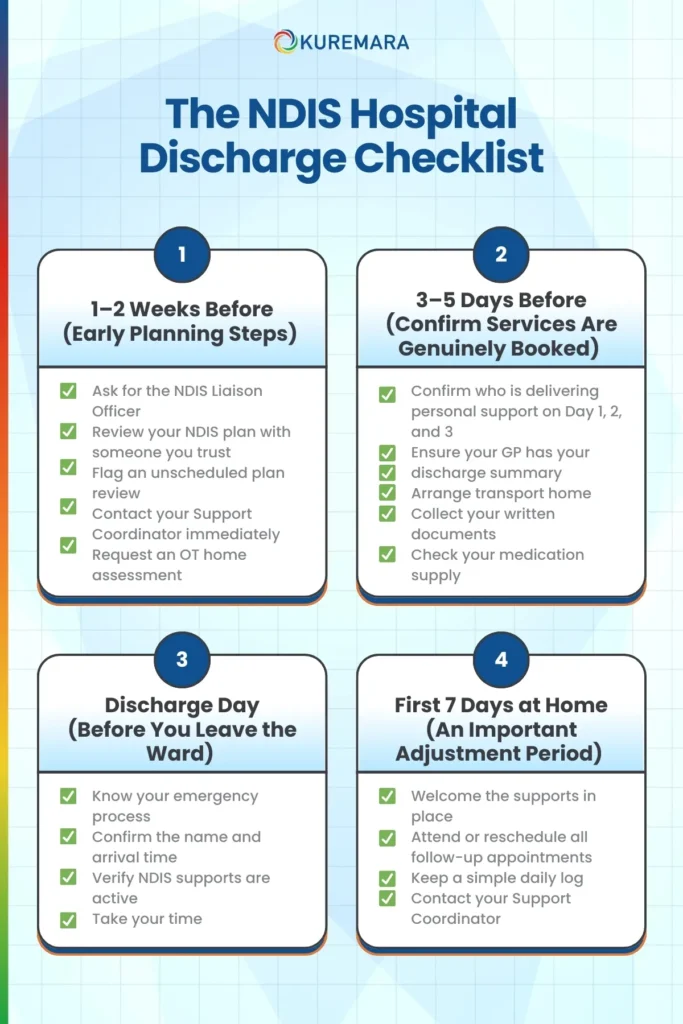
Here is the practical, step-by-step checklist — organised by timeline so you know what to do and when.
1–2 Weeks Before (Early Planning Steps)
-
- Ask for the NDIS Liaison Officer — many major hospitals have one embedded in the team whose whole job is this
-
- Review your NDIS plan with someone you trust — does it include Support Coordination, daily living, or home modification budgets?
-
- Flag an unscheduled plan review if your circumstances have significantly changed, a hospitalisation absolutely qualifies
-
- Contact your Support Coordinator immediately — they should be leading your discharge planning from this point
- Request an OT home assessment — fundable through your NDIS plan under Improved Daily Living, can be done in person or remotely
3–5 Days Before (Confirm Services Are Genuinely Booked)
-
- Confirm who is delivering personal support on Day 1, 2, and 3 — not just “in progress” but formally confirmed
-
- Ensure your GP has your discharge summary and understands your transition care needs
-
- Arrange transport home — wheelchair-accessible or non-emergency transport must be pre-booked; it’s not automatic
-
- Collect your written documents — discharge summary, medication list, wound care instructions, follow-up appointments
-
- Check your medication supply — you should leave with at least two weeks’ worth
Discharge Day (Before You Leave the Ward)
-
- Know your emergency process — who to call and when if your health changes at home
-
- Confirm the name and arrival time of your first support worker or community nurse
-
- Verify NDIS supports are active — confirmed with the provider, not just scheduled in a system
-
- Take your time — it’s completely okay to slow down, ask questions, and leave only when you feel ready
First 7 Days at Home (An Important Adjustment Period)
-
- Welcome the supports in place — even on days you feel you’re managing well, consistency matters in the first week
-
- Attend or reschedule all follow-up appointments within 48 hours if you’re genuinely unable to make them
-
- Keep a simple daily log of how you’re feeling — physically, emotionally, functionally — to share with your care team
-
- Contact your Support Coordinator if anything in your plan isn’t working as intended; that’s exactly what they’re there for
Remember: Using your supports is not a sign of not coping. It’s you directing your own recovery and life, on your own terms.
NDIS Support Categories That Fund Post-Hospital Care
Many people with disability don’t realise how many of their existing NDIS support categories can fund post-hospital support services. Here is a plain-language breakdown:
| NDIS Support Category | What It Can Fund After Discharge |
| Daily Activities (Core) | Personal care, meal preparation, household tasks, community access |
| Improved Living Arrangements | Support to find and set up appropriate housing post-discharge |
| Improved Health & Wellbeing | Allied health, exercise physiology, dietitian support |
| Support Coordination | Planning and connecting all your discharge supports |
| Improved Daily Living | Occupational therapy, physiotherapy, speech pathology |
| Assistive Technology | Wheelchairs, shower chairs, adjustable beds, communication devices |
| Home Modifications | Ramps, grab rails, wider doorways, accessible bathrooms |
From the Kuremara team: If you have unspent funds in your plan at the time of discharge, these can often be redirected with NDIA agreement to cover urgent post-discharge needs. Your Support Coordinator is the right person to initiate this conversation.
Not Yet an NDIS Participant? A Fast-Track Pathway Exists
Here’s something many hospital teams and people with disability haven’t heard: the NDIA has a hospital pathway for people who need urgent access to the NDIS following a newly acquired disability.
The NDIA’s Operational Guidelines allow a person in hospital who is likely to have a permanent disability and who needs support to return home safely to apply as an access request under urgent or complex circumstances. This can meaningfully shorten the standard 21-business-day processing window.
- Ask your hospital social worker to submit documentation of your functional support needs
- Request written confirmation from your treating specialist that your condition is likely to be ongoing or permanent
- Submit your access request as early as possible. The NDIA cannot process requests retroactively
If NDIS access isn’t confirmed before your discharge date, interim support options include My Aged Care (65+, or 50+ for First Nations Australians), the Commonwealth Home Support Programme (CHSP), and your state or territory’s post-acute care services. A social worker, community health nurse, or Local Area Coordinator (LAC) can help identify the right pathway for you.
Five Things That Can Slow a Smooth Transition — And How to Navigate Them
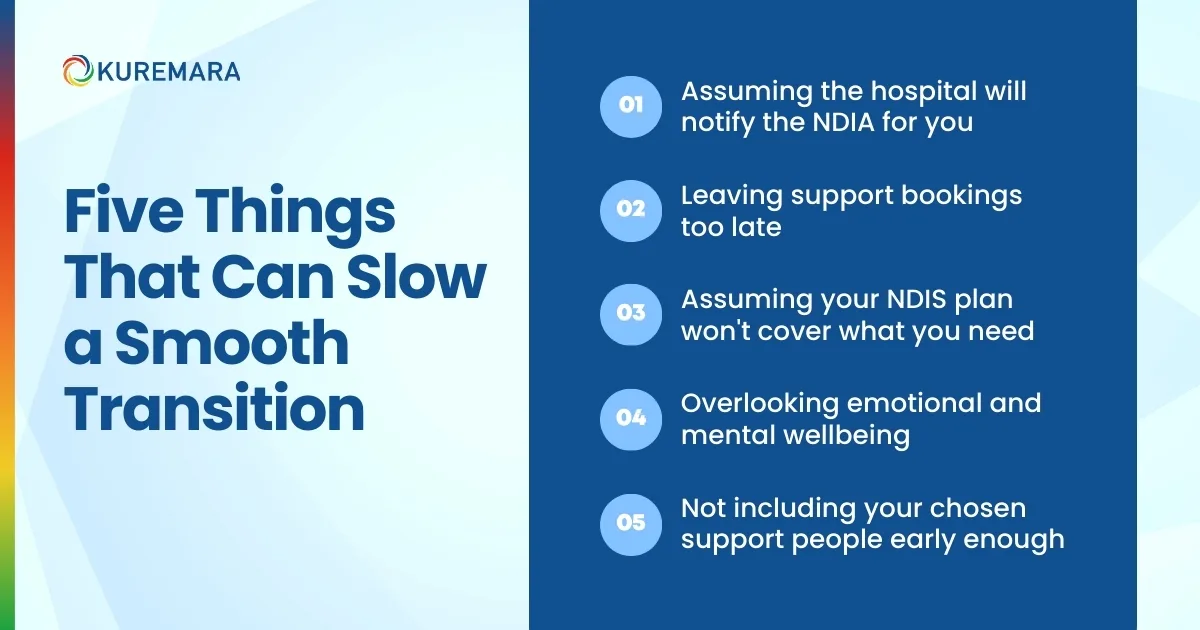
These situations come up regularly across Australia. Knowing about them in advance means you’re better placed to work through them.
- Assuming the hospital will notify the NDIA for you. Hospitals are not legally required to do this. A direct call from you, your guardian, or your nominated representative is all it takes, and it makes all the difference.
- Leaving support bookings too late. Support workers, especially in regional and rural communities, often have full schedules. The earlier you confirm providers, the more genuine choice you have.
- Assuming your NDIS plan won’t cover what you need. NDIS plans are designed to be flexible and responsive to real life. If you’re unsure whether something is fundable, ask your Support Coordinator or the NDIA directly rather than assuming no.
- Overlooking emotional and mental wellbeing. Returning home from hospital can bring up a wide range of feelings, grief, uncertainty, frustration. All of these experiences are valid. NDIS-funded psychosocial supports, including counselling and peer support, can be part of your transition plan.
- Not including your chosen support people early enough. Whether it’s a family member, partner, friend, or chosen carer, involve them in the discharge conversation from the beginning. Carer wellbeing matters too. The Carer Gateway (1800 422 737) provides free, dedicated support for anyone in a caring role.
For people from Culturally and Linguistically Diverse (CALD) backgrounds:
The NDIA provides interpreter services and translated resources at no cost. When contacting the NDIA, you are entitled to request an interpreter. Some disability support providers including Kuremara, also work with bilingual support workers and culturally responsive approaches, so that every person feels genuinely respected throughout their transition.
How Kuremara Supports Your Hospital-to-Home Transition
We work with people across Australia to deliver post-hospital discharge support built around your goals, your community, and your life. Every person’s needs are different, and we take the time to understand yours.
This Information Belongs to Everyone
The NDIS exists because every Australian with disability deserves full participation in community life, including the right to come home from hospital with the care, equipment, and support they need to live well.
The information in this checklist isn’t secret, but it is too often left unshared. Whether you are a participant, a support person, a health professional, or an ally please pass it on to anyone who could use it.
The more people who understand their rights, the more people come home to a life that genuinely works for them.