care@kuremara.com.au
 1300 000 799


Last Update: 13 October 2026
Early childhood intervention is the support given to young children who have a developmental delay or disability, and to the families who care for them. In Australia it is delivered mainly through the NDIS early childhood approach, which is for children younger than 9. From October 2026 a second pathway opened alongside it: Thriving Kids, for children aged 8 and under with developmental delay or autism and low to moderate support needs.
If your child is already on an NDIS plan, nothing changes right now. Access arrangements for children do not change until 1 January 2028. This guide explains what early childhood intervention is, who it helps, what age it covers, how to get it, and what the 2026–2028 reforms mean for your family.
What is early childhood intervention?
Early childhood intervention (ECI) is specialised support for children with developmental delay, disability or developmental concerns, provided as early as those concerns appear. It covers the child, the family and the everyday settings a child spends time in home, childcare, kindergarten and the local community.
The defining feature of early childhood intervention is that it is not therapy delivered to a child in isolation. Modern practice in Australia is family-centred and embedded in everyday routines. A speech pathologist might work with a parent on how to build language into bath time and mealtimes rather than running a clinic session the child then leaves behind. An occupational therapist might visit a childcare centre to adjust how an activity is set up so a child can take part alongside their peers.
You will also see the term written as early childhood early intervention, or shortened to ECI or ECEI. ECEI was the original name of the NDIS pathway. It was renamed the early childhood approach in 2021, and from 1 July 2023 the age range was extended from children under 7 to children younger than 9. The underlying idea has not changed: act early, support the family, and build the child’s capability in the places they already live and learn.
Which children does early childhood intervention help?
Early childhood intervention is for any young child whose development is not following the usual pattern. You do not need a diagnosis to raise a concern, and in many cases you do not need one to get support.
Children commonly supported include those with:
- Developmental delay – where a child is not reaching milestones in one or more areas such as speech, movement, play, thinking or self-care
- Autism – diagnosed, or where assessment is underway
- Intellectual disability or learning difficulties affecting how a child understands and responds to the world
- Physical and neurological disability, including cerebral palsy, muscular conditions and acquired brain injury
- Sensory impairment, including hearing and vision loss
- Genetic and congenital conditions such as Down syndrome
- Communication difficulties, including speech sound disorders and childhood apraxia of speech
Families are supported too, and deliberately so. Parents, carers, grandparents and siblings all shape a child’s development, and the evidence is clear that building family confidence produces better outcomes than working with the child alone. If you are weighing up providers after a recent diagnosis, our guide to choosing an NDIS provider for autism walks through what to ask.
What age is early childhood intervention for?
The NDIS early childhood approach is for children younger than 9. Children aged 9 and over work with an NDIS partner, usually a local area coordinator, through the standard NDIS pathway instead.
Thriving Kids is for children aged 8 and under with developmental delay and/or autism and low to moderate support needs.
These age rules are worth stating plainly, because older guidance still circulating online refers to ECEI for children under 7. That age limit has not applied since 2023.
Within the early childhood approach there is one further distinction. Children under 6 can access NDIS support on the basis of developmental delay as defined in the NDIS Act, without a confirmed diagnosis. From age 6, a child generally needs a diagnosed disability that meets the NDIS disability or early intervention requirements.
A question we are asked often: is early intervention only for young children? No. Early intervention under the NDIS means providing support now to reduce the need for support later, and it is not limited to young children — people of any age who apply before they turn 65 can meet the early intervention requirements. It is the early childhood approach specifically that is capped at age 9.
There is also no need to wait for a milestone to be badly missed before acting. The whole premise of early intervention is that support given during the period of fastest brain development does more with less. If something concerns you about your child’s development, that concern alone is reason enough to speak to someone.
Types of early childhood intervention support
Early childhood intervention is not a single service. It is a mix matched to what a child and family actually need, and it usually changes over time.

- Speech pathology – understanding and using language, speech clarity, social communication, and feeding and swallowing
- Occupational therapy – play, fine motor skills, sensory processing, and everyday tasks such as dressing and eating
- Physiotherapy – movement, strength, balance and mobility
- Psychology and behaviour support – emotional regulation, behaviours of concern, and strategies families can use consistently
- Key worker support – one named professional who coordinates the team so a family is not managing five separate relationships
- Inclusion support – working alongside childcare and kindergarten staff so a child can participate with their peers
- Assistive technology – communication devices, mobility aids and equipment that supports independence
- Family capacity building – coaching, information and peer connection so families can support development day to day
Best practice is a transdisciplinary team: several professionals contributing, with one key worker as the family’s main contact. That structure is set out in the national guidelines for early childhood intervention and is designed to prevent the fragmented, appointment-heavy experience many families describe. If you are new to how therapy is funded and delivered under the scheme, our overview of NDIS therapy supports covers the basics.
How the NDIS early childhood approach works
The NDIS early childhood approach is the scheme’s pathway for children younger than 9. Its design reflects a deliberate decision: a family with a developmental concern should get help quickly, without first having to prove their child qualifies for a funded plan.
The approach is delivered by early childhood partners, local organisations funded by the NDIA whose teams include professionals with clinical expertise in early childhood development. A family’s first contact is with an early childhood partner, not with the NDIA directly.
From there, one of three things usually happens.
- Information and connection. For many families, the right answer is practical information about development, a link to community and mainstream services, or a connection with other families in the same position. This is available whether or not a child is eligible for the NDIS.
- Early supports. For children under 6 with developmental concerns, an early childhood partner can arrange short-term supports directly, without an NDIS plan. This is the part of the system families most often do not know exists. It is designed for children who need help now but may not need or may not qualify for ongoing NDIS funding.
- An NDIS access request. Where a child has a developmental delay or impairment likely to meet the eligibility requirements, the early childhood partner helps the family apply for the NDIS. If access is granted, the family works with the partner to develop a plan with funded supports and goals.
These pathways are collectively described by the NDIS as early connections. The key point for families: support is not all-or-nothing, and being found ineligible for an NDIS plan does not mean being turned away.
Early childhood partners and early connections
An early childhood partner is a local organisation contracted by the NDIA to deliver the early childhood approach in a defined region. They are the front door.
What a partner does:
- Talks through your concerns and your child’s development, at no cost
- Explains the options, including those outside the NDIS
- Arranges early supports for children under 6 where appropriate
- Helps prepare and lodge an NDIS access request
- Works with the family to build a plan and identify goals
- Connects families to community, health and education services
You do not need a referral, a diagnosis or an NDIS plan to contact an early childhood partner. You can find the partner for your area through the NDIS website or by calling the NDIA on 1800 800 110.
Once a plan is in place, some families choose to add support coordination to help them put it into practice, particularly where a child has supports running across health, education and disability services at the same time.
What Thriving Kids changes from 2026
This is the most significant change to early childhood support in Australia since the NDIS began, and it is the question families are asking most.
Thriving Kids is a new national program for children aged 8 and under with developmental delay and/or autism and low to moderate support needs. It sits outside the NDIS, as the first phase of what governments call foundational supports. The Australian Government and the states and territories have committed $4 billion over five years to it, split evenly.
Thriving Kids was agreed by all governments under the National Agreement on Foundational Supports and announced on 5 February 2026. The NDIS amendment legislation enabling the 2028 access changes passed the Senate on 18 August 2026, and the first Thriving Kids services became available to families from 1 October 2026, with rollout continuing state by state.
What Thriving Kids provides
- Information about child development, developmental delay and autism
- Help recognising when a child may need extra support
- Advice and help finding suitable services
- Programs that support a child’s development at home
- Targeted supports for children and families who need them, including allied health, capacity building and low-cost assistive technology
What opened from October 2026 is the general layer; information, advice, parenting support and the national phone lines. Allied health supports are expected to come online during 2027, with all supports rolled out by 1 January 2028.
Supports are delivered mostly where children live, learn and play. A diagnosis is not required. Families do not apply in the way they apply for the NDIS; support is reached through GPs, early childhood services, schools, state and territory programs, the Thriving Kids information hub, the national phone line on 1800 882 436, or the Autism Helpline on 1300 654 789.
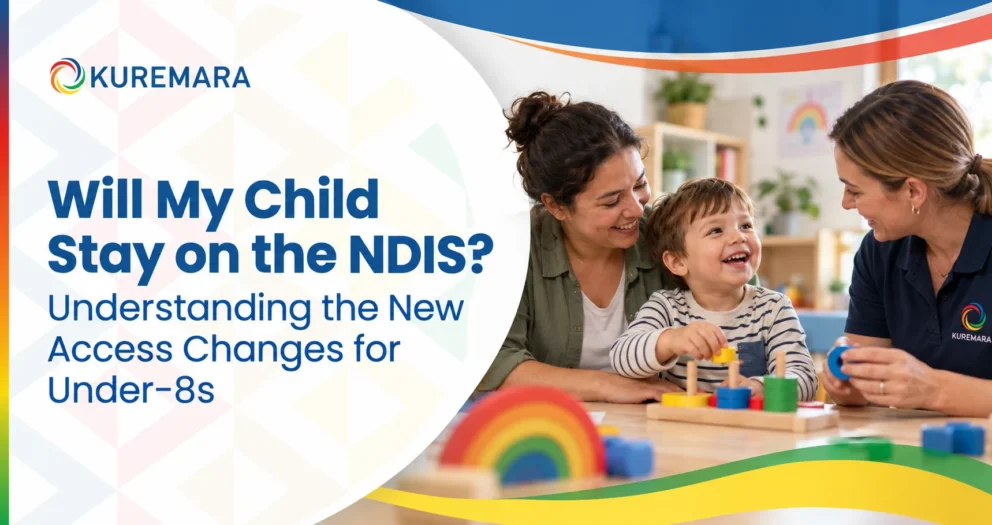
Learn in more details to know Will My Child Stay on the NDIS? Understanding the New Access Changes for Under-8s
How to access support: step by step
- Write down what you have noticed. Specific observations carry more weight than general worry. Note what your child does and does not do, at what age, and in which settings. Your child and family health nurse (maternal and child health nurse in Victoria), GP or childcare educator can help you put language around it.
- Contact an early childhood partner. For a child younger than 9, this is the starting point. Find yours through the NDIS website or call 1800 800 110. There is no cost, no referral needed and no diagnosis required to have the conversation.
- Have the planning conversation. The partner will talk through your child’s development and your family’s situation, and explain the options, which may be information and community connection, early supports, an NDIS access request, or Thriving Kids.
- If applying to the NDIS, gather evidence. Reports from treating professionals, assessment results and developmental records. For children under 6 this is evidence of developmental delay; from age 6 it is generally evidence of diagnosed disability. Some families will also encounter the I CAN assessment as part of how support needs are described.
- Build the plan around goals, not services. Plans work best when they start from what you want for your child to be understood by their kindergarten teacher, to join in at the playground and then identify the supports that get there.
- Review as your child grows. Needs change quickly at this age. Plans are reviewed regularly, and what a four-year-old needs is rarely what the same child needs at seven.
Does early intervention actually work?
Yes, and the reason is developmental rather than administrative.
In the first years of life the brain forms neural connections at a rate it never matches again. That period of plasticity is when skills in communication, movement, regulation and social connection are most responsive to support. The same input delivered at four years old achieves more than it does at ten, because the underlying architecture is still being built.
The National Best Practice Framework for Early Childhood Intervention, developed by the University of Melbourne for the Australian Government and published in 2025, sets out what effective practice looks like in Australia and what families should expect from it. It builds on the ECIA National Guidelines for Best Practice in Early Childhood Intervention, which set out family-centred, inclusive and team-based practice as the sector’s agreed best practice.
Both documents point the same way on what actually makes the difference:
- Family-centred practice. Supports built around the family’s priorities and delivered through the people the child spends most time with
- Everyday routines. Skills practised in real settings transfer far better than skills practised only in a clinic
- Inclusion. Participating alongside peers, rather than being withdrawn from them
- Team-based support. One coordinated team instead of parallel, uncoordinated services
- Starting early. The earlier support begins, the more it tends to achieve
The outcomes families report are practical ones: a child who can make themselves understood, who can join in at kindergarten, who needs less intensive support later. For families, the gains are information, confidence and a reduction in the isolation that often comes with a new diagnosis.
Early childhood intervention around Australia
The NDIS early childhood approach is national, so the pathway is the same wherever you live: contact your local early childhood partner, and they work with you from there. What differs between regions is which organisation holds the partner contract, how long waiting lists are, and which providers deliver services locally.
Thriving Kids is being rolled out by each state and territory, which means the services available, and when they become available, will vary by jurisdiction through 2027. Some jurisdictions, including the ACT and NSW, began their first services from 1 October 2026. Check your state or territory health or disability department for local detail.
Kuremara works with NDIS participants and their families across South East Queensland, Central Queensland, Greater Melbourne and Sydney. Families in metropolitan areas generally have more provider choice; families in regional areas often rely more heavily on telehealth and on providers who travel. Both are legitimate, and both are fundable under NDIS plans.
Frequently asked questions
What is early childhood intervention?
Early childhood intervention is support for young children with developmental delay, disability or developmental concerns, and for their families. It combines therapies such as speech pathology, occupational therapy and physiotherapy with family coaching and inclusion support, delivered in the places a child lives and learns.
What age is NDIS early intervention for?
The NDIS early childhood approach is for children younger than 9. Thriving Kids, the program outside the NDIS, is for children aged 8 and under. Children aged 9 and over access the NDIS through the standard pathway with an NDIS partner.
Is there an age cut-off for NDIS early intervention?
Yes, for the early childhood approach specifically: it applies to children younger than 9. After that, children move to the standard NDIS pathway. Early intervention funding itself is not age-limited.
Can adults get NDIS early intervention?
Yes. Early intervention under the NDIS means support provided now to reduce the need for support later, and it is not limited to young children — people of any age who apply before they turn 65 can meet the early intervention requirements. It is the early childhood approach, not early intervention as a whole, that stops at age 9.
Does early intervention actually work?
Yes. Early childhood is the period of greatest brain plasticity, so the same support achieves more at three or four than it does later. The National Best Practice Framework for Early Childhood Intervention and the ECIA national guidelines set out the practices with the strongest evidence behind them: family-centred, inclusive, team-based support delivered in everyday routines.
What are the benefits of early intervention?
For children: stronger communication, movement, play and self-regulation skills, and better participation in childcare and school. For families: practical knowledge, confidence and connection to others in the same situation. Over the longer term, children who receive early support often need less intensive help later.
How do I apply for NDIS early childhood support?
Contact your local early childhood partner, which you can find through the NDIS website or by calling 1800 800 110. You do not need a diagnosis, a referral or an NDIS plan to start the conversation, and the partner can arrange some supports directly without an NDIS plan.
What is the difference between ECEI and the early childhood approach?
They are the same pathway under different names. ECEI, or early childhood early intervention, was the original NDIS program for children under 7. It was renamed the early childhood approach in 2021, and from 1 July 2023 the age range was extended to children younger than 9. Older material still using ECEI and the under-7 age limit is out of date.
What is an early childhood partner?
An early childhood partner is a local organisation funded by the NDIA to deliver the early childhood approach in your region. Their teams include professionals with clinical expertise in early childhood development, and they are the first point of contact for families with a developmental concern.
What does Thriving Kids mean for my child’s NDIS support?
Nothing changes before 1 January 2028. Children aged 8 and under with low to moderate support needs remain eligible for the NDIS until then, and families can still apply now. From 1 January 2028, new applicants in that group will be supported through Thriving Kids and mainstream services instead; children already on a plan before that date will be reassessed under the criteria that applied before 1 January 2028. Children with significant and permanent disability, including those with high support needs, continue to be eligible for the NDIS.
How Kuremara supports families
Kuremara is a registered NDIS provider working across South East Queensland, Central Queensland, Sydney and Greater Melbourne. We do not deliver early childhood intervention therapy, for a child younger than 9, your early childhood partner is the right starting point, and we will say so.
Where we can help is everything around it. Families navigating the 2026–2028 reforms often need someone to help them understand what is changing and what to do about it, and participants with plans in place frequently need help putting them to work. Our support coordination team does exactly that: connecting participants with the right providers, resolving problems when services are not working, and preparing for plan reviews.
As children move into adolescence and adulthood, our broader services; in-home support, community access, community nursing, complex care and supported independent living become relevant for participants with ongoing needs.
If you are unsure where your family sits in all of this, get in touch or call 1300 000 799. If early childhood intervention is what you need, we will point you to your early childhood partner rather than keep you in a conversation that does not help.