care@kuremara.com.au
 1300 000 799
Imagine you’ve just received your NDIS plan and your Support Coordinator mentions two terms: ILO and SIL. Both sound like they’re about living independently. Both are funded by the NDIS. And yet, they are fundamentally different, and choosing the wrong one could mean a living arrangement that doesn’t suit your needs, your goals, or your lifestyle.
This is a conversation Kuremara has with participants and their families regularly. Across our services in Sydney, Melbourne, Brisbane, and surrounding communities, we’ve seen how confusing NDIS home and living terminology can be and how much is at stake when families try to make the right call.
The good news? Once you understand how ILO and SIL work, the decision becomes a lot clearer. This guide breaks it all down: what the ILO is, how it compares to SIL, who each option suits best, and how you can access either through the NDIS in Australia.
Understanding the NDIS Home and Living Landscape
Before diving into ILO and SIL specifically, it helps to understand where these two options sit within the broader NDIS home and living framework.
The NDIS currently supports 751,446 participants across Australia as of September 2025 (Source: NDIS Property Australia). For most of them, housing is funded independently through private rental, home ownership, or social housing. The NDIS does not generally pay for the cost of a property, rent, food, utilities, or everyday household expenses. What it does fund is the support a person needs to live safely and independently in that home.
There are three primary NDIS-funded home and living support types:
- SIL (Supported Independent Living): structured, ongoing daily support, typically in a shared home setting
- ILO (Individualised Living Options): a flexible, participant-designed support package for those who want more choice and control over how and where they live
- SDA (Specialist Disability Accommodation): purpose-built, accessible housing for participants with extreme functional impairment or very high support needs
What Is Individual Living Options (ILO)?
The Core Idea
Individual Living Options officially called Individualised Living Options (ILO), is an NDIS support that gives participants genuine choice about where they live and how their support is structured. Rather than fitting a participant into an existing shared home or group arrangement, ILO builds the support package around the individual.
As the NDIS puts it directly: “An ILO is a package of supports that can help you live how you want in the home environment you have chosen.”
Crucially, the ILO is not the house itself. It is the combination of paid and informal supports from personal care to skill building to emotional support that helps a participant live well in a home they have independently secured (private rental, owned home, or social housing).
ILO is designed for NDIS participants aged 18 or over who require at least six hours of daily support (formal or informal) and who are ready and willing to invest time in designing their future living arrangement.
The Two Stages of ILO
ILO funding works in two distinct stages, which is quite different from most other NDIS supports:
Stage 1 — Exploration and Design
This stage is all about working out what living arrangement is right for you. With the help of a Support Coordinator and an ILO provider, participants explore:
- Where they want to live (own home, shared rental, host family)
- Who they want to live with (housemates, a host, or alone)
- What supports they need including both paid and informal (family, friends, community)
- What risks exist and how they can be managed
The NDIS may fund between 30 to 100 hours for this exploration phase, depending on the individual’s circumstances. Funding is added as a line item in the participant’s plan, but unlike most NDIS funding, there is no fixed dollar amount attached to Stage 2 from the start. The amount is determined collaboratively once the support design is complete.
Stage 2 — Putting Supports in Place
Once a preferred living arrangement is identified and a service proposal is approved by the NDIA, Stage 2 kicks in. This is where the actual supports are delivered personal care, household assistance, skill development, and more. Annual funding for Stage 2 ranges from approximately $105,000 to $230,000, across three funding bands depending on the participant’s level of need.
Importantly, participants are not locked in. ILO supports can be adjusted as a person’s needs or circumstances change a flexibility that is central to the model’s design.
Common ILO Living Arrangements
ILO is not one-size-fits-all. The NDIS recognises several common arrangements under the ILO framework:
- Host arrangement — A participant lives full-time in the home of a host who is not a family member. The host provides day-to-day support as a primary support person.
- Housemates — A participant lives in their own home or a shared rental with chosen housemates. This could include other NDIS participants or non-disabled individuals.
- Co-residency — A support person (paid or unpaid) lives full-time or part-time in the participant’s home.
- Living alone — A participant lives independently with drop-in support workers and informal supports as needed.
What ILO Does and Does Not Cover
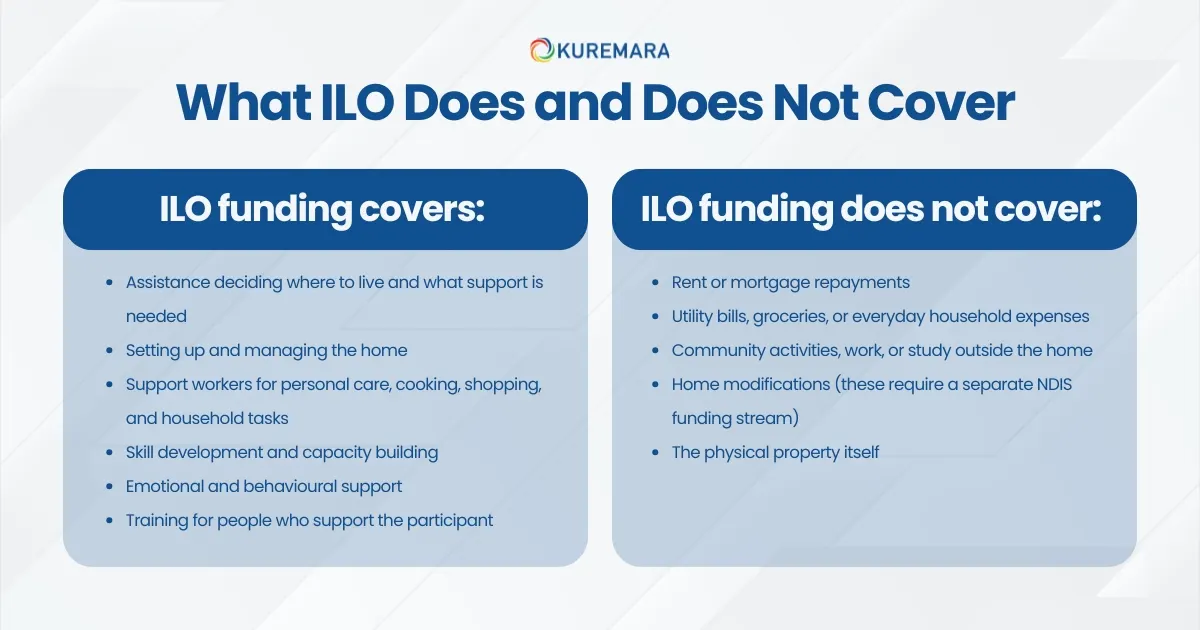
ILO funding covers:
- Assistance deciding where to live and what support is needed
- Setting up and managing the home
- Support workers for personal care, cooking, shopping, and household tasks
- Skill development and capacity building
- Emotional and behavioural support
- Training for people who support the participant
ILO does not cover:
- Rent or mortgage repayments
- Utility bills, groceries, or everyday household expenses
- Community activities, work, or study outside the home
- Home modifications (these require a separate NDIS funding stream)
- The physical property itself
What Is Supported Independent Living (SIL)?
For comparison, let’s briefly recap what SIL is because understanding the contrast is the key to choosing the right support.
Supported Independent Living (SIL) is help or supervision with daily tasks in the home that enables participants to live as independently as possible, while building their skills over time. SIL is most commonly delivered in a shared living arrangement typically two to four participants sharing a home, with support workers rostered on to be available throughout the day and, where needed, overnight.
SIL is designed for participants who require high-level or 24/7 support. According to the NDIS, this means needing significant help throughout the day, seven days a week, which may include personal care, meal preparation, medication management, and overnight supervision.
Key features of SIL include:
- The SIL provider manages and coordinates all supports
- Support workers are rostered, meaning scheduled shifts, not informal arrangements
- Participants typically share support staff with housemates (which makes SIL cost-effective for high-need individuals)
- The SIL provider often presents a quote for the whole house to the NDIA, rather than for individual participants
- Changing supports can require a planned reassessment and may involve changing homes or housemates
Kuremara has been a trusted SIL provider in Sydney, Melbourne, Brisbane, and surrounding areas for over a decade. Our SIL homes are known for their professional, caring teams and a culture that puts participants first something our families and support coordinators have consistently recognised.
ILO vs SIL: The Key Differences, Side by Side
Here is a clear comparison of the two models across the dimensions that matter most to participants and their families:
| Factor | ILO | SIL |
| Best suited for | Lower-to-mid support needs; participants who want more control | Higher, complex, and/or 24/7 support needs |
| Support structure | Flexible mix of paid + informal supports | Rostered paid support workers |
| 24/7 support | Not included – no round-the-clock rostered care | Yes, on-site or overnight |
| Who manages support | Participant (with ILO provider support) | SIL provider |
| Living arrangement | Chosen by participant; own home, host, shared rental | Typically provider-managed shared home |
| Flexibility | High – supports can be adjusted as needs change | Lower – changes may require reassessment |
| NDIS funding mechanism | No fixed dollar amount; designed with Support Coordinator; stated as separate line items in plan | Provider submits a quote for the whole house |
| Informal supports | Central to the model: family, friends, community | Primarily paid support workers |
| Accommodation | Participant secures independently (private rental, own home, social housing) | Often provided or managed by the SIL provider |
Despite their differences, both ILO and SIL exist to empower NDIS participants to live with greater independence, dignity, and choice. Neither is inherently “better”; the right option depends entirely on the individual’s support needs, lifestyle preferences, and long-term goals.
One important note: The NDIS can generally only fund one of these at a time. Getting the right choice matters, which is why it’s worth taking the time to understand both and speaking with a trusted provider like Kuremara before your planning meeting.
Who Is ILO Right For?
ILO occupies what the disability support sector sometimes calls the “grey space” somewhere between fully independent community living (with occasional drop-in support) and the highly structured, intensive support of SIL.
ILO may be the right fit if a participant:
- Wants genuine control and input over where they live and who supports them
- Has lower-to-moderate support needs and does not need 24/7 rostered care
- Has strong informal support from family members, friends, or community connections, who can form part of the support package
- Is ready to invest time in the exploration and design process
- Is exploring the transition to independence for the first time
Specific life situations where ILO is commonly recommended include:
- Young people turning 18 who are moving out of the family home and want independence without a group home model
- Participants in shared living who want more say over who they live with and how their supports are structured
- Those at risk of homelessness or currently in temporary accommodation, who need a stable, personalised living solution
- Participants living in inappropriate housing: overcrowded, in poor condition, or too costly
- People who want to trial living arrangements before committing to a permanent option
A note on ILO and complex needs: ILO is not exclusively for those with low support needs. Participants with complex behavioural needs may still be eligible for ILO if strong informal supports are in place and a robust risk management plan is developed. The NDIA assesses ILO on a case-by-case basis.
How to Access ILO in Australia: A Step-by-Step Guide
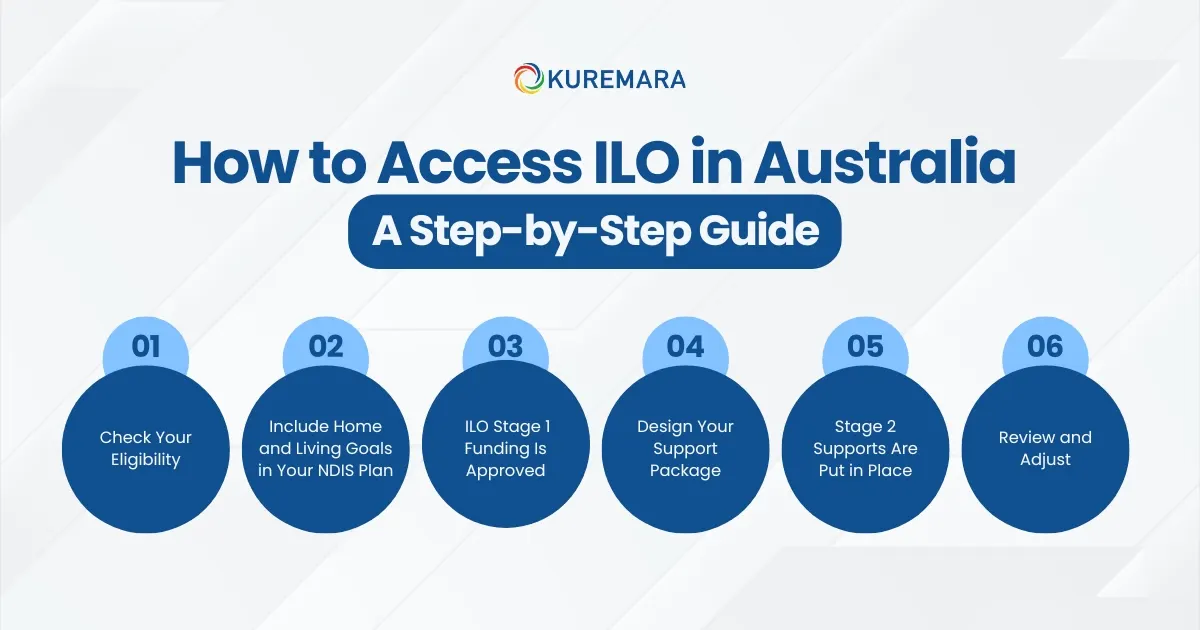
Accessing the ILO through the NDIS involves several steps. Here is a practical overview for Australian participants:
Step 1: Check Your Eligibility
To be eligible for the NDIS (and by extension, ILO), a person must be:
- An Australian citizen, permanent resident, or holder of a Protected Special Category Visa
- Under the age of 65
- Living with a permanent and significant disability that affects their ability to participate in everyday activities
ILO specifically is available to participants aged 18 or over who require substantial daily support (at least six hours per day, formal or informal)
Step 2: Include Home and Living Goals in Your NDIS Plan
Speak with your Local Area Coordinator (LAC) or NDIS planner about your housing goals before your planning meeting. The more clearly you can articulate why ILO is reasonable and necessary for your situation, in terms of your goals, risks, and long-term aspirations, the better placed you will be to have funding included in your plan.
Step 3: ILO Stage 1 Funding Is Approved
If approved, Stage 1 funding will appear as a line item in your plan under Core Supports Assistance with Daily Living. You’ll work with a Support Coordinator and an ILO provider (such as Kuremara) to begin the exploration and design process.
Step 4: Design Your Support Package
Together with your provider and coordinator, you will identify your preferred living arrangement, map informal supports, assess risks, and design a package that suits your lifestyle and goals. At the end of Stage 1, a service proposal is submitted to the NDIA for approval.
Step 5: Stage 2 Supports Are Put in Place
Once your proposal is approved, Stage 2 begins, and your chosen supports are delivered. Your ILO provider is responsible for coordinating and monitoring the arrangement, checking regularly that it is working for you and making adjustments as needed
Step 6: Review and Adjust
One of ILO’s greatest strengths is that it can flex with you. If your needs change, whether your housemate moves out, your informal support changes, or your health situation evolves, your ILO supports can be redesigned accordingly.
How Kuremara Can Help
At Kuremara, we’ve spent over a decade working with NDIS participants, their families, and support coordinators to design and deliver home and living supports that genuinely reflect each person’s goals.
We are a registered NDIS provider approved by the NDIS Quality and Safeguards Commission, with registration active until November 2028. Our services span Sydney, Melbourne, Brisbane, and surrounding regions with a team that is passionate, experienced, and deeply committed to person-centred care.
Whether you are exploring ILO for the first time, comparing it with SIL, or ready to start your Stage 1 exploration, our team can walk you through your options without pressure. We believe every participant deserves to live on their own terms and we’re here to help make that happen.
What we offer:
- Support Coordination to help you explore ILO and SIL options
- ILO Exploration and Design (Stage 1) support
- SIL services across shared homes in major Australian cities
- Personalised consultations for participants, families, and support coordinators
Conclusion: The Right Option Is the One That Fits Your Life
ILO and SIL both exist for the same fundamental reason: to help Australians with disabilities live safely, independently, and with dignity. But they do that in very different ways.
ILO offers flexibility, participant-led design, and a blend of paid and informal supports ideal for those who want more control over their living situation. SIL offers structure, intensive 24/7 support, and a managed shared living environment, essential for those with higher and more complex support needs.
The most important thing is not choosing the “right” option in the abstract, it is choosing the right option for you, right now, based on your goals, your support needs, and your vision for your future.
If you’re not sure where to start, that’s exactly what our team at Kuremara is here for.
Frequently Asked Questions (FAQ)
1: Can I switch from SIL to ILO?
Yes, but it requires a plan reassessment with your NDIA planner. Your Support Coordinator can help you build the case and navigate the process.
2: Does ILO cover my rent?
No. ILO funding covers the support you receive at home, not the cost of the property itself, rent, utilities, or groceries. You are responsible for securing your own housing through private rental, home ownership, or social housing.
3: Who manages ILO funding?
ILO funding is added to your NDIS plan as a line item under Core Supports. Your ILO provider manages the delivery and monitoring of supports, but you retain choice and control over how those supports are designed and delivered.
4: Can I receive both ILO and SIL at the same time?
Generally, no, the NDIS funds either ILO or SIL, not both simultaneously. The NDIA will assess your situation to determine which is reasonable and necessary.
5: What is the difference between ILO and drop-in support?
Drop-in support is typically occasional, scheduled assistance with specific tasks. ILO is a more comprehensive, individually designed package of supports usually for participants needing at least six hours of support daily that may include a mix of paid, informal, and community-based assistance in a chosen living arrangement.
6: Do I need a Support Coordinator to access ILO?
Having a Support Coordinator is strongly recommended for ILO, as the exploration and design process is complex and time-intensive. Some participants may also access ILO through a Local Area Coordinator (LAC), depending on their plan.