care@kuremara.com.au
 1300 000 799
If you or a loved one is exploring support under the National Disability Insurance Scheme (NDIS), one of the first questions you may ask is:
“Is my condition on the NDIS list of disabilities?”
While many people search for an official NDIS disability list, the truth is more nuanced. The NDIS does not operate from a simple checklist of conditions. Instead, eligibility is based on how a disability impacts daily functioning and independence.
In this practical guide, we’ll break down:
- What qualifies under the NDIS
- Categories included in the NDIS list of disabilities
- The NDIS list of disabilities for adults
- How eligibility is assessed
- How Kuremara, a Registered NDIS Provider, supports participants in Sydney and Melbourne
Let’s simplify the process and help you move forward with confidence.
What Is the NDIS and Who Is It For?
The National Disability Insurance Scheme (NDIS) is an Australian Government initiative designed to provide funding and support to individuals living with permanent and significant disabilities.
The NDIS helps participants:
- Build independence
- Access therapy and support services
- Participate in community life
- Improve daily living skills
- Achieve personal goals
Basic Eligibility Criteria
To qualify, you must:
- Be under 65 years of age when applying
- Be an Australian citizen, permanent resident, or Protected Special Category Visa holder
- Have a permanent disability that significantly impacts daily life
The focus is not just the diagnosis, it’s how the condition affects functional capacity.
Understanding the NDIS List of Disabilities
It is a common misconception that there is a single, exhaustive “NDIS disability list.” Instead, the NDIA uses two primary categories to streamline the access process: List A and List B.
List A: Streamlined Access
Conditions on List A are considered to meet the “disability requirements” automatically. Because these conditions are recognised as having a permanent and significant impact on functional capacity, the NDIS typically only requires proof of diagnosis.
- Examples: Intellectual disability (Moderate to Profound), Autism (Level 2 or 3), Cerebral Palsy (GMFCS Level 3-5), and severe sensory loss (Blindness or Deafness).
List B: Permanent but Variable
Conditions on List B are recognised as permanent, but their impact on a person’s life can vary significantly. If your condition is on List B, you must provide additional evidence showing how it affects your daily life.
- Examples: Multiple Sclerosis (MS), Parkinson’s Disease, ADHD (in specific cases), and rare genetic disorders.
Two people with the same condition may have different eligibility outcomes depending on how their disability affects mobility, communication, learning, social interaction, or self-care.
When people search for the ndis disability list, they’re typically looking for the categories commonly accepted under the scheme — which we outline below.
Categories Included in the NDIS Disability List
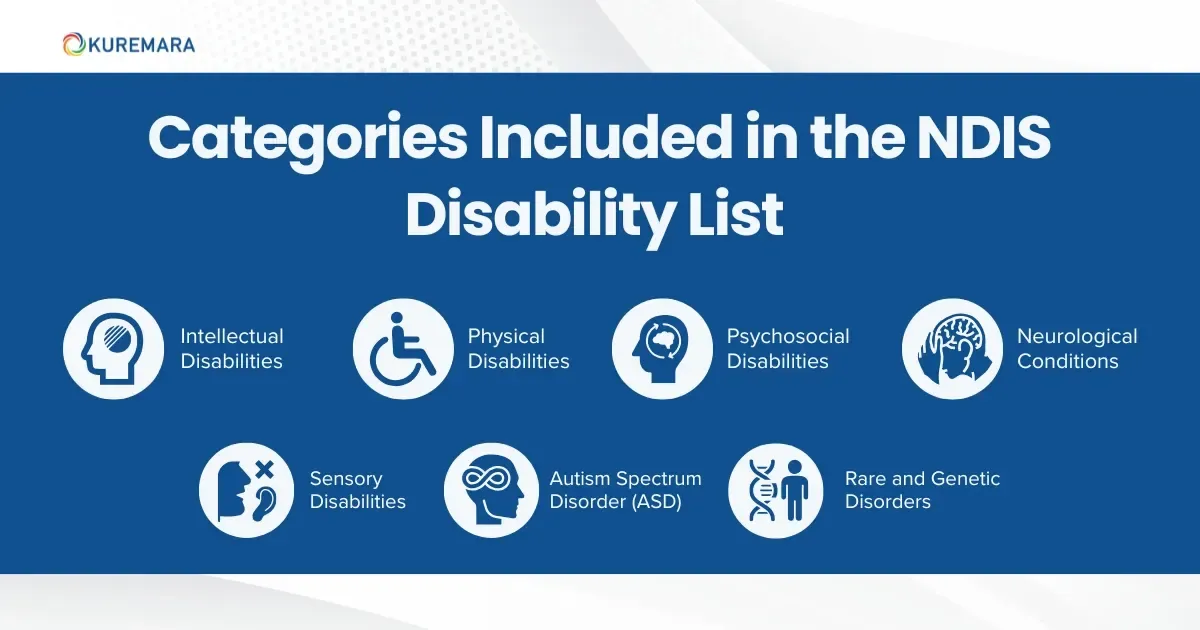
Although not an official checklist, the following categories commonly qualify if the functional impact is significant.
a. Intellectual Disabilities
These affect cognitive functioning and adaptive behaviour.
Common examples:
- Down syndrome
- Global developmental delay
- Intellectual developmental disorder
Support may include therapy, life skills training, and daily assistance.
b. Physical Disabilities
Physical disabilities affect mobility and physical functioning.
Examples include:
- Cerebral palsy
- Muscular dystrophy
- Spinal cord injury
- Acquired brain injury
Participants may receive mobility aids, home modifications, or personal care support.
c. Psychosocial Disabilities
Psychosocial disabilities arise from severe and persistent mental health conditions.
Examples:
- Schizophrenia
- Bipolar disorder
- Severe depression
- Post-traumatic stress disorder (PTSD)
To qualify, the condition must cause long-term functional impairment.
d. Neurological Conditions
These impact the brain or nervous system.
Common qualifying conditions:
- Multiple sclerosis
- Parkinson’s disease
- Epilepsy
Supports may evolve as conditions progress.
e. Sensory Disabilities
Sensory impairments significantly affecting daily life may qualify.
Examples:
- Blindness or low vision
- Deafness or severe hearing impairment
Funding may include assistive technologies and communication aids.
f. Autism Spectrum Disorder (ASD)
Autism is one of the most commonly supported conditions under the NDIS.
Eligibility depends on diagnostic level and functional impact, particularly in communication, social interaction, and daily living skills.
g. Rare and Genetic Disorders
Many rare genetic conditions qualify when permanent and functionally limiting.
Examples may include:
- Rett syndrome
- Fragile X syndrome
- Other congenital disorders impacting development
NDIS List of Disabilities for Adults
Many adults assume the NDIS is only for children. This is not true.
The ndis list of disabilities for adults includes:
- Degenerative neurological conditions
- Late-diagnosed autism
- Acquired brain injuries
- Psychosocial disabilities
- Progressive physical conditions
Adults can access support for:
- Independent living
- Employment assistance
- Social participation
- Daily personal care
- Community access
As long as you are under 65 at the time of application, you may qualify.
How the NDIS Determines Eligibility
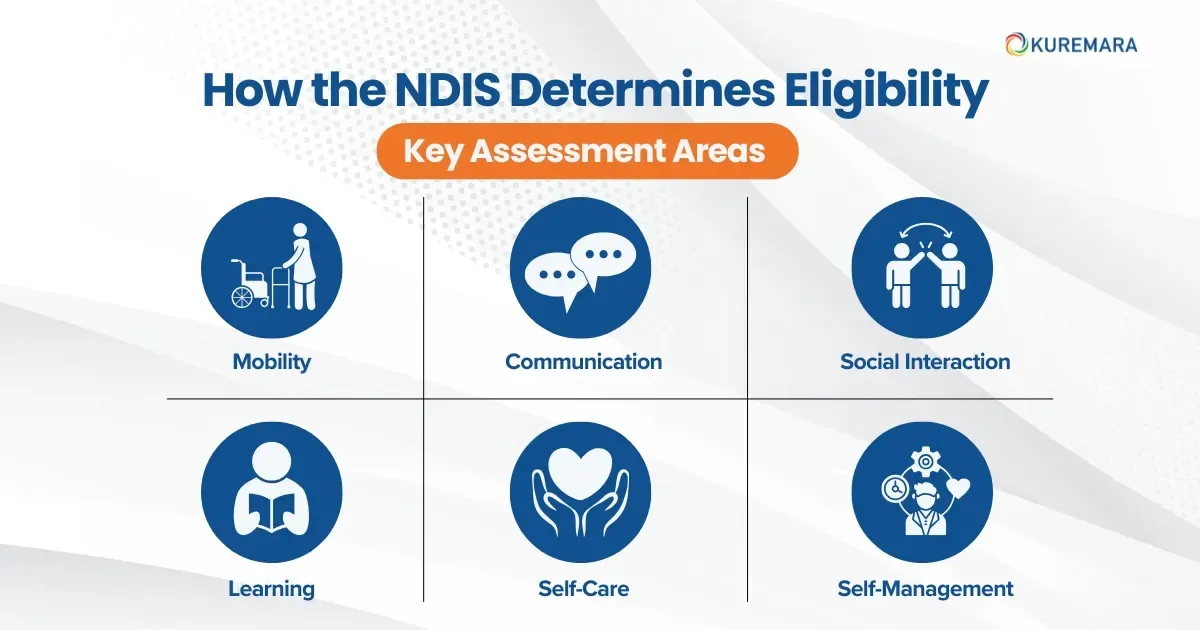
For most adults applying for the NDIS, eligibility hinges on proving that your disability significantly impacts one or more of these six life domains:
Key Assessment Areas
1. Mobility: Difficulty moving around the home or community.
2. Communication: Challenges in being understood or understanding others.
3. Social Interaction: Difficulty making friends or participating in community activities.
4. Learning: Challenges in understanding or remembering new information.
5. Self-Care: Needing help with grooming, eating, or personal hygiene.
6. Self-Management: Difficulty organising daily life and making decisions.
Medical evidence from treating professionals is essential.
Important Reminder
A diagnosis alone does not guarantee funding. The impact on everyday functioning is what matters most.
Common Misconceptions About the NDIS Disability List
Let’s clear up a few myths:
❌ There is a fixed public checklist
✔ Eligibility is impact-based
❌ Temporary injuries qualify
✔ The disability must be permanent
❌ Income affects eligibility
✔ The NDIS is not income-tested
Understanding these distinctions prevents unnecessary stress during the application process.
What If Your Disability Isn’t Clearly Listed?
The NDIS focuses on functional impact, not just the name of your diagnosis. Even if your condition isn’t explicitly named on a list, you may still be eligible if you can prove a “substantial reduction in functional capacity” or if:
- It is permanent
- It significantly limits daily life
- It requires ongoing support
Strong documentation from medical professionals is critical.
If initially declined, there is also a review and appeal process available.
How Kuremara Supports Participants Across Australia
Navigating the NDIS system can feel overwhelming, but you don’t have to do it alone.
Kuremara, a Registered NDIS Provider, delivers compassionate, participant-focused services tailored to individual needs.
1. NDIS Disability Services Sydney
Kuremara provides professional and reliable NDIS disability services Sydney, including:
- In-home personal care
- Community participation support
- Capacity-building programs
- Support coordination
- Assistance with daily living
Our local team understands the Sydney community and ensures culturally sensitive, person-centred care.
2. NDIS Disability Services Melbourne
For participants seeking NDIS disability services Melbourne, Kuremara offers:
- Flexible support models
- Adult disability support
- Plan management guidance
- Community integration services
- Family-centred care
Our Melbourne support workers are trained, experienced, and committed to empowering participants to live independently.
Step-by-Step Guide to Applying for the NDIS
1. Confirm eligibility criteria
2. Gather supporting medical documentation
3. Submit an Access Request
4. Attend your planning meeting
5. Receive your NDIS plan
6. Choose a trusted NDIS Registered Provider like Kuremara
Choosing the right provider ensures your plan is implemented effectively and aligned with your goals.
Why Choosing a Registered NDIS Provider Matters
Working with a registered provider ensures:
- Compliance with Australian quality standards
- Trained and screened staff
- Transparent service agreements
- Safeguarding and accountability
Kuremara prioritises dignity, independence, and long-term wellbeing.
Final Thoughts: Navigating the NDIS with Confidence
Understanding the NDIS list of disabilities can feel complex, but at its core, the system is designed to support Australians living with permanent and significant disabilities.
Whether you’re exploring the NDIS disability list, applying as an adult, or searching for trusted NDIS disability services Sydney or NDIS disability services Melbourne, the key is finding the right support partner.
Kuremara is here to guide you every step of the way from eligibility to daily support, empowering you to live independently and achieve your goals.
Frequently Asked Questions
1. What is included in the NDIS list of disabilities?
The NDIS supports permanent disabilities that significantly affect daily functioning across areas such as mobility, communication, and self-care.
2. Is autism automatically approved for NDIS?
Autism may qualify, but approval depends on the level of functional impairment and diagnostic criteria.
3. Does NDIS cover mental health conditions?
Yes, severe and permanent psychosocial disabilities may qualify if they significantly impact daily life.
4. Can adults over 40 apply for NDIS?
Yes. Anyone under 65 at the time of application may apply if the eligibility criteria are met.
5. How do I access NDIS disability services in Sydney or Melbourne?
You can contact Kuremara directly to discuss support options and develop a personalised care plan aligned with your NDIS goals.