care@kuremara.com.au
 1300 000 799
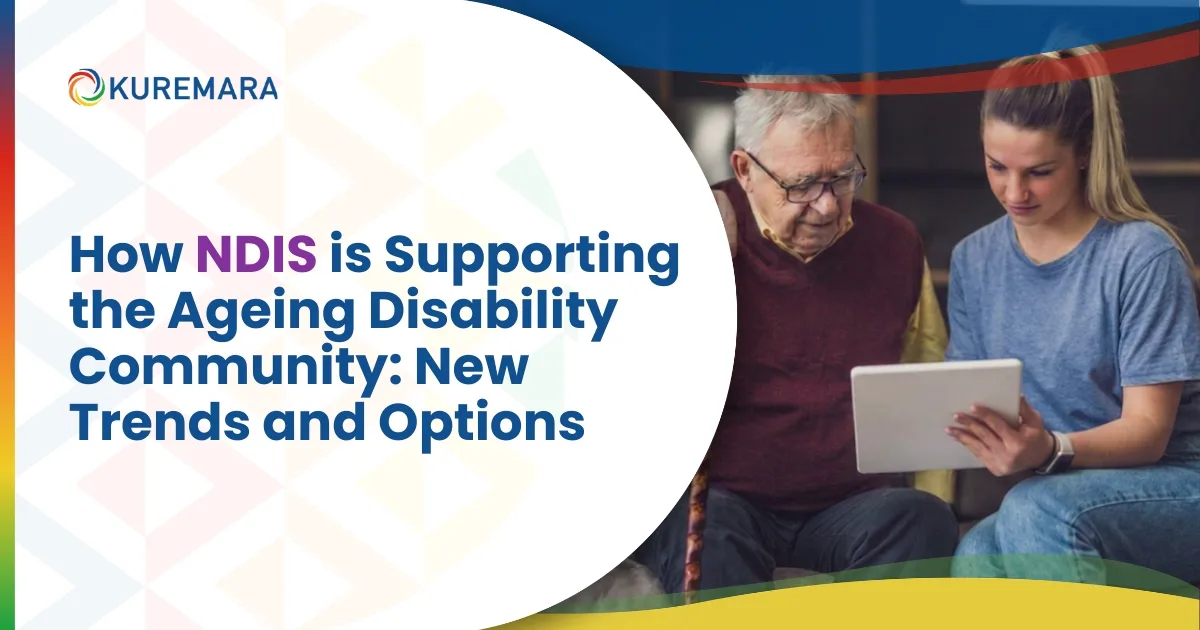
A decade on from the launch of the National Disability Insurance Scheme, something has quietly changed about who the Scheme supports. The participants who joined in those early years are growing older, and for the first time, the NDIS is supporting a meaningful and growing population of people ageing with disability, not just living with it.
For participants approaching their later years, and for the families and support coordinators who walk alongside them, this raises real and pressing questions. What happens to my NDIS support as I age? Will I be moved into aged care? Where does the NDIS end and the aged care system begin? These questions matter, and the answers are not always made clear.
At Kuremara, we work with participants and families navigating exactly these crossroads every day. This guide brings together the most current information on how the NDIS supports an ageing disability community, what is changing in 2026 and beyond, and how to make sense of the line between disability support and aged care.
The disability community is ageing, and the numbers show it
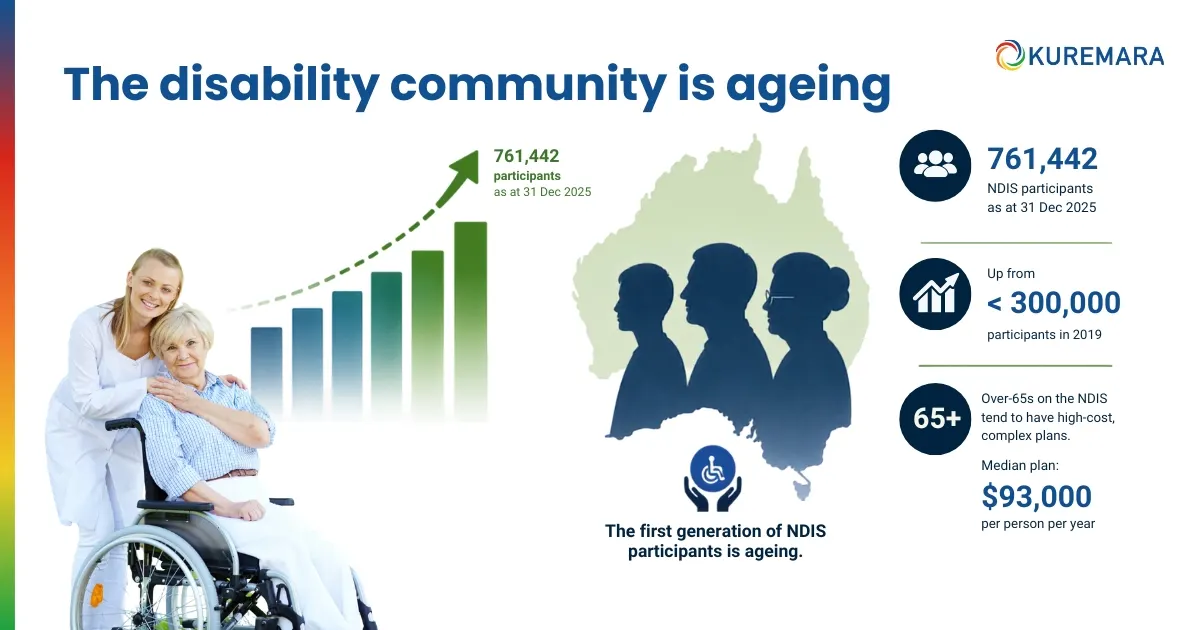
The NDIS has grown far faster and far larger than anyone predicted. As of 31 December 2025, the Scheme supported 761,442 participants, up from fewer than 300,000 in 2019. It is now the second-largest social program in Australia, behind only the Age Pension.
Within that growth sits a trend that gets less attention than it deserves: participants are getting older. People who entered the Scheme in their forties and fifties a decade ago are now approaching and passing the age of 65, and they are staying. According to the Grattan Institute, over-65s on the NDIS tend to have high-cost, complex plans, with the median plan sitting at around $93,000 per person per year and this group is projected to keep growing as a share of all participants in the years ahead.
This is not a quirk in the data. It reflects a genuine demographic shift. The first generation of NDIS participants is ageing, and the Scheme is becoming, for many of them, a lifetime support system rather than a stage-of-life one.
The big point of confusion: NDIS vs aged care
Here is where many families get understandably confused. The NDIS and the aged care system (delivered through My Aged Care) are two separate, federally funded systems, and the dividing line between them is age, specifically, the age of 65.
To apply for the NDIS for the first time, you must be under 65 years of age. Disability support for people over 65 who do not already have a plan is provided through the aged care system instead. This is the source of a common and painful misconception that turning 65 means losing your NDIS support.
It does not. This is one of the most important things for participants and families to understand:
- If you became an NDIS participant before turning 65, you can continue to receive your NDIS support after 65. There is no automatic transition out of the Scheme.
- You could, if you choose, remain on the NDIS for the rest of your life.
- Your plan continues to be reviewed against your disability-related needs and goals, just as it was before your 65th birthday.
The catch lies in what happens if your circumstances change. Under current rules, you generally stop being eligible for the NDIS if, after turning 65, you move permanently into residential aged care for the first time, or you begin receiving permanent aged care home-care services (such as the new Support at Home program) for the first time. Importantly, you cannot use the NDIS and My Aged Care at the same time, and once you leave the NDIS for aged care, you cannot return. That makes the decision a significant one, and one worth taking advice on rather than rushing.
Why the difference matters for your support
The two systems are not just administratively different; they are built for different purposes, and the practical differences are substantial:
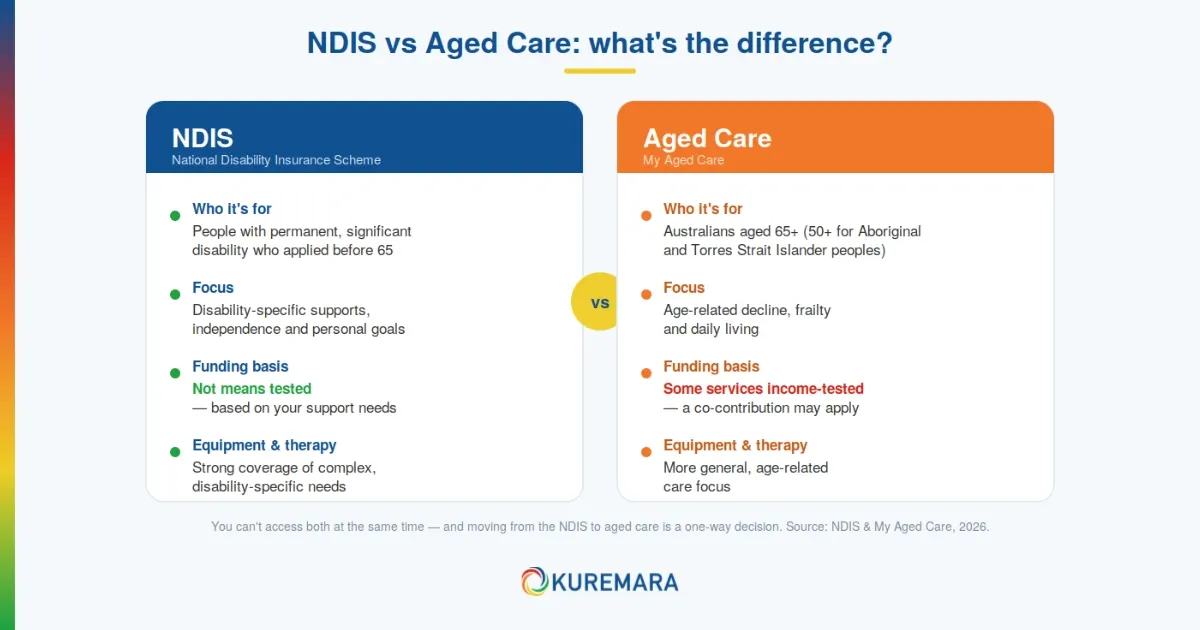
| NDIS | Aged Care (My Aged Care) | |
| Who it’s for | Australians with permanent, significant disability who applied before 65 | Australians aged 65+ (50+ for Aboriginal and Torres Strait Islander peoples) |
| Focus | Disability-specific supports, independence and goals | Age-related decline, frailty and daily living |
| Funding basis | Support needs — not means tested | Assessed care needs — some services income-tested |
| Specialised equipment & therapy | Strong coverage of complex, disability-specific needs | More general care focus |
The headline difference is that NDIS funding is not means-tested; your income and assets do not affect your allocation, and you keep a high degree of control over how funds are used to pursue your own goals. Aged care, by contrast, can require a personal co-contribution for some services depending on your financial situation. For someone with complex, specialised disability needs, the disability-specific design of the NDIS is often a much better fit than the aged care system. This is precisely why so many participants choose to stay.
The “grey zone”: people who fall between the systems
Not everyone is so neatly placed. One of the most difficult issues in this whole area affects people who acquire a disability later in life but do not have an NDIS plan in place before 65.
Researchers describe these Australians as sitting in a “grey zone” at risk of being excluded from both systems. They may have an ageing-related disability that does not meet the NDIS access threshold, while also facing the age-65 entry rules that now govern aged care. People in this position can find themselves relying on services outside the NDIS and facing increasing disability without adequate aged care support. It is a real and recognised gap, and one that current reforms are attempting imperfectly to address.
The lesson for families is a practical one: timing matters enormously. Because you generally cannot apply for the NDIS for the first time after 65, anyone with an emerging or worsening disability in their late fifties or early sixties should seek advice early rather than waiting.
What’s changing: the 2026 reforms and the new “Foundational Supports”
The biggest shake-up to this landscape in years is now underway. Following the Independent NDIS Review and the Getting the NDIS Back on Track Act, a wave of reforms is rolling out gradually between 2026 and 2028. Several of these directly affect ageing participants and the NDIS–aged care boundary.
Foundational Supports. Governments have committed around $10 billion over five years, split evenly between the Commonwealth and the states and territories, to build a whole new tier of “Foundational Supports” that sit outside the NDIS. These are designed to catch people who need support but are not on the Scheme, potentially including some of those in the grey zone described above. Targeted Foundational Supports are expected to include home and community care-type supports, aids and equipment, and psychosocial supports.
A closer integration of disability, health, and aged care. In a structural change with long-term significance, disability has now been brought together with health and aged care at both ministerial and departmental levels. The Scheme is administered by the National Disability Insurance Agency as part of the Department of Health, Disability and Ageing. The stated aim is to make the two systems work together more coherently for the people who sit across both.
The 2026–27 Federal Budget. Announced on 12 May 2026, the Budget invested $3.7 billion in aged care alongside major NDIS reforms. A notable change for older Australians: from 1 October 2026, personal care services under the Support at Home program (such as showering, dressing and continence support) are being reclassified as clinical care and will no longer attract a co-contribution for eligible participants, making everyday support more affordable for those who do move into aged care.
A push to let participants access both systems. The NDIS Review’s final report recommended that the Government introduce changes allowing participants over 65 to access supports from both the NDIS and the aged care system concurrently, with clear guidelines on when aged care supports are reasonable and necessary. The report was emphatic that the NDIS was never intended to replace the aged care system, but to complement it. Whether this recommendation becomes law remains to be seen, but it signals a clear direction of travel toward closing the gaps that ageing participants currently fall into.
A word of realism: many of these changes are staged, depend on legislation and consultation, and will not all happen at once. Participants and families should keep checking official updates at ndis.gov.au and health.gov.au for confirmed timing.
What this means for you: practical options
If you or someone you support is ageing with disability, here is how to think about the road ahead.
If you’re already on the NDIS and approaching 65, you do not need to do anything to “keep” your NDIS support; staying is the default. Your plan will keep being reviewed against your disability needs. The decision point only arrives if your needs change in a way that pushes you toward residential or permanent home aged care. Because that move is one-way, it deserves careful, informed thought rather than a snap decision.
If your needs are changing, the central question at 65 is whether your support needs are primarily disability-related (pointing toward the NDIS) or primarily age-related (pointing toward aged care). For many people with complex, lifelong disability, the disability-specific design and non-means-tested funding of the NDIS continue to be the better fit. For others, the broader aged care offering may suit emerging age-related needs.
If you’re not yet on the NDIS but may need to be, act early. The age-65 application cut-off is firm, and the cost of waiting can be losing access to the more generous, disability-focused system altogether.
Whatever your situation, get good advice. The interface between these systems is genuinely complex, and the consequences of a wrong turn are real. A trusted provider or support coordinator who understands both systems can help you see the full picture before you make any irreversible decisions.
How Kuremara supports participants ageing with disability
This is exactly the kind of complexity we exist to help with. As a registered NDIS provider with more than ten years’ experience, Kuremara delivers tailored support across Southeast and Central Queensland, Sydney and Greater Melbourne, and we walk alongside participants as their needs evolve over time.
For participants navigating their later years, our services are built around independence, dignity, and continuity of care:
- Supported Independent Living (SIL) and Individualised Living Options (ILO) — homes and living arrangements that adapt as your support needs change.
- Complex Care and Community Nursing — clinical and high-needs support delivered with consistency.
- In-Home Support and Community Access — helping you stay connected, active and at home.
- Support Coordination — perhaps the most valuable service of all when you’re navigating a changing system. A good support coordinator helps you understand your options, make sense of the reforms, and plan ahead with confidence.
Ageing with disability shouldn’t mean uncertainty about your support. With the right provider beside you, it can mean continuity, choice and a plan that grows with you.
Quality support services when choice matters.
If you have questions about your NDIS plan as you age, or you’re trying to understand your options, we’d be glad to help. Get in touch with the Kuremara team on 1300 000 799 or visit kuremara.com.au
Disclaimer:
This article is for general information only and does not constitute legal, financial or professional advice. NDIS and aged care rules are changing through 2026–2028; for the latest confirmed information, refer to ndis.gov.au, health.gov.au and myagedcare.gov.au.
Sources
- National Disability Insurance Scheme — participant numbers and Scheme overview (Wikipedia, citing NDIA data, accessed 2026)
- Grattan Institute, Saving the NDIS: How to rebalance disability services to get better results (August 2025) — over-65 plan values and trend data
- Aging with a Disability: Transitioning from the NDIS to Aged Care (NDSP Plan Managers, May 2026)
- Can you get the NDIS after 65? (Five Good Friends, March 2026)
- Is There NDIS Funding for The Elderly? (MyIntegra, February 2026)
- Howe et al., The Interface Between Australia’s Aged Care System and the NDIS: Population Perspectives, Australian Journal of Social Issues (March 2025) — the “grey zone”
- What NDIS Providers Need to Know About the Over 65 Rule (Provider + ) — Recommendation 2.11 on concurrent access
- National Agreement on Foundational Supports 2026–2031 (Federal Financial Relations, March 2026)
- People with Disability Australia, What are the NDIS reforms, and why are they happening? (March 2026) — $10 billion Foundational Supports
- Federal Budget 2026-27: Aged Care and NDIS Changes Explained (Just Better Care, May 2026)
- Understanding the aged care and NDIS interface (Australian Ageing Agenda, April 2026) — July 2026 reforms