care@kuremara.com.au
 1300 000 799
Your NDIS plan is often associated with the “essentials” of daily personal care, transport, or home modifications. But living a “good life” goes beyond just the basics. It’s about thriving, connecting, and feeling good in both body and mind.
At Kuremara, we believe that true independence requires a holistic approach. Whether you are based in our expanded service areas of Brisbane, Sydney, or Melbourne, your NDIS plan can be a powerful tool for building resilience.
Many participants ask us: Can I use my NDIS funding for a gym membership? Or does the NDIS cover therapy? The answers are nuanced. This guide explores how to effectively utilise your NDIS plan for mental wellbeing and your NDIS plan for physical wellbeing to support a healthier, happier you.
Understanding the “Psychosocial” Aspect: Using Your NDIS Plan for Mental Wellbeing
Mental health conditions that cause a permanent or significant functional impairment are referred to by the NDIS as psychosocial disabilities.
It is important to understand the distinction between the Health System and the NDIS:
- The Health System (Medicare): Covers clinical treatments, such as seeing a psychiatrist for a diagnosis, getting a prescription, or acute hospital care.
- The NDIS: Covers the functional supports you need to manage everyday life because of your disability.
Key Supports for Mental Wellbeing
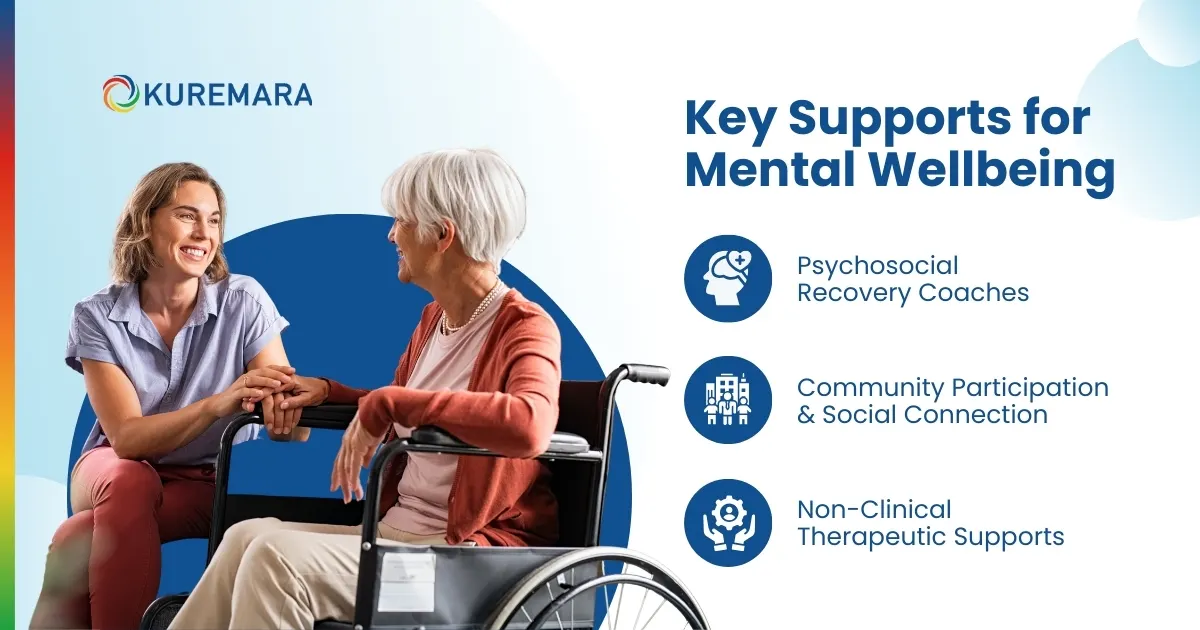
If you have a psychosocial disability, your NDIS plan for mental wellbeing might fund:
1. Psychosocial Recovery Coaches
This is one of the most valuable supports available. A Psychosocial Recovery Coach is different from a standard Support Coordinator. They have specialist knowledge of mental health services and often have “lived experience” of mental illness themselves.
A Recovery Coach will:
-
-
-
-
-
- Work with you to design a recovery plan.
-
-
-
-
-
-
-
-
-
- Help you navigate the mental health system in Sydney, Brisbane, or Melbourne.
-
-
-
-
-
-
-
-
-
- Collaborate with your clinical team to ensure your supports are aligned.
-
-
-
-
-
-
-
-
-
- Provide coaching to build your confidence and decision-making skills.
-
-
-
-
2. Community Participation & Social Connection
Social isolation is a significant contributor to poor mental health. The NDIS funds “Social and Community Participation” to help you reconnect with the world.
This is where Kuremara’s support workers shine. We don’t just provide transport; we provide companionship and safety.
-
-
-
-
-
- In Sydney: This might look like having a support worker join you for a community art class in the Inner West to help manage social anxiety.
-
-
-
-
-
-
-
-
-
- In Melbourne: It could involve assistance in navigating public transport to attend a peer support group in the CBD.
-
-
-
-
-
-
-
-
-
- In Brisbane: It might be supportive to access calming nature spots like the Roma Street Parkland for mindfulness activities.
-
-
-
-
3. Non-Clinical Therapeutic Supports
Funding can be used for psychology or counseling if the goal is to manage the functional impact of your disability (e.g., learning coping strategies for anxiety to improve your ability to work or study), rather than treating the clinical illness itself.
Moving & Thriving: Using Your NDIS Plan for Physical Wellbeing
Physical health is often the foundation of independence. However, the NDIS generally does not fund standard gym memberships, as these are considered day-to-day living costs that everyone pays.
However, under the Capacity Building: Improved Health and Wellbeing category, you can access specialised support if it is “reasonable and necessary” for your disability.
Eligible Physical Supports
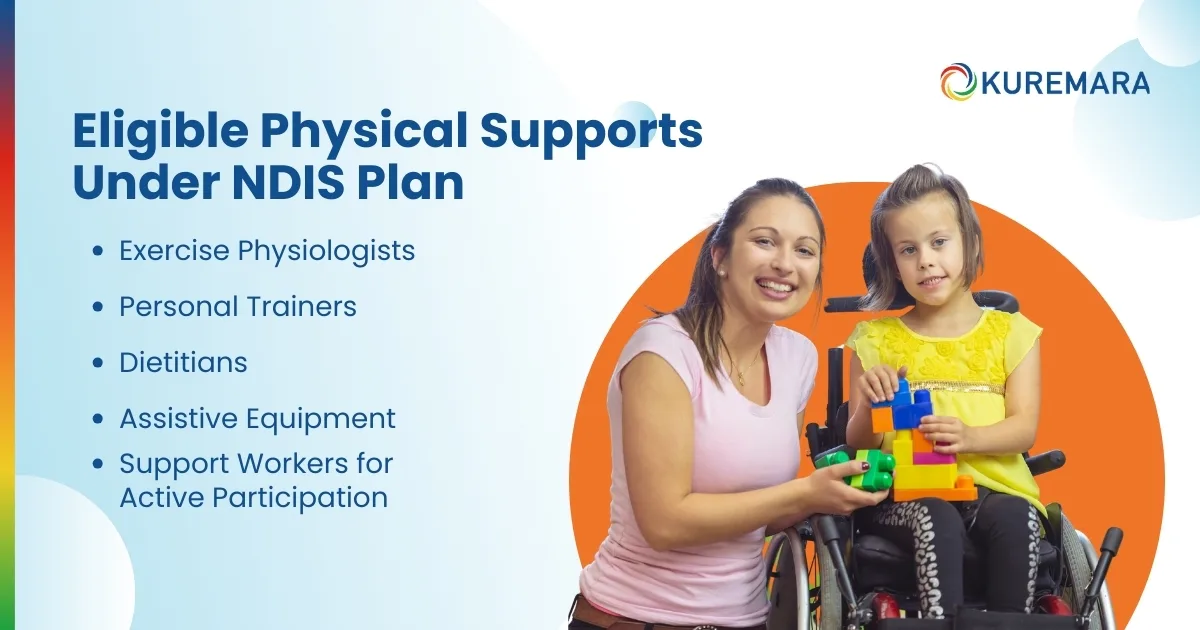
To utilise your NDIS plan for physical wellbeing, the support must relate to your specific condition:
- Exercise Physiologists: These are not just personal trainers. They are allied health professionals who prescribe exercise to manage conditions. For example, improving muscle tone for a participant with Cerebral Palsy or building strength for someone with mobility restrictions.
- Personal Trainers: In specific cases, the NDIS may fund a PT if you cannot access a mainstream gym independently due to your disability, or if you require a specialised program devised by an allied health professional.
- Dietitians: If your disability affects your nutrition (e.g., difficulty swallowing or weight gain caused by necessary medication), a dietitian can be funded to create a meal plan that keeps you healthy.
- Assistive Equipment: Items like mobility aids, adaptive tools, or supports to reduce fatigue can be funded if your plan shows they’ll improve functioning.
- Support Workers for Active Participation: NDIS support workers can help you take part in exercise‑based programs, attend community fitness classes, or build physical skills in your home or community.
How to Structure Your Goals for Wellbeing Funding
The single most important factor in getting approval for these supports is how you word your goals. The NDIS operates on the “Reasonable and Necessary“ test. If your goal is vague, the funding will be denied.
- For Mental Wellbeing: Avoid vague goals like “I want to be happy.” Instead, use functional language:
“I want to increase my social and community participation in Sydney to reduce isolation and build my independence.“
- For Physical Wellbeing: Focus on function rather than fitness:
“I want to improve my physical mobility and strength so I can transfer myself from my wheelchair independently.“
Pro Tip: Always have a recommendation letter or report from an Occupational Therapist (OT) or Psychologist. They can draw the link between the therapy you want (e.g., Exercise Physiology) and the functional outcome (e.g., walking safely).
Using Your Plan — Step‑by‑Step
1. Check Your Budgets
Look at what’s allocated for Capacity Building, Core supports, and any Improved Health & Wellbeing. Understanding your budgets helps you plan and book the right services.
2. Choose Providers Who Match Your Needs
Select providers experienced in mental and physical wellbeing goals, whether that’s counsellors, allied health professionals in Melbourne, or support workers in Brisbane.
3. Track Progress & Adjust as Needed
Keep notes on how supports are helping you. This makes it easier to discuss plan reviews or adjustments based on what’s working.
4. Use Support Coordination
If you have support coordination in your plan, they can help schedule services, connect with providers, and troubleshoot challenges.
How Kuremara Supports Your Journey
At Kuremara, we don’t just fill shifts; we help you fulfill your potential. With our services now available across Brisbane, Sydney, and Melbourne, we are uniquely positioned to support your wellbeing journey.
- Tailored Support Workers: We match you with support workers who understand your specific needs, whether that’s a gym buddy who knows how to use accessible equipment or a compassionate companion for community outings.
- Local Knowledge: Our teams in Brisbane, Sydney, and Melbourne know the local landscape. We can help you find accessible parks, community centers, and inclusive activities in your city.
- Collaborative Care: We work alongside your Recovery Coaches, Exercise Physiologists, and Plan Managers to ensure your daily support aligns with your broader health goals.
Ready to Prioritise Your Wellbeing?
Your NDIS plan is a powerful tool that goes beyond daily tasks. It can support your mental wellbeing and physical wellbeing so you can live with greater confidence, independence, and connection. By understanding what supports are available, setting practical goals, and working with providers like Kuremara in Brisbane, Sydney, Melbourne, and across Australia, you can make your plan work for your life and your strengths.
Ready to get started? Talk to the friendly team at Kuremara to tailor your support and make wellbeing goals a reality.
Let’s make your well-being a priority.